
Introduction
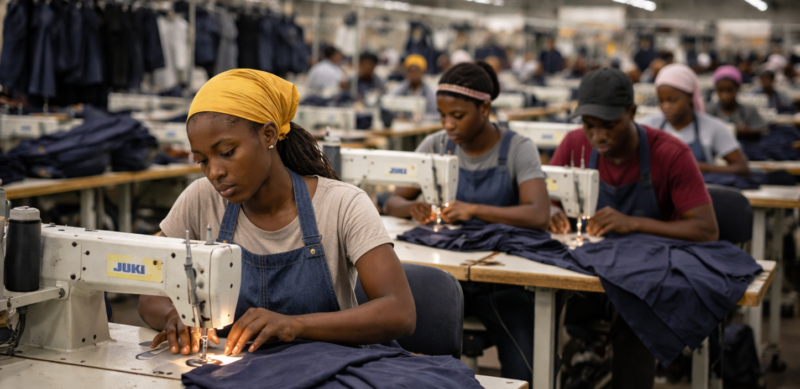
The global fashion industry is undergoing a major transformation. As brands search for more resilient supply chains, Africa apparel manufacturing is quickly gaining attention from international companies.
For decades, most clothing production has been concentrated in Asia. However, rising labor costs, supply chain disruptions, and geopolitical risks have encouraged brands to explore new manufacturing destinations.
Africa is now becoming one of the most promising alternatives.
With a young workforce, favorable trade agreements, and growing industrial infrastructure, the continent is positioning itself as a major hub for global apparel production.
Companies such as HANJEN INTERNATIONAL LTD., which operates manufacturing facilities in Kenya, are already demonstrating how Africa can deliver both efficiency and quality for global fashion brands.
The Rise of Africa Apparel Manufacturing
Over the past decade, Africa has become increasingly attractive to international apparel manufacturers.
Several countries—including Kenya, Ethiopia, Morocco, and Egypt—have built export-oriented garment industries supported by government policies and foreign investment.
The shift toward Africa apparel manufacturing is driven by several structural advantages that make the region highly competitive in the global supply chain.
1. A Young and Growing Workforce
Demographic Advantage
Africa has the youngest population in the world. More than half of the population is under the age of 25.
This demographic trend provides a large labor pool that can support labor-intensive industries such as garment manufacturing.
Competitive Labor Costs
Compared with traditional apparel hubs like China or Vietnam, labor costs in many African countries remain significantly lower.
For international brands, this cost advantage makes Africa apparel manufacturing a compelling option when managing production expenses.
2. Trade Agreements Supporting Export Growth
One of the most powerful drivers of Africa’s apparel industry is access to international markets.
AGOA (African Growth and Opportunity Act)
The AGOA agreement allows eligible African countries to export apparel products to the United States duty-free.
Kenya is one of the major beneficiaries of this agreement.
Manufacturers operating in Kenya can ship garments to the U.S. market without the tariffs that many Asian producers face.
This trade advantage significantly boosts the competitiveness of Africa apparel manufacturing.
3. Strategic Global Location
Africa’s geographic location offers important logistical benefits.
Manufacturing hubs in East Africa can ship products to:
- Europe
- The United States
- The Middle East
For example, shipments from Kenya’s port of Mombasa typically reach the U.S. East Coast in around 25–27 days.
This shipping time is competitive with many Asian supply routes.
Shorter logistics chains also help fashion brands respond faster to consumer demand.
4. Expanding Industrial Infrastructure
Governments across Africa have invested heavily in textile and garment infrastructure.
Industrial Parks
Countries such as Ethiopia and Kenya have built export-oriented industrial parks dedicated to apparel manufacturing.
These facilities offer:
- Ready-to-use factory buildings
- Stable electricity supply
- Water treatment systems
- Logistics support
Such infrastructure reduces barriers for international companies entering the African manufacturing sector.
5. Supply Chain Diversification
The COVID-19 pandemic exposed weaknesses in global supply chains.
As a result, many brands are now adopting multi-country sourcing strategies.
Instead of relying on a single region, companies distribute production across multiple countries.
Africa is becoming a key component of this strategy.
By integrating Africa apparel manufacturing into their supply networks, brands gain greater flexibility and risk management.
6. Access to Natural Resources
Africa is one of the world’s major cotton-producing regions.
Countries such as:
- Benin
- Mali
- Burkina Faso
- Tanzania
produce significant volumes of cotton.
This creates opportunities for vertical integration, where cotton can be processed into textiles and garments within the same region.
A localized supply chain reduces transportation costs and improves efficiency.
7. International Manufacturers Expanding Into Africa
Global apparel manufacturers are increasingly establishing operations in Africa.
One example is HANJEN INTERNATIONAL LTD., which operates garment production lines in Kenya alongside its Taiwan headquarters.
The company provides OEM and ODM apparel manufacturing services, covering the entire production process:
- Product design and development
- Fabric sourcing
- Garment production
- Quality control
- Global shipping
With more than 35 production lines, the company supports large-scale apparel production for international fashion brands.
This type of investment illustrates the growing confidence in Africa apparel manufacturing as a long-term industry.
Key Advantages of Africa Apparel Manufacturing
|
Advantage |
Impact on Global Brands |
|
Young workforce |
Large labor supply for garment production |
|
Competitive labor costs |
Lower production expenses |
|
Duty-free trade access |
Reduced export tariffs |
|
Strategic location |
Faster delivery to Western markets |
|
Industrial parks |
Modern manufacturing infrastructure |
|
Cotton production |
Opportunities for vertical integration |
|
Foreign investment |
Improved manufacturing capabilities |
Regional Apparel Manufacturing Strengths in Africa
|
Region |
Key Strength |
Example Countries |
|
East Africa |
Export-oriented garment manufacturing |
Kenya, Ethiopia |
|
North Africa |
Fast-fashion supply to Europe |
Morocco, Egypt |
|
Southern Africa |
Established textile sector |
South Africa, Lesotho |
|
West Africa |
Cotton production |
Benin, Ghana |
The Future of Africa Apparel Manufacturing
The long-term outlook for Africa apparel manufacturing is extremely promising.
Several trends support continued growth:
- Expansion of the African Continental Free Trade Area (AfCFTA)
- Increasing foreign investment in garment factories
- Rising global demand for diversified supply chains
- Infrastructure improvements across African economies
As global fashion brands continue to rethink sourcing strategies, Africa is positioned to become one of the most important manufacturing hubs of the next decade.
FAQ About Africa Apparel Manufacturing
Why are global brands moving apparel production to Africa?
Brands are moving production to Africa because of lower labor costs, favorable trade agreements, and the need to diversify supply chains.
Which African countries produce the most garments?
Some of the leading garment-producing countries in Africa include:
- Kenya
- Ethiopia
- Morocco
- Egypt
- Lesotho
What advantages does Africa have over Asian manufacturers?
Africa offers several advantages:
- Lower labor costs
- Duty-free access to U.S. markets
- Strategic geographic location
- Growing industrial infrastructure
Conclusion: The Strategic Future of Africa Apparel Manufacturing
In conclusion, the rise of Africa apparel manufacturing is not a short-term trend—it represents a fundamental shift in the global fashion supply chain. As brands continue to prioritize cost efficiency, speed to market, and supply chain resilience, Africa offers a compelling combination of advantages that are difficult to ignore.
From its young and rapidly growing workforce to duty-free trade access through agreements like AGOA, the continent is uniquely positioned to support the next phase of global apparel production. Investments in infrastructure, industrial parks, and vertically integrated supply chains further strengthen Africa’s role as a competitive manufacturing destination.
Moreover, the expansion of experienced manufacturers such as HANJEN INTERNATIONAL LTD. into regions like Kenya highlights a growing confidence among global players. These companies are not only leveraging Africa’s cost benefits but also building long-term, scalable production capabilities that meet international quality standards.
Looking ahead, as supply chain diversification becomes the norm rather than the exception, Africa is set to become a core pillar in global sourcing strategies. Brands that proactively adopt Africa apparel manufacturing today will be better positioned to navigate future disruptions, optimize costs, and remain competitive in an increasingly dynamic market.
Ultimately, Africa is no longer an emerging option—it is becoming a strategic necessity in the future of apparel manufacturing.
Contact Us
If you would like to learn more about Africa apparel manufacturing, global garment supply chains, or partnership opportunities with Twaweza Kenya Apparel (EPZ) Limited, please contact us.
Company Name: Hanjen International LTD.
Address: 5F, No. 657-8 Chung Cheng Road, Hsin Chuang District, New Taipei City, Taiwan
Phone: +886-2-2903 7662
Email: hanjen.intl.ltd@gmail.com