
Global Apparel Sourcing has undergone a fundamental restructuring over the past five years, with the traditional concentration in Asian production hubs giving way to a more distributed sourcing landscape that recognizes the strategic value of geographic diversification across multiple regions. Kenya has emerged as one of the most consequential beneficiaries of this restructuring, transitioning from a peripheral sourcing destination to a leading hub for US apparel imports. The combination of AGOA preferential treatment that eliminates US import duties on qualifying exports, mature manufacturing infrastructure that supports commercial scale operations, established certification ecosystems that support brand compliance requirements, and competitive logistics performance that delivers reliable supply chain outcomes has made Kenya a primary strategic option for forward-looking apparel brands.
The shift in global sourcing patterns reflects several converging trends that have reshaped the strategic calculus for apparel brands. Trade policy volatility introduced through the 2025 reciprocal tariff framework imposed cost pressures on Asian sourcing locations that fundamentally altered the comparative economics that had supported Asian sourcing concentration for decades. Compliance enforcement priorities including UFLPA implementation and broader supply chain due diligence requirements created new exposure dimensions that affected sourcing locations differently. Geopolitical tensions raised structural questions about long-term reliance on production capacity concentrated in specific regions. Each of these trends contributed to the strategic reconsideration that has led major US apparel brands to evaluate Kenya seriously as a primary sourcing destination, with the resulting capacity expansion at established Kenya factories validating the trend through commercial commitments rather than just analytical interest.
This article examines the structural drivers behind the global sourcing shift, the specific advantages that have positioned Kenya as a leading sourcing destination, the comparative position relative to traditional and emerging alternatives, and the strategic implications for brands developing forward-looking sourcing strategies. The analysis draws on industry data from the past five years of trade flow developments, factory capacity expansion patterns across major sourcing regions, official tariff and trade policy documentation, and direct experience working with US brand customers who have transitioned production from traditional Asian hubs to Kenya facilities. The conclusion is that Kenya’s position as a leading sourcing destination is supported by structural factors that are likely to persist across the foreseeable planning horizon, making the brand operations that have engaged with Kenya production well-positioned for sustainable competitive advantage relative to peers maintaining traditional concentrated structures. The competitive positioning advantages compound over time as accumulated operational learnings, supplier relationships, and institutional capability create barriers to easy replication by less experienced peers. Brand customers that have invested in Kenya capability over the past several years have built sustainable advantages that newer entrants cannot quickly match, supporting the long-term strategic value of early engagement with the Kenya production ecosystem. The first-mover advantages extend across multiple dimensions including factory relationship depth, capacity priority during high-demand periods, technical knowledge transfer, and operational rhythm establishment that supports reliable performance at scale. Brands that engage early in the Kenya transition typically achieve better operational outcomes than later-entering peers, with the gap typically widening rather than narrowing as the operational dynamics mature. The compounding advantages provide the structural foundation for sustainable competitive positioning that justifies the strategic priority of Kenya engagement over the multi-year horizons relevant to brand strategic planning across both immediate operational performance and longer-term competitive positioning that defines successful apparel brand operations in evolving global trade environments characterized by persistent policy uncertainty and structural transformation across the apparel sector.
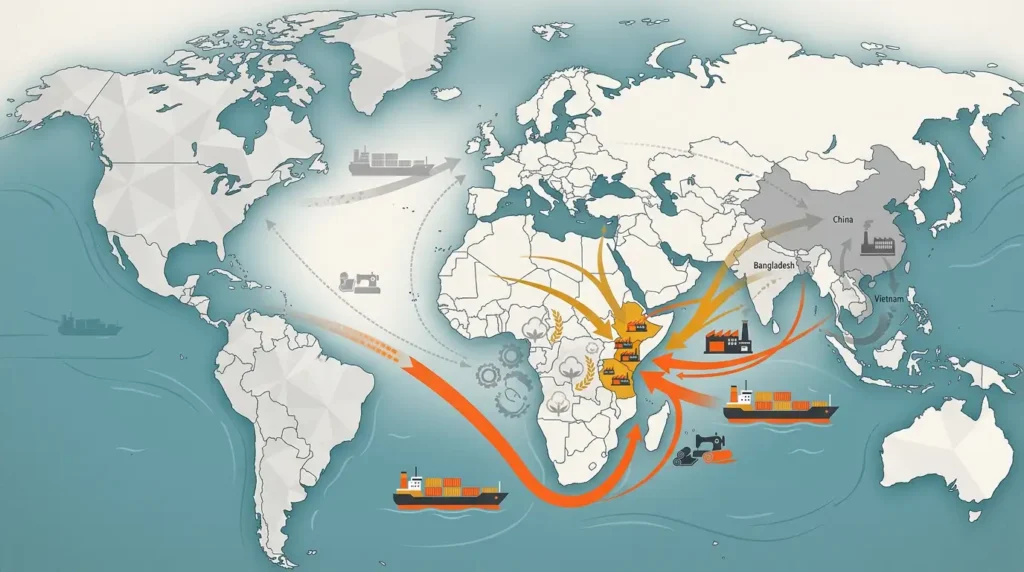
The 2026 Landscape of Global Apparel Sourcing
The 2026 landscape of Global Apparel Sourcing presents a fundamentally different strategic environment than what characterized the apparel industry through most of the post-2000 era. The traditional pattern of progressive concentration in Asian sourcing hubs has reversed, with brands actively diversifying production across multiple regions to manage the new risk profile that has emerged from policy volatility and operational disruption events. The 2026 environment requires sourcing organizations to think strategically about regional diversification, structural risk management, and the interplay between cost optimization and resilience considerations that previously did not require active management. Brands that have not adapted their sourcing approach to the new environment continue to operate with strategic frameworks that no longer match the current realities, producing outcomes that progressively diverge from peer performance as the new dynamics reshape competitive positioning. The strategic divergence is not merely temporary or cyclical, with the structural drivers favoring distributed sourcing approaches likely to persist across multiple future business cycles. Brand customers that have not yet adapted should treat the adaptation as a strategic priority that warrants senior management attention, recognizing that the cost of continued legacy approaches compounds across each successive production season. The window of opportunity to adapt while maintaining competitive parity is closing as more sophisticated peer operations capture the available value, with delayed adapters potentially facing structural disadvantages that become increasingly difficult to recover as the gap widens through accumulated operational learnings and supplier relationship development.
Trade Policy Volatility and Its Lasting Effects
Trade policy volatility has been the most visible driver of the sourcing landscape transformation, with the 2025 reciprocal tariff framework imposing rates ranging from 10 to 49 percent on apparel imports from various Asian countries. Bangladesh, Vietnam, Cambodia, Indonesia, and other major Asian sourcing hubs experienced rate increases that fundamentally altered the cost economics of their production for US brands. The Supreme Court ruling in February 2026 introduced additional complexity by establishing uniform 10 percent baseline reciprocal rates for some categories, but the temporary nature of that framework and the planning uncertainty about post-July 2026 rates means that the underlying volatility has not resolved. Brands operating in this environment cannot simply wait for clarity because each season’s production decisions lock in cost structures for forward sales periods, and the exposure created by sub-optimal sourcing choices compounds across multiple seasons.
The lasting effects of the 2025-2026 policy volatility extend beyond the specific tariff rates to include the strategic recognition that single-region concentration has become structurally risky in ways the industry had not previously fully internalized. Brands that maintained focused single-region structures experienced substantial margin pressure during the volatility periods, with limited ability to shift production quickly enough to mitigate the impact. The performance gap between brands operating distributed structures and brands maintaining concentrated structures widened during these periods, demonstrating the structural advantage that diversification provides. The pattern is unlikely to reverse because the underlying drivers of policy volatility persist beyond any specific tariff scenario, with reciprocal trade frameworks remaining a feature of the policy environment rather than a temporary aberration. Official USTR statements confirm the administration’s intention to continue evaluating trade relationships through a reciprocal lens, suggesting that the underlying volatility will persist for the foreseeable future. Industry analysts at major research organizations have documented how the cumulative tariff burden on Asian sourcing has increased by orders of magnitude relative to pre-2025 baselines, with knock-on effects rippling through retail pricing, consumer demand patterns, and brand profitability. The brands that have responded most effectively to this volatility have built sourcing portfolios that include preferential trade frameworks like AGOA alongside their primary Asian production, creating multiple parallel pathways for goods to reach US consumers under varying tariff conditions. The structural lesson from the 2025-2026 period is that any sourcing strategy concentrated in a small number of countries inherits the policy volatility of those specific bilateral relationships, while sourcing strategies that diversify across geographically and politically distinct hubs can dampen the impact of any single policy development. Brands operating sophisticated supply chain organizations have institutionalized this diversification thinking into their planning frameworks, treating policy diversification as a foundational strategic capability rather than as a tactical response to specific events.
The Compliance Pressure Reshaping Sourcing Decisions
The compliance pressure reshaping sourcing decisions has intensified across multiple regulatory dimensions that affect Global Apparel Sourcing in different ways depending on the specific origin location. The Uyghur Forced Labor Prevention Act has expanded the documentation burden for any supply chain with potential connections to restricted production areas, with detentions of shipments and reputational risk affecting brands that cannot demonstrate adequate due diligence. Country of origin determinations have become more rigorous as CBP applies greater scrutiny to substantial transformation analyses for finished goods incorporating inputs from multiple countries. Sustainability reporting requirements have expanded under the EU Corporate Sustainability Reporting Directive and similar frameworks, with implications for US brands serving European markets through their global apparel programs.
The compliance dimension has become a meaningful sourcing decision factor because the cost of compliance failures has grown substantially. Shipment detentions can produce demurrage charges, opportunity costs from delayed inventory, and reputational damage that affects long-term brand value. Forced labor findings can produce forced removal of products from retail channels, with cascading impacts on brand relationships with retail customers. Documentation deficiencies can produce penalty assessments under various regulatory frameworks, with the financial impact often exceeding the underlying duty savings that the deficient documentation was meant to support. The combination of expanded compliance scope and increased enforcement intensity has elevated compliance considerations from secondary to primary sourcing decision factors. CBP guidance documentation provides current information on enforcement priorities and procedural requirements that affect sourcing decisions across the global apparel industry. The compliance dimension also affects brand reputation through retail customer requirements, with major retailers tightening vendor compliance standards in response to consumer expectations and regulatory pressure. Vendors that cannot demonstrate adequate compliance documentation face restrictions on retail placement, with cascading impacts on brand growth and channel access. The compliance pressure has therefore moved from a back-office concern to a frontline strategic consideration that affects sourcing decisions, vendor selection, and overall brand positioning in the competitive marketplace. Brands operating with mature compliance frameworks gain access to retail opportunities that brands operating with weaker frameworks cannot pursue, creating commercial advantages that extend beyond direct compliance cost considerations into the broader business positioning that determines competitive success.
How Distributed Sourcing Has Become the New Standard
Distributed sourcing has transitioned from a defensive risk management approach to the new standard architecture for sustainable apparel brand operations. The transition reflects the accumulated evidence from recent years that single-region concentration produces inferior outcomes across the range of plausible operating scenarios that brands face. Major brand operations that historically maintained concentrated Asian sourcing have actively built capability across multiple regions, with the resulting distributed structures supporting better outcomes during volatility periods. The pattern has accelerated as the structural drivers of policy uncertainty have persisted, with each successive cycle of volatility reinforcing the value of distributed sourcing relative to concentrated alternatives.
The specific structures of distributed sourcing vary across brands but typically involve some combination of Asian production for technical and capability-specific work, AGOA Kenya production for synthetic and performance categories where duty savings are substantial, USMCA Mexico production for replenishment-driven categories where short lead times provide value, and Latin American production for specific regional needs. Each component of the distributed structure addresses specific operational requirements while contributing to the overall portfolio resilience that distributed structures provide. The architectural choice should be matched to each brand’s specific operational capability and category mix, with the operational complexity of multi-region structures requiring sustained organizational commitment that smaller brands sometimes find challenging to maintain. The trend toward distributed sourcing has accelerated across the apparel industry, with industry research from Brookings Institution global trade analysis documenting the structural shift across multiple brand categories and operational scales. The transition has been particularly pronounced for brands operating in synthetic and performance categories where AGOA preferential treatment provides substantial duty savings that justify the operational investment in distributed structures. Brands operating in basic apparel categories have moved more cautiously due to the smaller percentage savings on lower-MFN-rate products, but even these brands have generally increased their sourcing diversification relative to pre-2025 baselines. The aggregate effect across the apparel sector has been a meaningful structural shift in production volume distribution, with Kenya and other AGOA-eligible countries capturing increasing market share at the expense of traditional Asian concentration points. The capacity expansion at established AGOA factories has accelerated to meet the increased demand, with multiple new facility openings and capacity additions at existing facilities supporting the volume growth. The capacity expansion confirms the structural nature of the shift through commercial commitments rather than just analytical interest, providing the operational foundation for sustained brand sourcing transitions. The capacity expansion has been particularly visible in the synthetic and performance categories where AGOA savings are most substantial, with multiple Kenya factories adding dedicated production lines for activewear, swimwear, and athleisure categories. The category-specific capacity additions support the brand customer requirements while creating opportunities for additional brand customers to engage with Kenya production through facilities specifically designed for their category needs. The capacity additions also support better service levels for existing brand customers, with reduced capacity tightness during peak demand periods and more flexibility to accommodate program changes throughout the operational cycle. The capacity scaling reinforces the leadership position that Kenya has established, with the operational depth supporting confident commercial commitments from brand customers planning meaningful production transitions.
Why Kenya Has Emerged as the Leading Sourcing Hub
Kenya has emerged as the leading sourcing hub among AGOA-eligible countries through a combination of structural advantages that few alternative locations can match. The country offers the most developed apparel manufacturing infrastructure in sub-Saharan Africa, with established factory operations supporting commercial scale production across major apparel categories. Foreign direct investment from international apparel manufacturing groups has built the capability foundation through facilities specifically designed to serve US brand customers under AGOA preferential treatment. The combination of capability infrastructure, AGOA framework benefits, geographic positioning, and operational ecosystem maturity produces a sourcing destination that increasingly competes with and frequently surpasses traditional Asian alternatives across the dimensions that matter most for sustainable brand operations.
| Capability Dimension | Kenya 2020 | Kenya 2026 | Position vs Vietnam | Position vs Bangladesh |
|---|---|---|---|---|
| Total Apparel Export Capacity | ~400M units/year | ~700M units/year | Smaller scale | Smaller scale |
| Synthetic Knit Capability | Limited specialty | Strong, scaled | Comparable mid-tier | Comparable mid-tier |
| Activewear Production | Emerging | Established leader | Comparable | Stronger |
| Swimwear Production | Limitado | Specialized strength | Stronger | Stronger |
| WRAP Certified Factories | ~15 | ~45+ | Comparable density | Comparable density |
| GRS Certified Capacity | Minimal | Significant | Comparable | Stronger |
| Average Effective Duty (US) | 0% (AGOA) | 0% (AGOA) | Major advantage | Major advantage |
| Lead Time to US East Coast | 28-32 days | 25-28 days | Comparable | Faster |
The capability evolution at Kenya factories over the past five years has been substantial, with multiple dimensions improving simultaneously to produce a fundamentally stronger sourcing proposition. Production capacity has expanded through both greenfield facility development and capacity additions at established factories. Capability depth has expanded through equipment investment, technical training programs, and accumulated experience across major apparel categories. Certification depth has expanded across WRAP, SMETA, GRS, OEKO-TEX, and Higg FEM frameworks, supporting the comprehensive compliance documentation that brand customers require. Logistics performance has improved through Standard Gauge Railway operations and port capacity expansion. Each of these improvements contributes to the overall strength of Kenya as a sourcing destination, with the cumulative effect producing the leadership position that the country now holds among AGOA-eligible alternatives.
The Specific Advantages Driving Kenya Leadership
The specific advantages driving Kenya’s leadership position can be organized into structural advantages from the AGOA framework, operational advantages from the manufacturing infrastructure, and strategic advantages from the broader sourcing ecosystem. Each category of advantages contributes to the comprehensive value proposition that Kenya offers brand customers, with the combination producing outcomes that few alternative locations can replicate. Brands evaluating Kenya production should understand the full picture of these advantages rather than focusing on any single dimension, because the strategic value of Kenya sourcing comes from the integrated combination of multiple favorable factors rather than from optimization on any single metric. The integrated value proposition is particularly valuable for sophisticated brand operations that recognize the importance of multi-dimensional strategic positioning, with the various advantages reinforcing each other to produce outcomes that exceed what would be achievable through optimization on any single dimension. Brand customers developing comprehensive evaluation frameworks should incorporate the integrated value perspective rather than fragmenting the analysis into separate optimization exercises that miss the strategic synergies. The integrated perspective typically produces stronger justification for Kenya engagement than fragmented analysis, supporting the strategic prioritization that converts analytical interest into operational commitment.
AGOA Framework Benefits and Structural Cost Advantages
The AGOA framework provides the foundational structural advantage that distinguishes Kenya production from non-preferential alternatives. AGOA preferential treatment eliminates the 16 to 32 percent MFN duty rates that apply to most synthetic and performance apparel imports, producing immediate cost savings that are difficult or impossible to match through any factory-level cost optimization. The framework was reauthorized through December 31, 2026 by legislation signed in February 2026, with retroactive effect to September 30, 2025, providing legal certainty within the defined window. The third-country fabric provision allows Kenya factories to source competitive fabrics from non-AGOA suppliers including Asian mills while still claiming AGOA preferential treatment on the finished garments, supporting access to the same fabric library that Asian factories use while delivering the duty advantages that only AGOA can provide. The combination of duty elimination and fabric flexibility produces structural cost advantages that compound across multiple operating dimensions.
The structural cost advantages extend beyond the direct duty savings to include reduced exposure to the layered tariff frameworks that affect Asian production. AGOA-eligible imports operate outside the Section 122 reciprocal tariff framework that has imposed substantial costs on Vietnamese, Bangladeshi, and Cambodian production. AGOA-eligible imports also avoid the Section 301 tariff stack that affects Chinese imports, providing a clean cost structure that supports forward planning across multi-quarter horizons. The clean cost structure simplifies financial modeling, reduces risk exposure to policy changes, and supports more accurate margin forecasting than is possible with the variable tariff frameworks that affect most Asian sources. Brands prioritizing financial planning discipline particularly value this clean structure, recognizing that the operational benefits of cost predictability extend beyond the direct savings to include better strategic decision-making across the broader business. The clean cost structure also supports more effective communication with retail customers and financial stakeholders, providing transparent visibility into sourcing economics that supports collaborative relationships and strategic planning. Brand operations that can articulate clear sourcing economics typically achieve better outcomes in vendor negotiations, retail relationships, and capital allocation decisions than operations operating with opaque or volatile sourcing structures. The transparency benefit accrues across multiple stakeholder relationships and supports the broader business positioning that contributes to sustainable competitive advantage. The USITC Harmonized Tariff Schedule database provides the official duty rate references that support the financial modeling underpinning these strategic conversations, ensuring that the analytical foundation reflects current regulatory reality rather than outdated assumptions.
Manufacturing Infrastructure and Capability Maturity
The manufacturing infrastructure in Kenya has developed to support commercial scale operations across major apparel categories that brands actually source. Major Kenya factory operations now include facility footprints of 1,000 to 5,000 employees per major facility, with capacity ranging from 500,000 to over 5 million pieces per month at the largest operations. Equipment infrastructure includes modern automated cutting systems, flatlock and coverstitch sewing equipment for performance apparel, sublimation printing capability for polyester sportswear, bonded seam construction for technical applications, and integrated finishing operations including embroidery, screen printing, and garment treatments. The equipment base has been built through sustained investment from international apparel manufacturing groups that brought decades of accumulated knowledge into the African production infrastructure.
The capability maturity extends to quality systems, production planning, and operational management that match international standards for apparel manufacturing. Quality systems include detailed quality manuals, in-line inspection protocols, pre-final audit processes, and AQL inspection capability that meets the requirements of major brand customers. Production planning systems support multi-customer production scheduling, capacity allocation, and lead time management at commercial scale. Operational management includes the experienced production managers and engineering teams transferred from Asian operations along with the locally developed management depth that supports sustainable factory operations. Brand customers conducting factory audits in Kenya consistently find capability profiles comparable to mid-tier Asian alternatives, with the additional structural advantages from AGOA preferential treatment producing total value propositions that frequently exceed Asian alternatives. Our analysis of Africa apparel manufacturing development provides additional context on the capability evolution that has positioned Kenya as a leading sourcing hub. The capability development has been supported by structured training programs that develop sewing operators, quality controllers, and production supervisors through curricula spanning basic skills through advanced technical capabilities. The training infrastructure represents one of the most important enablers of the capability scaling, because the equipment and facility infrastructure can be acquired relatively quickly while the workforce capability requires sustained development investment. Major Kenya factories typically maintain internal training centers with dedicated training capacity, supporting both new operator development and ongoing skill enhancement for the existing workforce. The training investment has produced a workforce capable of meeting international apparel manufacturing standards across the major product categories, with productivity levels that have improved substantially over the past five years to approach mid-tier Asian benchmarks on most operational metrics. The productivity comparison reveals that the gap between Kenya and Asian alternatives has narrowed substantially across multiple dimensions, supporting the favorable total economics that drive the brand customer interest. Productivity dimensions where Kenya now competes effectively include sewing line throughput, cutting room efficiency, quality first-pass rates, and on-time shipping performance. Some specialty productivity dimensions remain stronger at established Asian factories, particularly for highly engineered technical products that benefit from accumulated expertise developed over decades of focused production. The portfolio approach to capability allocation continues to make sense, with most brand operations finding optimal results through structured allocation across multiple sourcing locations rather than through full concentration in any single hub regardless of how favorable the location may appear on aggregate metrics.
Strategic Ecosystem Including Logistics and Compliance
The strategic ecosystem supporting Kenya production extends beyond individual factory operations to include the broader infrastructure that affects sourcing performance. Port of Mombasa operations support reliable container throughput with regular service from major liner alliances to US East Coast destinations, providing the logistics foundation that supports commercial scale brand programs. The Standard Gauge Railway connects inland production areas to the port with daily container freight service, eliminating the truck congestion that historically affected inland logistics. Air freight services through Jomo Kenyatta International Airport provide premium logistics options for time-sensitive shipments. Each component of the logistics ecosystem has been the subject of substantial investment over the past decade, producing the operational performance that supports reliable supply chain operations.
The compliance ecosystem includes the AGOA designated authority infrastructure that issues certificates supporting preferential treatment claims, the customs broker network that handles the technical filing requirements at US ports, and the audit and certification ecosystem that supports brand compliance documentation. WRAP, SMETA, GRS, OEKO-TEX, and Higg FEM auditors all maintain operations in Kenya, with regular audit schedules supporting the certifications that brand customers require. Trade compliance counsel with AGOA expertise serves the brand customer community, providing legal and procedural guidance that supports robust compliance operations. The combination of logistics, compliance, and certification ecosystems produces the integrated environment that supports sustainable brand operations at scale, distinguishing Kenya from less developed sourcing alternatives that lack the supporting infrastructure required for confident commercial operations. Our facility capabilities and ecosystem connections provide direct visibility into the integrated infrastructure that supports brand customer operations. The compliance ecosystem maturity also extends to data infrastructure and reporting capabilities that support modern brand operational requirements. Major Kenya factories operate enterprise resource planning systems that integrate production data, inventory management, quality records, and shipment documentation into unified platforms that support brand customer visibility and reporting. The data infrastructure investment has accelerated as brand customer expectations for supply chain transparency have increased, with leading factories now offering real-time production status reporting, quality data sharing, and integrated documentation flows that match the operational sophistication of mid-tier Asian alternatives. The infrastructure maturity supports the operational efficiency that brand customers require while creating the documentation foundation that supports ongoing compliance across the various regulatory frameworks affecting global apparel operations.
Comparing Kenya Against Traditional Sourcing Alternatives
Comparing Kenya against traditional sourcing alternatives requires structured analysis across the multiple dimensions that affect sourcing decisions, recognizing that the optimal location for any specific brand depends on the particular product portfolio, volume profile, and strategic priorities. Vietnam has long been a leading Asian alternative, with established capability across most apparel categories and competitive factory pricing that has supported substantial brand customer concentrations. Bangladesh has been a leading destination for basic apparel and fast fashion, with deep capacity and very competitive pricing that supported high-volume operations. China remains technically capable across virtually all apparel categories, with the deepest fabric and trim ecosystem and the most advanced production technology among the major sourcing alternatives. Each of these alternatives has specific strengths that may continue to support brand sourcing in particular categories or operational circumstances.
The comparison shifts in favor of Kenya when the full economic picture including tariff effects is considered. Kenya production at zero AGOA duty produces total landed costs that frequently beat Vietnam production at 10 to 46 percent reciprocal tariffs, Bangladesh production at 10 to 37 percent reciprocal tariffs, and Chinese production at 20 to 60 percent stacked tariffs. The factory gate pricing differential between Kenya and Asian alternatives has narrowed substantially as Kenya production capacity has scaled and operational efficiencies have improved, with current factory pricing typically 10 to 18 percent above Chinese alternatives and 5 to 12 percent above Vietnamese alternatives on equivalent specifications. The factory pricing differential is more than offset by the duty differential in most cases, particularly for synthetic and performance categories with high MFN rates. The total landed cost outcomes therefore favor Kenya across most apparel categories that brands actually source, with the operational considerations including lead time, quality, and reliability supporting the financial case rather than offsetting it. Brand customers conducting comprehensive comparisons should examine multiple operational dimensions beyond unit cost, recognizing that the total value proposition reflects the integrated picture across capability fit, lead time performance, quality consistency, compliance profile, and strategic resilience. Kenya production typically performs well across most of these dimensions, with specific strengths in compliance documentation and strategic resilience that distinguish it from concentrated Asian alternatives. The capability fit varies by category, with synthetic and performance products particularly well-suited to Kenya production while certain technical specialty categories remain better served by established Asian factories with deeper specialized capability. The category-specific capability assessment should inform brand portfolio decisions, with priority categories shifted to Kenya production while specialty categories may continue with Asian sourcing during the transition period when Kenya capability for those specific products may not yet be fully developed. The portfolio approach captures maximum value across the full product mix while managing the operational complexity of multi-region sourcing across different category profiles.
Strategic Implications for Brand Sourcing Decisions
Strategic implications for brand sourcing decisions extend beyond unit cost optimization to include the broader strategic positioning that sourcing structure provides. Brands that have engaged with Kenya production have generally outperformed peers across multiple performance dimensions including financial results, supply chain reliability, and stakeholder confidence during the period of greatest tariff volatility. The performance gap reflects the structural advantages of AGOA preferential treatment combined with the diversification benefits of distributed sourcing structure. The gap is likely to persist across the foreseeable planning horizon because the underlying structural drivers favor distributed sourcing approaches over concentrated alternatives. Brands developing forward-looking sourcing strategies should incorporate Kenya production as a primary strategic option rather than as a backup or hedge, recognizing that the strategic value extends well beyond the direct cost savings to include the broader competitive positioning that sourcing structure influences.
The implementation pathway for engaging with Kenya production is well-established for brands ready to take action. Portfolio analysis identifies the priority categories where Kenya sourcing delivers the greatest value, factory qualification establishes the production partnerships that will execute the program, and structured implementation moves volume on a controlled timeline that minimizes execution risk. The timeline from initial engagement to first commercial shipment typically runs 12 to 24 weeks, with full commercial scale operation achieved over 12 to 18 months. The investment required is meaningful but predictable, with the implementation costs typically recouped through duty savings within the first year of full operation. Brands that delay engagement face the opportunity cost of continued exposure to Asian sourcing concentration, with each successive production season locking in cost structures that reflect the legacy approach rather than the optimal strategic positioning available through Kenya engagement. The opportunity cost compounds across multiple production cycles, with each season of delayed transition representing both immediate margin pressure and lost optionality that proactive Kenya adoption would have created. Sophisticated sourcing organizations recognize this opportunity cost dynamic and prioritize early engagement to capture the cumulative benefits over multi-year horizons. The strategic decision framework should incorporate explicit quantification of the opportunity cost of inaction, providing the analytical foundation for prioritizing Kenya engagement against competing organizational priorities that may compete for management attention and capital allocation.
The implementation should also be paced to match the brand’s broader strategic objectives and operational capabilities. Brands experiencing rapid growth typically benefit from aggressive Kenya transition pacing that captures the duty savings on growing volume bases, while brands in mature categories may benefit from more measured pacing that minimizes operational disruption to existing systems. The pacing decision should reflect the brand’s specific circumstances rather than generic timeline recommendations, with successful programs typically structured around the operational rhythm of the specific brand rather than around external timeline pressures.
Risk Considerations for Kenya-Centered Sourcing
Risk considerations for Kenya-centered sourcing must acknowledge several material factors that brands should incorporate into their decisions. The most pressing limitation is the December 31, 2026 sunset date built into the current AGOA reauthorization, with renewal beyond that date dependent on congressional action that remains uncertain. Long-term renewal proposals are under active congressional consideration, but the political dynamics remain unsettled and brands cannot rely on any specific extension framework being enacted on a particular timeline. Forward planning should incorporate scenario analysis that includes both extension and expiration outcomes to ensure that the sourcing strategy performs acceptably across the range of plausible policy futures. The Congressional Research Service brief on AGOA provides current information on the renewal dynamics.
Country-specific eligibility risk represents a second material consideration. The annual AGOA eligibility review process can result in countries being added to or removed from the beneficiary list, with significant implications for brands concentrated in any single country. Kenya has maintained strong eligibility status throughout the program’s history, but the underlying review process means that eligibility is not guaranteed indefinitely. Brands implementing Kenya sourcing should monitor the political and governance developments that could affect eligibility status, supporting proactive risk management. Operational risks beyond the legal framework include currency fluctuations between the Kenyan shilling and the US dollar, port and infrastructure performance during peak demand, and capacity constraints during high-demand periods. Each operational risk is manageable through standard supply chain practices, but they should be incorporated into sourcing decisions alongside the strategic analysis. Cobertura de Reuters en África provides ongoing reporting on the political and economic developments that affect Kenya operations. Capacity constraints during peak production seasons can affect Kenya factories serving multiple US brand customers, with periods of elevated demand sometimes producing tightness in available capacity that affects late-arriving orders. Brand customers planning significant Kenya volume should engage with factory partners early in the planning cycle to secure capacity allocation for their priority programs and avoid the squeeze that affects late-arriving orders during peak demand. The capacity engagement discipline supports reliable program execution and produces better outcomes than reactive capacity sourcing during high-demand periods. Operational risks beyond capacity also include port and logistics performance during peak demand or unusual weather events, with Mombasa generally performing well but with periodic congestion that may affect specific shipping windows. The risks identified are manageable through standard supply chain practices, but they should be incorporated into sourcing decisions alongside the strategic analysis to produce a complete picture of the value proposition.
PREGUNTAS FRECUENTES
Why has Kenya emerged as a leader in Global Apparel Sourcing rather than other AGOA countries?
A1: Kenya has emerged as the leading AGOA-eligible sourcing hub through a combination of factors that few alternative AGOA countries can match. The country offers the most developed apparel manufacturing infrastructure in sub-Saharan Africa, with established factory operations supporting commercial scale production across major apparel categories. Foreign direct investment from international apparel manufacturing groups has built the capability foundation through facilities specifically designed to serve US brand customers, bringing decades of accumulated knowledge into the African production infrastructure. The Port of Mombasa operates as the largest container handling facility in East Africa, providing reliable logistics performance that supports commercial scale brand programs. The Standard Gauge Railway connects inland production areas to the port with daily container freight service. The certification ecosystem including WRAP, SMETA, GRS, OEKO-TEX, and Higg FEM auditors supports the comprehensive compliance documentation that brand customers require. The combination of capability infrastructure, logistics performance, and certification depth produces a sourcing environment that other AGOA countries have not yet matched. Madagascar, Lesotho, and other AGOA countries have specific strengths that support brand operations in particular categories or operational structures, but the comprehensive value proposition that Kenya offers makes it the leading destination for brands transitioning meaningful production volume to AGOA-eligible alternatives. The leadership position is supported by accumulated investment over the past decade that competing AGOA destinations have not yet matched at scale. The accumulated investment has produced network effects that further reinforce Kenya’s leadership position, with established factory operations attracting additional fabric suppliers, freight forwarders, customs brokers, and other ecosystem partners that strengthen the overall sourcing environment. Each additional ecosystem participant contributes to the operational efficiency that brand customers experience, supporting the integrated sourcing environment that distinguishes mature production hubs from less developed alternatives. The network effects are difficult for competing AGOA destinations to replicate quickly, providing Kenya with a sustainable advantage that should support its leadership position over the multi-year horizons that brand sourcing decisions require.
How does Kenya’s cost position compare to leading Asian alternatives in 2026?
A2: Kenya’s cost position has strengthened substantially relative to Asian alternatives over the past two years, with the combination of AGOA preferential treatment and competitive factory pricing producing total landed cost outcomes that frequently beat traditional Asian alternatives. Factory gate pricing in Kenya runs 10 to 18 percent above Chinese alternatives and 5 to 12 percent above Vietnamese alternatives on equivalent product specifications, with the gap narrowing over time as Kenya production capacity has scaled and operational efficiencies have improved. The factory gate pricing differential is typically more than offset by the duty differential when total landed cost is calculated. Chinese production faces the 32 percent MFN duty plus Section 301 tariffs that often add 7.5 to 25 percent, producing total duty stacks frequently exceeding 50 percent of customs value. Vietnamese production has faced reciprocal tariffs ranging from 10 to 46 percent during 2025 and early 2026, with substantial planning uncertainty about post-July 2026 rates. Kenya AGOA production eliminates MFN duty entirely on qualifying entries, providing zero duty exposure. The total landed cost comparison favors Kenya across most synthetic and performance categories, with advantages of 15 to 35 percent versus Chinese alternatives and 8 to 22 percent versus Vietnamese alternatives in typical brand portfolios. The cost position is most favorable for high-MFN rate categories such as synthetic activewear at 28.2 percent and synthetic knits at 32 percent, where the duty saving represents a larger percentage of customs value. The cost position is also more favorable for brands operating at meaningful volume scale where the fixed costs of Kenya transition spread across larger volume bases. Brand operations sourcing 1 million or more units annually in priority categories typically achieve unit cost positions that beat any Asian alternative, while smaller-scale operations may face less pronounced advantages due to the fixed cost burden of Kenya transition. The volume threshold for clearly favorable Kenya economics typically falls in the range of 100,000 to 500,000 annual units in priority categories, though the specific threshold depends on operational capability and the available manufacturing partnerships. Brand customers below this threshold can sometimes participate in Kenya production through manufacturing partners that aggregate volume across multiple brand customers, capturing the duty savings without bearing the full operational overhead of independent Kenya sourcing operations.
What apparel categories work best for sourcing from Kenya?
A3: The apparel categories that work best for Kenya sourcing are concentrated in synthetic and performance products with high MFN duty rates, where the AGOA savings are most substantial. Synthetic polo shirts, hoodies, sweatshirts, and pullovers at 32 percent MFN show the largest landed cost advantages versus Asian alternatives. Athletic shorts, leggings, and base layer compression at 28.2 percent MFN show similar magnitude advantages. Swimwear at 24.9 to 28.2 percent MFN shows substantial advantages with the additional benefit of established Kenya capability in elastic fabric handling and chlorine-resistant construction. Activewear and athleisure categories combine high duty rates with the technical capability that established Kenya factories have developed, producing competitive positions across the full category range. Synthetic outerwear including light jackets at 28.2 percent MFN works well where Kenya capability is appropriate to the specific product specifications. Basic cotton apparel including T-shirts at 16.5 percent MFN produces smaller percentage advantages but still favorable total landed cost outcomes for most brand programs. Brand customers should conduct detailed analysis at the SKU level to identify the specific categories where Kenya sourcing produces the greatest value, prioritizing the implementation accordingly. The portfolio approach captures maximum value while managing the operational complexity of sourcing transitions across multiple categories simultaneously, supporting the sustainable scale that justifies the operational investment in Kenya capability development. Specific Kenya production capabilities can be reviewed at our dedicated category pages. The category prioritization should also consider the strategic dimensions beyond unit cost, including the alignment of each category with the brand’s growth strategy, the importance of supply chain resilience for that category, and the capability fit with established Kenya factories. Categories experiencing high growth typically benefit from sourcing optimization that delivers cost advantages quickly, while mature categories may warrant more measured transition pacing that minimizes disruption to existing operational rhythms. Brand customers developing detailed category prioritization should engage their finance, sourcing, and product development teams in joint analysis to ensure that the optimization conclusions reflect the full strategic context rather than narrow cost metrics alone. The cumulative volume across multiple categories from a single brand customer also strengthens the commercial relationship with the factory, supporting better service levels, priority capacity allocation during peak demand, and pricing flexibility that single-category relationships rarely achieve.
What are the main risks of concentrating significant production in Kenya?
A4: The main risks of concentrating significant production in Kenya include AGOA program continuity, country-specific eligibility, currency fluctuations, and operational concentration risks similar to those affecting any single-country sourcing structure. The AGOA program continuity risk is the most significant near-term consideration, with the current authorization running through December 31, 2026 and renewal beyond that date dependent on congressional action that remains uncertain. The country-specific eligibility risk is currently low because Kenya has maintained strong AGOA eligibility status throughout the program’s history, but the underlying annual review process means that eligibility is not guaranteed indefinitely. Currency risk affects the Kenyan shilling against the US dollar, with factory pricing typically incorporating currency hedging assumptions that affect per-unit pricing over time. Operational concentration risks include capacity constraints during peak demand, port and logistics performance during exceptional events, and the specific dynamics affecting any single-country production structure. The risks are manageable through several mitigation strategies including diversification across multiple AGOA-eligible countries when appropriate, maintained backup capacity options, structured contingency planning, and ongoing monitoring of the political and economic developments affecting Kenya operations. Brand customers should incorporate these risk considerations into their strategic planning while recognizing that the structural benefits of Kenya sourcing typically outweigh the manageable risks for most operational scales and product portfolios. The risk profile of Kenya-concentrated sourcing is generally more favorable than concentrated single-country Asian alternatives despite the AGOA program continuity uncertainty, because the underlying tariff and operational dynamics favor Kenya across the range of plausible scenarios that brands face. Risk mitigation through portfolio diversification remains a sensible strategy regardless of the underlying favorability of any single sourcing location, with brands operating significant Kenya volume often maintaining secondary capacity options that support continuity if specific Kenya-related risks materialize. The diversification strategy can include other AGOA-eligible countries, Mexico under USMCA, or maintained Asian capacity for specific categories, with the optimal diversification structure depending on the brand’s specific operational scale and category mix. The structured approach to risk management captures the strategic benefits of Kenya leadership while maintaining the operational resilience that distinguishes leading brand operations.
How quickly can a brand transition meaningful production volume to Kenya?
A5: The transition timeline for shifting meaningful production volume to Kenya typically runs 12 to 24 weeks from initial factory engagement to first commercial shipment, with full scale production achieved over a 12 to 18 month horizon depending on the brand’s volume profile and product complexity. The factory qualification phase including audits and capability validation takes 6 to 12 weeks. Sample development including proto, fit, and pre-production samples takes 8 to 16 weeks for typical apparel programs, with longer cycles for complex technical products. Initial production runs typically cover 10 to 20 percent of target annual volume in the first season, with subsequent ramp-up scaling to 50 to 70 percent in the second season and full target volume in the third or fourth season. Brands seeking faster transition can compress the timeline by working with factories that have established programs in similar product categories, leveraging the existing capability infrastructure to accelerate qualification and sample cycles. The factory selection decision substantially affects transition timeline, and brands prioritizing speed should weight factory maturity heavily in their qualification criteria. Capacity availability also affects practical timeline because high-demand factories often have limited near-term openings that constrain the achievable production ramp regardless of brand priorities. The optimal transition pace balances speed against execution risk, with most successful programs prioritizing sustainable scale-up over aggressive timeline compression to ensure that quality and operational performance are not compromised during the ramp-up phase. Larger brands with experienced sourcing teams often achieve faster transitions than emerging brands by leveraging institutional expertise that streamlines the documentation and quality systems integration work. The transition timeline can also be accelerated when brands have completed prior preferential treatment program implementations such as USMCA, CAFTA-DR, or other preferential frameworks, because the documentation discipline and procedural framework experience translates effectively to AGOA implementation. Brands new to preferential treatment programs face a steeper learning curve initially, but the experience accumulated through Kenya AGOA implementation creates institutional capability that supports subsequent preferential treatment program adoption across other regions and frameworks. The cumulative experience effect makes the initial Kenya transition strategically valuable beyond the immediate program economics, providing organizational capability development that supports broader sourcing sophistication over multi-year strategic horizons.
Conclusión
The shift in Global Apparel Sourcing toward Kenya as a leading destination reflects structural changes in the trade policy environment, manufacturing capability landscape, and strategic risk management requirements that have reshaped the apparel sourcing landscape over the past five years. The combination of AGOA preferential treatment, mature manufacturing infrastructure, established certification ecosystems, and competitive logistics performance has positioned Kenya as a primary sourcing destination rather than a peripheral alternative. The leadership position is supported by structural factors that are likely to persist across the foreseeable planning horizon, making the brand operations that have engaged with Kenya production well-positioned for sustainable competitive advantage relative to peers maintaining traditional concentrated structures. The competitive positioning advantages compound over time as accumulated operational learnings, supplier relationships, and institutional capability create barriers to easy replication by less experienced peers. Brand customers that have invested in Kenya capability over the past several years have built sustainable advantages that newer entrants cannot quickly match, supporting the long-term strategic value of early engagement with the Kenya production ecosystem. The first-mover advantages extend across multiple dimensions including factory relationship depth, capacity priority during high-demand periods, technical knowledge transfer, and operational rhythm establishment that supports reliable performance at scale. Brands that engage early in the Kenya transition typically achieve better operational outcomes than later-entering peers, with the gap typically widening rather than narrowing as the operational dynamics mature. The compounding advantages provide the structural foundation for sustainable competitive positioning that justifies the strategic priority of Kenya engagement over the multi-year horizons relevant to brand strategic planning across both immediate operational performance and longer-term competitive positioning that defines successful apparel brand operations in evolving global trade environments characterized by persistent policy uncertainty and structural transformation across the apparel sector.
The strategic implications for brand operations extend beyond the direct cost effects to include the broader resilience and competitive positioning that sourcing structure provides. Brands that have moved decisively to engage with Kenya production over the past 18 months have generally outperformed peers across multiple performance dimensions during the period of greatest tariff volatility, demonstrating the structural advantages that the model provides in real operating conditions. The brands that delayed engagement have absorbed concentrated tariff exposure that compressed margins and forced operational pressure that proactive Kenya adoption would have avoided. The asymmetric outcome between proactive and reactive engagement suggests that the value of Kenya sourcing extends well beyond the direct duty savings to include the broader strategic positioning that resilience-focused supply chain construction provides.
The implementation pathway for engaging with Kenya production is well-established for brands ready to take action. Portfolio analysis identifies the priority categories where Kenya sourcing delivers the greatest value, factory qualification establishes the production partnerships that will execute the program, and structured implementation moves volume on a controlled timeline that minimizes execution risk. The investment in transition pays back through duty savings within the first year of production at scale, and the ongoing benefits compound across multiple production seasons. Brands ready to begin this process can connect with experienced manufacturing partners through structured engagement that addresses both the strategic and operational dimensions of the transition.
The window for capturing maximum value from Kenya production under the current AGOA framework runs through December 31, 2026, with renewal beyond that date dependent on congressional action that remains uncertain. Brands that move within this window have the opportunity to build sourcing relationships, establish documentation infrastructure, and capture duty savings that compound over time. The trade policy environment shows no signs of reverting to the predictable framework that previously governed Asian sourcing economics, which means that the case for Kenya production strengthens with each successive policy cycle. Brands ready to engage can connect with our team through our Solicitar presupuesto page or review specific category capabilities at Mallas, Bañadores, and other product pages. The strategic question for brands is no longer whether Kenya offers competitive sourcing positioning but how quickly to scale engagement to capture the full value available within the current policy framework before the next reauthorization cycle determines the long-term framework for US-Africa preferential trade. The brands that act decisively in this window will establish the cost structures and sourcing relationships that drive competitive performance across the multi-year horizon, while the brands that defer action absorb opportunity costs that compound across each successive production season they delay engagement with the Global Apparel Sourcing transformation underway. The implementation choices made over the next several quarters will substantially influence which brands emerge from the current trade volatility with stronger margin structures and which brands continue to absorb concentration exposure that competitive pressure will eventually force into retail price points. The window of opportunity is finite, the implementation pathway is well-established, and the strategic logic is clear for any brand serving the US apparel market with meaningful synthetic or performance category volume. The brands that engage decisively position themselves to capture both immediate cost relief and long-term competitive positioning, while brands that defer continue to operate with strategic frameworks that no longer match the competitive realities of the global apparel industry. The choice between proactive engagement and continued legacy approaches will likely be one of the defining strategic decisions for apparel brand operations over the multi-year horizon ahead.