
The collar is the single most visible feature of a polo shirt and the most demanding component to engineer correctly. A well-constructed collar holds its shape through hundreds of wash cycles, lays flat against the wearer without curling, frames the face symmetrically, and projects the casual-yet-refined aesthetic that has made the polo shirt a staple of business casual, athletic, and corporate apparel for over a century. A poorly constructed collar curls at the points within weeks of normal use, loses its shape after a few washes, fails to lay flat against the chest, or develops the rolled-edge distortion that signals cheap construction to even casual observers. The difference between these outcomes depends on engineering decisions made across yarn selection, knit structure, interlining specification, sewing technique, and finishing chemistry. Polo Shirt Collar Engineering is therefore one of the most consequential disciplines in performance apparel manufacturing, with direct effects on perceived product quality, brand reputation, and the actual durability that determines consumer satisfaction.
The challenges of polo collar construction stem from the fundamental tension between aesthetic and functional requirements. The collar must be soft enough to feel comfortable against the neck while being structured enough to hold its shape when not buttoned. It must be flexible enough to fold naturally during wear while resistant enough to spring back to its intended position. It must be stable enough to retain its dimensions through washing while maintaining the soft hand feel that consumers associate with quality apparel. Achieving this balance requires precise specification of every construction element and disciplined execution across the manufacturing process. Major brands including Lacoste, Ralph Lauren, Tommy Hilfiger, and athletic specialists like Nike, Adidas, and Under Armour have built their polo collections around proprietary collar engineering approaches that distinguish their products in retail environments where polo shirts compete on subtle quality cues that consumers register quickly even without articulating the specific differentiators.
This guide examines the engineering decisions that determine polo collar quality, the materials and construction methods used by leading manufacturers, the testing protocols that quantify collar performance, the manufacturing implications for brands sourcing polo programs, and the practical implementation roadmap for brands seeking to upgrade their collar quality. The analysis draws on textile engineering research, manufacturing experience producing polo shirts for global brand customers, and observed market practices across the major polo brand portfolios. The depth of treatment reflects the technical complexity of the discipline and the commercial importance of getting collar engineering right for brand reputation in the polo category, where small construction differences produce visible product differences that consumers compare side-by-side in retail environments. The polo category remains one of the most competitive product categories in performance apparel, with established premium brands defending market positions against athletic specialists, athleisure entrants, and value-driven private label programs. The competitive environment makes collar quality a particularly important differentiator, since consumers shopping the polo category often compare multiple options visually and physically before making purchase decisions, and the visible quality differences in collar construction influence those decisions in ways that consumers may not consciously recognize but that drive their preferences and brand loyalty patterns.
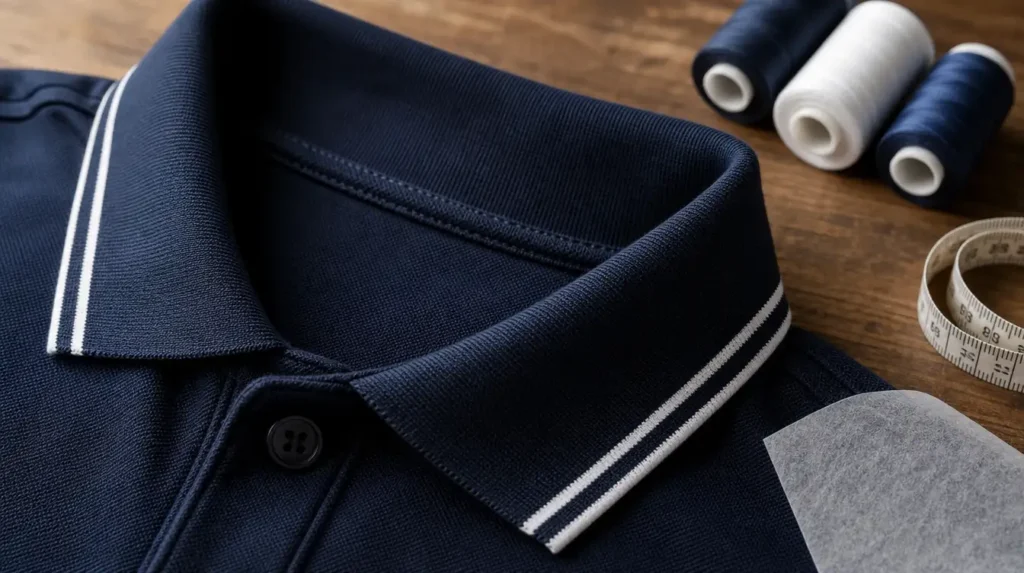
The Anatomy of a Performance Polo Collar
Before examining the engineering decisions, it is essential to understand the anatomy of a polo collar and the role each component plays in the finished assembly. The collar itself consists of multiple layers and elements that work together to deliver the structural and aesthetic outcomes the wearer experiences. Understanding the anatomy provides the foundation for appreciating why specific construction choices matter and how they interact to produce the overall collar performance. The component-by-component analysis also helps brand customers communicate effectively with manufacturing partners about the specific aspects of collar quality they want to optimize, since vague descriptions of desired outcomes often produce inconsistent results across different manufacturing partners.
Collar Body and Structural Foundation
The main body of the polo collar is typically a separate piece of knit fabric, designed and constructed specifically for the collar function rather than cut from the same fabric used in the body of the shirt. The dedicated collar fabric, often called collar pique or rib collar fabric depending on the construction, uses a denser knit structure than the body fabric to provide the firmness needed for shape retention. The most common collar constructions include 1×1 rib (single rib), 2×2 rib (double rib), and self-trim pique that matches the body fabric texture but uses a denser gauge. Each construction produces distinct hand feel, drape, and shape retention characteristics, with 1×1 rib being most common in athletic polo shirts, 2×2 rib in premium athletic and athleisure polos, and self-trim pique in classic dress polos that prioritize a refined aesthetic over maximum stretch.
The collar body is typically knit on flat knitting machines that allow precise control over the dimensional stability and edge finishing. Flat knitting produces collars with finished edges that do not require additional hemming or binding, resulting in cleaner aesthetic and reduced bulk at the collar perimeter. Circular knitting can also be used for some polo collar constructions, particularly when the collar will be cut and sewn rather than fully fashioned. The choice between flat and circular knitting affects production economics, with flat knitting supporting smaller batch sizes and more design flexibility while circular knitting supports higher production volumes at lower cost per unit. Brand customers selecting collar construction approaches should consider both the immediate cost implications and the long-term quality implications of the construction choice. Brands developing polo programs can review production capabilities at our Polo production page where multiple collar construction approaches are supported.
The collar fabric weight specification interacts with the body fabric weight to determine the overall garment proportions and the relative visual prominence of the collar. Athletic polos typically use collar fabric weights of 250 to 320 gsm paired with body fabric weights of 180 to 220 gsm, producing a collar that is visually prominent and structurally substantial relative to the body. Dress polos sometimes use lighter collar fabrics of 200 to 270 gsm to produce a more refined visual proportion, with the structural performance maintained through interfacing rather than fabric weight alone. The interaction between collar and body fabric specifications affects the overall garment aesthetic and should be considered as a system rather than as independent decisions.
Interlining and Reinforcement
The interlining is the hidden structural element that gives a polo collar its shape retention and edge stability. Without interlining, even the most carefully knit collar fabric will gradually lose its dimensional stability through wash cycles and become limp, curled, or distorted. The interlining is typically a fusible interfacing material applied to the inside of the collar fabric during construction, using heat and pressure to bond the interfacing permanently to the collar body. The choice of interfacing affects multiple performance characteristics including stiffness, shape retention, hand feel, and washability. Common interfacing types for polo collars include woven fusible interfacings (providing strong structure with refined hand feel), non-woven fusible interfacings (providing moderate structure with cost efficiency), and knit fusible interfacings (providing gentle structure with maximum drape and softness).
The interfacing weight is specified in grams per square meter (gsm) and typically ranges from 35 to 75 gsm for polo collar applications. Lighter weights produce softer collars with less aggressive shape retention, while heavier weights produce more structured collars with stronger shape retention but potentially harder hand feel. The optimal weight depends on the polo style positioning, with athletic polos typically using 35 to 50 gsm interfacings for soft hand feel and dress polos using 55 to 75 gsm interfacings for stronger structure. The interfacing application process must be precisely controlled to ensure full bonding without over-application that creates stiff spots or under-application that produces gradual delamination during washing. According to AATCC technical guidance, the bond strength can be measured through standardized peel testing that quantifies the interfacing adhesion to the base fabric, providing quantitative data that supports supplier qualification and ongoing quality monitoring.
Collar Edge and Tipping Construction
The edge construction of the polo collar is one of the most distinctive design elements and one of the most challenging to execute consistently. Common collar edge approaches include rolled edges (the edge folded under and stitched, producing a soft and rounded finish), self-finished edges (the edge produced directly by the flat knitting process, requiring no additional finishing), tipped edges (a contrasting color or stripe finished into the collar edge during knitting, producing the classic athletic polo aesthetic), and bound edges (a separate strip of fabric or trim wrapping the collar edge, producing a structured aesthetic). Each approach produces distinct visual results and requires different manufacturing capabilities, equipment, and quality controls. The edge construction choice should align with the brand positioning and the overall garment aesthetic, with athletic polos typically using tipped or self-finished edges and dress polos using bound or rolled edges.
The tipping construction, often called pic stitch or contrast tipping, produces the colored stripe that runs along the collar edge in athletic polo shirts. The tipping is created during the flat knitting process by introducing one or more contrasting color yarns at the edge stitches, producing a clean color separation without the need for additional sewing operations. The complexity of the tipping pattern affects the production speed and yarn handling requirements, with simple single-stripe tipping running at near-standard knitting speeds and complex multi-stripe or jacquard-pattern tipping requiring slower knitting speeds and more skilled operator attention. The tipping yarns must be color-matched precisely to the desired final appearance and must use compatible fiber chemistry to avoid problems during dyeing and finishing. Brand customers can review tipping capabilities through our Polo production page.
Materials and Construction Decisions
The material selection for polo collar construction interacts with the construction techniques to produce the finished collar performance. Yarn selection, knit gauge, interfacing specification, and sewing thread all affect the durability, hand feel, and aesthetic outcomes. Brand customers and OEM partners working on polo programs should understand these material decisions to make informed specifications that produce the intended collar quality at the target cost position. The interaction between materials and construction is what defines the unique performance signature of high-quality polo collars in the broader practice of Polo Shirt Collar Engineering, and the decisions cannot be made in isolation from each other.
Yarn Selection for Collar Applications
The yarn selection for polo collars typically uses higher-denier yarns than the body fabric to provide the structural foundation needed for shape retention. Common collar yarn specifications include 30/1 to 40/1 cotton yarns for classic polo applications, 40/1 to 60/1 polyester or polyester blend yarns for athletic polo applications, and various spandex-blended yarns for stretch-incorporated collars in premium athletic styles. The yarn count affects the fabric weight, hand feel, drape, and durability, with finer counts producing softer and more refined collars at the cost of structural firmness, while coarser counts producing more structured collars with potentially harder hand feel. The fiber selection within the yarn affects both the immediate hand feel and the long-term durability characteristics. Cotton yarns provide soft hand feel and natural appearance but require careful interfacing selection to maintain shape retention through wash cycles, since cotton itself has limited recovery from stretching and wrinkling.
Polyester yarns provide better shape retention and dimensional stability than cotton but produce a more synthetic hand feel that may not align with premium dress polo positioning. Polyester-cotton blends offer compromise solutions that balance hand feel against durability, with typical blends including 65/35 polyester-cotton and 50/50 polyester-cotton being common in athletic and casual polo applications. Premium athletic polos increasingly use engineered polyester yarns including Coolmax variants and microfiber polyester to deliver superior moisture management and hand feel performance simultaneously. Brand customers selecting yarn specifications should match the choice to the target consumer expectations and price positioning rather than defaulting to a single specification across all polo styles, since the yarn selection produces visible differences in the finished collar that consumers compare in retail environments.
Knit Gauge and Stitch Density
The knit gauge of the collar fabric determines the visible texture and the structural firmness of the finished collar. Common gauges for polo collar applications include 12 gauge (approximately 12 stitches per inch in the machine direction), 14 gauge, and 16 gauge, with finer gauges producing tighter and more refined collar fabrics and coarser gauges producing more visible rib texture and softer drape. The 14 gauge specification is the most common for athletic polo collars, balancing visual texture with structural performance. The 12 gauge specification is common for classic dress polos, providing a more textured appearance that aligns with refined aesthetics. The 16 gauge specification is used for premium athletic and athleisure polos that prioritize a smooth and refined collar appearance.
The stitch density within the gauge affects the firmness, weight, and shape retention. Higher stitch density (more stitches per centimeter) produces tighter and firmer collars with better shape retention but potentially harder hand feel and slightly higher production cost due to slower knitting speeds. Lower stitch density produces softer and more drapey collars with reduced shape retention. The optimal balance depends on the polo style and target consumer expectations, with athletic polos typically using moderately high density to support shape retention through athletic use and dress polos using moderate density to balance refined aesthetics with comfort. The density specification should be communicated precisely to the fabric mill, since small variations in density produce visible differences in finished collar performance that consumers can detect even without articulating specific quality attributes. Mature mills maintain detailed specification documents that support consistent reproduction of approved samples in production volumes. Industry resources including Textile Exchange technical publications document best practices for fabric specification management across global supply chains.
Sewing Thread and Construction Technique
The sewing thread used to attach the collar to the body of the polo shirt affects both the structural integrity and the visual quality of the collar attachment. Polo collar attachment typically uses fine polyester thread (Tex 27 to Tex 35) that produces clean stitches without excessive bulk at the seam. The thread color is typically matched to the collar color or to the body color depending on the design intent, with high-contrast threading sometimes used as an intentional design element on athletic polos. The stitch type for collar attachment is typically a clean lock stitch or a specialized cover stitch depending on the construction approach, with specific machinery requirements for each technique.
The skill of the sewing operator significantly affects the final collar attachment quality. The operator must align the collar precisely to the neckline opening, maintain consistent stitch tension across the curved seam, manage the bulk of the collar fabric through the sewing operation, and produce a finished seam that lays flat against the body fabric without puckering or distortion. Mature manufacturing facilities operate with experienced sewing operators specifically trained on polo construction, with quality controls that include in-line inspection of collar attachment quality and end-of-line verification before the garment proceeds to finishing. The investment in skilled labor and quality systems produces measurably better collar quality than facilities that treat polo construction as commodity work, and brand customers should consider the operator skill base when evaluating manufacturing partners for polo programs. Manufacturing partners with multi-decade experience in polo production typically maintain dedicated polo construction lines with specialists who understand the specific quality requirements at each construction stage.
Comparing Polo Collar Construction Approaches
The major construction approaches for polo collars produce distinctly different performance and aesthetic outcomes, supporting different brand positioning and price points. The table below summarizes the key characteristics of the most common approaches available in the global polo manufacturing market in 2026, providing a reference framework that brand customers can use to specify collars for their product programs. The values are representative of typical commercial conditions and should be validated against current factory quotations and the brand’s specific quality requirements.
| Construction Approach | Knit Type | Typical Application | Hand Feel | Shape Retention | Production Cost Index | Wash Durability | Brand Positioning Fit |
|---|---|---|---|---|---|---|---|
| 1×1 Rib Flat Knit | Single rib flat | Athletic, casual polos | Soft, stretchy | Moderate | 1.0x baseline | 40-60 cycles | Athletic, mid-market |
| 2×2 Rib Flat Knit | Double rib flat | Athletic premium, athleisure | Soft, structured | Strong | 1.1-1.2x | 50-80 cycles | Premium athletic, athleisure |
| Self-Trim Pique | Pique flat or circular | Classic dress polos | Refined, structured | Strong | 1.2-1.4x | 60-100 cycles | Dress, business casual |
| Tipped Athletic Collar | 1×1 or 2×2 rib with stripes | Athletic with visual detail | Soft, stretchy | Moderate to strong | 1.2-1.5x | 40-70 cycles | Sport-specific, branded |
| Engineered Polyester Rib | Performance polyester rib | Performance athletic | Smooth, technical | Strong, fast recovery | 1.3-1.5x | 60-90 cycles | Performance athletic |
| Cotton-Spandex Blend Rib | Cotton-spandex 1×1 rib | Premium athleisure | Soft, slight stretch | Strong with stretch | 1.2-1.4x | 50-70 cycles | Premium casual |
| Heavyweight Pique Collar | Dense pique flat knit | Premium dress polos | Refined, firm | Very strong | 1.4-1.7x | 80-120 cycles | Luxury dress, executive |
| Bound Edge Construction | Various with bound edges | Heritage and dress polos | Structured, classic | Strong | 1.3-1.6x | 70-100 cycles | Classic, premium |
The comparison reveals that the construction approach should match the polo positioning and target consumer expectations rather than defaulting to a single specification across the portfolio. Athletic polos benefit from the soft hand feel and stretch performance of 1×1 or 2×2 rib constructions, while dress polos benefit from the refined aesthetic and superior shape retention of self-trim pique or heavyweight pique constructions. Brand customers can review specific category capabilities through our T-shirt and Visit Factory pages. The cost premium for premium constructions is moderate (typically 20 to 70 percent above baseline) and is well justified by the brand differentiation and consumer-perceived quality benefits. Brand teams developing polo programs should engage manufacturing partners early in the design process to identify the optimal construction for the target positioning and to evaluate samples that demonstrate the construction differences before committing to large-volume production.
Manufacturing Process Control for Collar Quality
The execution of polo collar construction in production requires precise process control across multiple manufacturing stages. The variability in finished collar quality even between facilities using nominally similar specifications can be substantial, with mature facilities producing consistently high-quality collars while less mature facilities produce variable quality that disappoints consumers. Brand customers selecting manufacturing partners for polo programs should evaluate the production process maturity and quality systems carefully, since the difference in finished product quality is often more important than the difference in unit cost when total cost of ownership including returns and brand reputation effects is considered. The supplier evaluation should examine multiple dimensions including equipment investment level, operator skill base, quality control systems, supply chain relationships, certification status, financial stability, and leadership commitment to quality outcomes. Each dimension contributes to the supplier’s ability to deliver consistent results across production volumes, and weakness in any single dimension can produce quality issues that affect the brand. The most reliable suppliers typically demonstrate strong performance across all dimensions rather than excellence in one or two while being weak in others, since the integrated nature of polo production means that weak links in the value chain produce visible quality problems regardless of strength in other areas. The investment in selecting capable manufacturing partners typically pays back through dramatically lower defect rates and stronger consumer reception of the finished products.
Knitting Process Control
The collar knitting process produces the foundation fabric on which all subsequent construction depends. The flat knitting machines must be properly maintained, calibrated, and operated by skilled technicians who can detect and correct subtle quality variations before they become visible defects in finished collars. Common knitting issues that affect collar quality include yarn tension variations that produce uneven stitch sizes, machine timing errors that produce dropped or doubled stitches, dye lot variations that produce subtle color differences across collar pieces from the same production run, and edge finishing inconsistencies that produce variable collar perimeters. Mature knitting operations include systematic preventive maintenance, regular operator training, in-line quality inspection, and statistical process control that identifies trends before they produce unacceptable products.
The yarn supply management interacts with the knitting process to determine consistency. Yarn lots should be carefully tracked through production, with attention to maintaining consistent lot use within individual product programs to avoid the subtle color variations that occur between yarn lots from the same supplier. The yarn supplier qualification should include color matching to standard reference samples, fiber and chemical specifications, and dimensional tolerances that affect knitting performance. Brand customers operating with premium polo programs should specify single-lot yarn use within individual production batches and should require manufacturers to maintain documentation of yarn lot tracking through the production process. The investment in supply chain discipline produces measurably better consistency in finished collar appearance and supports the premium brand positioning that justifies the program economics. The yarn lot tracking system also supports root cause analysis when quality issues do occur, allowing the manufacturer to trace specific problems back to specific yarn lots and address the issues at the source rather than applying generic corrective actions that may not address the actual cause.
Interfacing Application and Bonding
The interfacing application is one of the most critical and often underappreciated stages in polo collar construction. The application process must produce uniform bonding across the entire collar area, without zones of incomplete adhesion that lead to delamination during washing or zones of excessive adhesion that produce stiff spots in the finished collar. The application requires precise control of temperature, pressure, and dwell time, with specifications typically in the range of 130 to 150 degrees Celsius applied for 12 to 18 seconds at 2 to 4 bar of pressure. The actual specifications should be matched to the specific interfacing product and the collar fabric construction, with the interfacing supplier providing recommended application parameters that the manufacturer should validate through testing.
The quality verification of interfacing application includes visual inspection for complete bonding, peel testing to verify adhesion strength, and wash testing to confirm bonding durability through expected consumer wash cycles. Mature manufacturers maintain dedicated interfacing application stations with calibrated equipment, trained operators, and systematic quality controls that catch application failures before they reach finished garments. Brand customers should request documentation of the interfacing application protocols and quality controls during manufacturing partner qualification, since this single process step has substantial impact on the long-term collar performance that consumers experience. According to ASTM International standards, peel testing protocols can be standardized to support comparable supplier evaluation across the industry, providing the quantitative foundation for objective supplier qualification decisions. The standardized testing approach also enables benchmarking across multiple supplier candidates during the qualification process, supporting data-driven selection rather than relationship-based selection that may not produce the optimal manufacturing partner for the brand’s specific quality requirements. The data-driven approach also creates documentation that supports succession planning when brand procurement leadership changes, ensuring that institutional knowledge about supplier capabilities transfers across personnel rather than depending entirely on individual relationships. Brand teams establishing supplier qualification programs should invest in the testing infrastructure and protocols required to evaluate candidates objectively, building organizational capabilities that support better long-term supplier decisions across multiple product categories.
Sewing and Assembly Operations
The sewing operations that attach the finished collar to the polo body require skilled operators using properly maintained machinery. The collar attachment is one of the most demanding sewing operations in polo construction, requiring precise alignment, consistent stitch tension, and clean finish on a curved seam that the consumer will see directly. Mature manufacturing facilities operate with dedicated polo construction lines staffed by experienced operators who specialize in polo work and understand the specific quality requirements. The line configuration typically includes preparation stations that pre-fold the collar to the correct shape, primary attachment stations using specialized machinery, and finishing stations that complete the construction and prepare the garment for next-stage operations.
The quality controls during sewing include in-line inspection by quality control technicians who walk the production line and identify defects in real time, statistical sampling that quantifies defect rates by line, shift, and operator, and end-of-line inspection that catches any defects missed during in-line inspection. Brand customers operating premium polo programs should consider implementing third-party in-line quality monitoring during the early production runs to validate that the manufacturing process delivers the quality intended by the specifications. The investment in quality monitoring during initial production builds confidence in the long-term supplier relationship and creates the foundation for the patient continuous improvement that drives lasting quality outcomes. Brand teams managing polo programs across multiple supplier relationships often establish standardized quality protocols that support consistent evaluation and direct comparison of supplier performance over time. The standardization supports both supplier accountability and brand operational efficiency, allowing the same quality framework to be applied across different supplier relationships without requiring custom protocols for each. The investment in standardization pays back through faster supplier onboarding, more consistent quality outcomes, and stronger negotiating position with suppliers who understand that the brand applies consistent standards across the supplier base.
Testing and Quality Specification
Validating polo collar quality requires structured testing protocols that quantify the performance attributes that consumers actually experience. The standard test methods address dimensional stability through wash cycles, shape retention after stretching, edge stability, color fastness, and overall appearance grading. Brand customers establishing supplier qualification programs and quality acceptance criteria should specify the testing protocols required for production approval, ensuring that suppliers provide documented evidence of quality performance rather than relying on assertions alone. The testing investment is meaningful but typically represents less than 1 percent of garment cost, while the returns from avoiding quality failures and brand reputation damage substantially exceed the testing cost.
The dimensional stability testing measures collar dimensions before and after standardized wash and dry cycles, quantifying any shrinkage or distortion that occurs during the simulated consumer care. AATCC 135 specifies the standardized washing protocol, while measurement protocols based on ASTM standards quantify the dimensional changes. Polo collars typically should show less than 3 percent shrinkage in length and width directions through 5 wash cycles, with progressive monitoring through 20 and 50 cycles to characterize long-term stability. The shape retention testing evaluates the collar’s ability to return to its intended dimensions after stretching, with the test typically applying a controlled stretch and measuring recovery at multiple time intervals after release. Strong polo collars should show 95 percent or greater recovery within 30 seconds of stretch release, with values below 90 percent indicating insufficient construction quality for consumer applications.
The visual appearance grading provides subjective but important characterization of finished collar quality. Trained graders evaluate finished polo shirts after defined wash cycle counts, scoring the collar appearance for curling at the points, edge distortion, dimensional changes, color consistency, and overall aesthetic appeal. The grading scales typically use 1 to 5 ratings with 5 representing as-new appearance and 1 representing severely degraded appearance. Brand customers should specify minimum visual grades at multiple wash cycle intervals (10, 20, and 50 cycles) to ensure that the polo collar maintains acceptable appearance throughout the expected garment life. According to AATCC standardized appearance evaluation protocols, the grading approach can be calibrated across multiple evaluators to support consistent supplier evaluation. The combination of dimensional, mechanical, and visual testing provides comprehensive characterization of collar quality and supports informed supplier evaluation decisions. The testing program should be calibrated to the brand’s specific quality positioning and consumer expectations, with athletic brands emphasizing different test priorities than dress brands and premium brands emphasizing different priorities than mid-market brands. The calibration ensures that the testing investment supports the specific brand positioning rather than applying generic standards that may not align with the brand’s actual quality requirements.
Risk Considerations and Practical Limitations
An honest assessment of polo collar construction must acknowledge several practical limitations and trade-offs that brand customers should incorporate into their decision-making. The first consideration is the fundamental trade-off between collar firmness and hand feel, with stronger structural performance typically requiring construction choices that produce harder hand feel. Brands committed to a specific aesthetic positioning may need to accept moderate compromises in shape retention to achieve the soft hand feel that aligns with their brand identity, or vice versa. The optimization should match the application and target consumer expectations rather than pursuing maximum performance on a single dimension. The trade-off awareness also helps brand teams set realistic expectations during product development rather than pursuing impossible combinations of attributes that no commercial construction can deliver. Mature product development processes include early conversations between design, technical, and manufacturing teams to identify the optimization priorities and the acceptable trade-offs before sample development begins, supporting more efficient development cycles and better-aligned final products. The collaborative process also creates documentation trails that support succession planning and knowledge transfer when team members change roles, ensuring that the design intent and technical reasoning behind each specification element remain understood across the organization, even as personnel transitions occur naturally over time. The discipline required for these conversations is meaningful, particularly in organizations where design and technical teams have historically operated in separate silos. Brand teams investing in cross-functional collaboration capabilities typically achieve better outcomes than teams that maintain rigid functional separations, since the integrated nature of polo construction requires integrated decision-making across the development lifecycle. The organizational capability for cross-functional collaboration is itself a competitive asset that brands can develop intentionally through training, process design, and incentive structures that reward integrated outcomes rather than functional excellence in isolation. The investment in organizational capability for cross-functional collaboration produces returns over multiple product cycles and supports brand resilience during competitive challenges. The compounding nature of these capabilities means that brands building them today position themselves favorably for the next decade of competition in the polo category, regardless of how specific competitive dynamics evolve. The strategic patience required to build these capabilities is meaningful, but the resulting competitive positions tend to prove more durable than positions built on shorter-term tactical advantages, justifying the investment for brands committed to sustained leadership in performance apparel categories. Brand teams seeking concrete starting points can begin by auditing their current polo programs against the construction approaches and quality benchmarks discussed in this guide, identifying specific opportunities for improvement that align with the brand positioning and consumer expectations and prioritize the upgrades with the highest expected impact on consumer satisfaction.
The second consideration is that even excellent collar engineering does not produce indefinite durability, with all polo collars eventually showing some signs of wear after extended use. Realistic durability expectations should consider the natural aging of the materials and the cumulative stress of repeated wash and wear cycles, with the goal being graceful aging rather than indefinite preservation. The third consideration is that collar engineering decisions interact with other construction elements including the body fabric weight, the buttons and placket construction, and the overall garment proportions. Optimizing one element in isolation can produce unexpected effects on the integrated garment performance, requiring holistic design thinking rather than component-by-component optimization. The fourth consideration is that consumer care practices substantially affect collar longevity, and brand investment in manufacturing quality should be matched by investment in consumer care education to maximize the return on the manufacturing investment. The fifth consideration is that supplier capabilities vary substantially across the industry, with the cost difference between capable and less capable manufacturers often smaller than the quality difference. The Apparel Brand Coalition documented through American Apparel and Footwear Association industry reports that the variability in supplier capability across the global apparel manufacturing base is substantial, with leading suppliers consistently outperforming average suppliers across multiple quality dimensions, making capable manufacturer selection one of the highest-leverage decisions in polo program management.
FAQ
Why do some polo collars curl at the points while others stay flat?
A1: Polo collars curl at the points due to several interrelated factors that combine to overwhelm the collar structural integrity. The most common cause is insufficient interfacing application or interfacing failure, where the bonded interfacing has either delaminated from the collar fabric or was inadequately specified for the structural requirements of the collar design. Other causes include improper interfacing weight selection (interfacing too light to provide structural support for the collar fabric weight), poor knitting process control that produces uneven stitch density across the collar fabric, inadequate dimensional stability of the collar fabric itself producing differential shrinkage that distorts the collar shape, and insufficient sewing precision in the collar attachment that creates differential stress along the collar perimeter. The interaction of these factors means that solving collar curl requires systematic engineering review rather than a single fix. Brand customers experiencing collar curl problems should engage manufacturing partners in detailed analysis of the construction specifications, with attention to the interfacing selection, application protocols, knit fabric specification, and sewing technique. The solution often requires upgrades across multiple specification points rather than a single change, and the upgraded specifications should be validated through extensive wash testing before being approved for production. The investment in solving collar curl produces measurable improvements in consumer satisfaction and brand reputation, since collar curl is one of the most visible and frequently mentioned quality complaints in consumer reviews of polo shirts. Brands that have addressed collar curl effectively typically report meaningful improvements in product reviews, return rates, and repeat purchase behavior. Manufacturing partners with deep polo experience can typically diagnose collar curl problems quickly and recommend specific specification changes that address the root causes systematically. The diagnostic process typically begins with examination of failed garments to identify the specific failure mode, followed by review of the manufacturing specifications and process parameters that produced the failure, and concludes with recommended specification changes validated through targeted sample testing. The systematic approach typically produces durable solutions that prevent recurrence rather than temporary fixes that address symptoms without addressing root causes. Brand teams that engage manufacturing partners in this systematic problem-solving approach build organizational learning that supports continuous improvement across multiple product programs, with the lessons from solving collar curl on one product applying to design and construction decisions on subsequent products. The cumulative organizational learning becomes a competitive advantage that brands operating with transactional supplier relationships cannot easily replicate, since the learning depends on sustained engagement and mutual investment between brand and manufacturer over multiple product cycles. The competitive advantage is particularly valuable in mature product categories like polos where the underlying technology evolves slowly and the differentiation comes from execution excellence rather than from breakthrough innovations. The execution excellence approach also tends to produce more sustainable commercial advantages because it cannot be easily copied or commoditized away, unlike technology-based advantages that may erode as suppliers and competitors gain access to similar capabilities. The lessons accumulated through patient supplier engagement compound across product seasons and consumer feedback cycles, building institutional knowledge about polo construction that supports better technical decisions on future programs.
What is the difference between flat-knit and circular-knit polo collars?
A2: Flat-knit and circular-knit polo collars represent different production approaches with distinct quality and economic implications. Flat-knit collars are produced on flat knitting machines where the collar is knit to its final shape with finished edges, typically using V-bed flat knitting machines that produce dimensionally stable structures with self-finished edges. The flat knitting approach supports detailed design work including tipping stripes, jacquard patterns, and engineered transitions, and produces collars with refined edge finishes that do not require additional sewing operations. The production speed is moderate, supporting batch sizes from a few hundred to several thousand collars per day per machine. The cost per collar is moderate, reflecting the slower production speed but reduced finishing operations. Circular-knit collars are produced on circular knitting machines that produce continuous tubular fabric that is then cut and sewn to form the collar shape. The circular knitting approach supports very high production speeds and lower cost per unit but requires additional cutting and edge-finishing operations to produce the finished collar. The edge finish is typically less refined than flat-knit collars, often requiring binding or hemming operations that add bulk to the collar perimeter and produce visually distinct finishing compared to flat-knit alternatives. The choice between approaches depends on the brand positioning, production volume, design complexity, and cost target. Premium polos typically use flat-knit collars to support the refined aesthetic and design flexibility that premium positioning requires, while volume-driven athletic and casual polos sometimes use circular-knit collars to support cost economics. Brand customers should consider both immediate cost and long-term quality implications when selecting the construction approach, since the construction choice affects multiple quality dimensions that consumers experience over the garment lifecycle. The construction choice also affects the brand’s flexibility to support seasonal updates, color additions, and design refreshes, with flat-knit production typically supporting faster development cycles and broader design experimentation than circular-knit production that depends on tooling and setup investments tied to specific designs.
How does interfacing selection affect polo collar durability?
A3: Interfacing selection has substantial impact on polo collar durability because the interfacing provides the structural foundation that maintains collar shape through repeated wash cycles and wear. The interfacing weight, fiber composition, bonding chemistry, and application process all affect the long-term performance, and the interaction of these factors determines whether the collar maintains its intended appearance through the expected garment life. Weight selection should match the collar fabric weight and the desired structural performance, with insufficient weight producing collars that lose shape quickly and excessive weight producing collars with harsh hand feel that consumers perceive as cheap. Common weight ranges of 35 to 75 gsm cover most polo applications, with athletic styles typically using 35 to 50 gsm for soft hand feel and dress styles using 55 to 75 gsm for stronger structure. Fiber composition affects the bonding chemistry and the wash durability, with woven fusible interfacings providing strong structure with refined hand feel, non-woven interfacings providing moderate structure with cost efficiency, and knit interfacings providing gentle structure with maximum drape. The bonding chemistry must be matched to the collar fabric chemistry to ensure compatible adhesion through wash cycles. The application process produces the most variable outcomes, with proper application of correctly specified interfacing producing 60 to 100 wash cycles of stable collar performance, while improper application producing collar delamination within 10 to 20 wash cycles regardless of the interfacing specification. Brand customers should specify both the interfacing product and the application protocol in their product specifications and should require manufacturers to validate the interfacing performance through wash testing before approving production. The investment in proper interfacing engineering pays back through dramatically longer collar performance and substantially higher consumer satisfaction with product quality. The polo category experiences particularly intense quality scrutiny because the product is worn in social and professional contexts where appearance matters substantially to consumers. A polo with a poorly performing collar reflects negatively on the wearer in business casual environments, golf course settings, and country club contexts where the polo serves as semi-formal wear. Consumers who experience collar quality issues with one brand often switch to alternatives, and the brand reputation effects extend beyond the individual purchase to affect future category decisions. Industry experience indicates that consumer reviews on e-commerce platforms increasingly cite collar quality as a specific differentiator, with reviews mentioning collar curl, distortion, or shape loss producing measurable negative impacts on conversion rates for new consumers evaluating the brand. The specific feedback in consumer reviews provides actionable signals about manufacturing quality that brand teams should monitor systematically and use to drive continuous improvement programs with manufacturing partners.
What is tipping construction and why is it important for athletic polo brands?
A4: Tipping construction refers to the colored stripes that run along the collar edge in athletic polo shirts, produced by introducing one or more contrasting color yarns at the edge stitches during the flat knitting process. The tipping creates a clean color separation along the collar edge without requiring additional sewing or printing operations, supporting an integrated visual design element that signals athletic performance positioning to consumers. Common tipping patterns include single-stripe tipping (most common), double-stripe tipping, triple-stripe tipping, and complex multi-color or jacquard-pattern tipping for premium designs. The tipping pattern is typically specified in the collar design phase and produced during the original collar knitting rather than added afterward, ensuring clean integration with the collar structure. The importance of tipping construction for athletic polo brands stems from several factors. First, tipping is a visible design element that distinguishes athletic polos from casual or dress polos at first glance, supporting the brand positioning and category recognition that drives consumer purchase decisions across multiple retail channels including specialty sports retailers, department stores, brand-owned retail, and online direct-to-consumer commerce. Second, the tipping color combinations often align with brand color palettes, producing brand-specific visual signatures that build brand recognition over time. Third, the tipping execution quality is a visible quality cue that consumers register without conscious analysis, with clean tipping signaling premium quality and sloppy or uneven tipping signaling lower quality. Fourth, the tipping color stability through wash cycles affects long-term garment appearance, with high-quality tipping using color-fast yarns that maintain their appearance and lower-quality tipping showing color migration or fading that degrades the garment’s perceived quality. Brand customers selecting tipping specifications should match the pattern complexity and color combinations to the brand positioning and should specify color fastness requirements that ensure long-term tipping appearance through the expected garment life. The investment in quality tipping supports the brand differentiation that justifies premium pricing in the competitive athletic polo category. Brands that have invested in distinctive tipping designs have built visual identities that consumers recognize across crowded retail environments, supporting premium pricing and customer loyalty that competitors cannot easily replicate through purely price-based competition strategies. The visual identity built through distinctive tipping, combined with consistent quality execution and broader brand storytelling, creates the foundation for the multi-decade brand equity that the most successful polo brands have built. Brand teams developing new tipping designs should consider both the immediate aesthetic appeal and the long-term brand identity implications, since tipping patterns once established become recognizable brand signatures that affect consumer recognition for years. The most successful brand tipping programs maintain consistency across product seasons while allowing periodic refinements that support fresh aesthetics without disrupting brand recognition. The balance between consistency and refresh requires deliberate brand management rather than ad-hoc design decisions, with the most disciplined brands maintaining detailed style guides that document the tipping standards and refresh boundaries that maintain brand integrity over time. The style guide documentation also supports manufacturer partner clarity, ensuring that tipping execution across multiple product programs and seasons matches the brand intent rather than drifting based on individual interpretation by different design or production team members.
How can brands ensure that suppliers actually deliver the polo collar quality they claim?
A5: Verifying supplier polo collar quality claims requires structured evaluation protocols that combine sample testing, manufacturing audits, ongoing production sampling, and consumer wear testing. The most reliable approach starts with detailed specifications in the product technical document, including the exact yarn count and fiber composition for the collar fabric, the knit gauge and stitch density specification, the interfacing product specification and application parameters, the sewing thread specification, and the quality acceptance criteria for finished collars. Each fabric and interfacing submission should be accompanied by certification documentation from the relevant suppliers, with the specifications matched to the brand requirements. Manufacturing audit visits during the supplier qualification process should examine the knitting equipment, interfacing application stations, sewing line configurations, and quality control systems to verify that the manufacturing capabilities match the specification requirements. Brand customers operating with sophisticated quality systems schedule recurring audit visits to maintain visibility into supplier process control over time, since supplier quality can drift over time without active monitoring. Ongoing production sampling should include periodic third-party testing of selected production samples through standardized wash and stretch protocols, with results compared against the original qualification samples to detect drift in supplier performance. Consumer wear testing on production garments provides validation that the laboratory test results translate into the wearer-perceived performance that drives consumer satisfaction. The testing investment is meaningful but typically represents less than 1 percent of garment cost, and the returns from avoiding quality failures, brand reputation damage, and consumer returns substantially exceed the testing cost. Brand customers should also establish clear corrective action procedures with manufacturing partners, ensuring that any quality issues identified through monitoring trigger immediate analysis and corrective action rather than being absorbed into ongoing production. The structured verification approach builds supplier accountability and supports the long-term supplier relationships that produce the consistent quality outcomes that brand customers ultimately need. The supplier relationships built on rigorous verification typically prove more durable through challenging periods than relationships built on price negotiation alone, since the verification framework creates mutual accountability and supports productive resolution of issues that arise during normal manufacturing operations. Brand teams should view supplier verification as relationship-building rather than purely as quality protection, recognizing that suppliers who understand and respect the brand’s quality standards become better partners over time.
Conclusion
Polo Shirt Collar Engineering is one of the most consequential disciplines in performance apparel manufacturing, with direct effects on perceived product quality, brand reputation, and the actual durability that determines consumer satisfaction. Polo Shirt Collar Engineering applies because the collar is the most visible feature of a polo shirt and the most demanding component to engineer correctly, requiring precise specification of every construction element from yarn selection through interfacing application to sewing technique. The difference between excellent and mediocre collar engineering is dramatic and consumer-perceptible, even when consumers cannot articulate the specific quality differentiators they are responding to.
The engineering decisions affecting collar quality span multiple construction stages and material choices. Yarn selection and knit gauge produce the foundation fabric on which all subsequent construction depends. Interfacing specification and application provide the structural integrity that maintains collar shape through repeated wash cycles. Sewing technique and operator skill determine the final assembly quality that consumers see directly. Quality controls and testing protocols ensure that the production execution matches the specification intent. Each stage of Polo Shirt Collar Engineering requires disciplined attention from manufacturing partners with the technical expertise and quality systems to deliver consistent results across production volumes. The integrated approach to collar engineering produces outcomes that exceed what any single specification element can deliver in isolation.
The major construction approaches available in the global polo manufacturing market support different brand positioning and price points, with athletic polos typically using 1×1 or 2×2 rib constructions, dress polos using self-trim pique constructions, and premium dress polos using heavyweight pique constructions. The cost premium for premium constructions is moderate and is well justified by the brand differentiation and consumer-perceived quality benefits. Brand teams developing polo programs should engage manufacturing partners early in the design process to identify the optimal construction for the target positioning and to evaluate samples that demonstrate the construction differences before committing to large-volume production. The early engagement supports better technical decisions and stronger long-term outcomes than the alternative of finalizing specifications without manufacturing input.
Brands ready to develop polo programs that capture the full benefits of disciplined Polo Shirt Collar Engineering can connect with experienced manufacturing partners who maintain the technical capabilities, quality systems, and category expertise required for the major polo segments. Our team can support program development, sampling, and production through our Get A Quote process, drawing on over 50 years of OEM and ODM manufacturing experience and our integrated production capabilities across athletic, athleisure, and dress polo categories. The combination of engineered collar construction and disciplined manufacturing execution is what transforms a polo specification into a finished garment that delivers the quality experience consumers expect from premium polo brands. The investment in quality polo collar engineering produces returns through stronger consumer satisfaction, lower return rates, and sustained brand reputation that supports long-term commercial success in this competitive product category. The brands that have invested most heavily in collar engineering excellence have built durable competitive positions that are difficult for cost-driven competitors to challenge, demonstrating the strategic value of the technical excellence approach in performance apparel categories where consumer-perceived quality drives long-term commercial outcomes. The investment horizon for building these capabilities typically spans multiple product cycles, requiring committed leadership and sustained organizational focus rather than tactical optimization mindsets. The brands that maintain the commitment over time consistently achieve outcomes that competitors operating with shorter time horizons cannot replicate, building cumulative competitive advantages that compound across product seasons and consumer relationships.