Starting production with a new factory on another continent can feel like a leap, especially when the factory is in a sourcing region your team has not used before. The good news is that a Kenya OEM partnership follows the same logic as any well-run apparel development program: a clear brief, a complete tech pack, disciplined sampling, transparent costing, a compliance review, a pre-production approval and a controlled bulk run. What differs is mostly the detail, such as fabric planning and AGOA documentation.
This guide walks through each stage from first inquiry to the first shipment, explaining what you should provide, what the factory should give back and where projects commonly slow down. It reflects how new customers start working with HANJEN’s Kenyan factory near Mombasa. Because timing and order size depend on your styles and materials, we discuss what drives them rather than quoting fixed numbers.
Stage 1: The First Inquiry and a Complete Tech Pack
The first inquiry sets the tone for the whole project. A message that says “we need hoodies, what is your price?” can only receive a generic answer. A message that includes the product type, target fabric, approximate annual volume, target price range, intended markets and planned launch season allows the factory to tell you quickly whether the project fits its capabilities, which production lines it would use and what information is still missing. Share any brand standards that apply, such as a supplier code of conduct or restricted substances list, at this stage too.
Once both sides agree the project fits, the tech pack becomes the core document. It is the instruction set that sample makers, cutters, sewing lines and quality inspectors will all work from, so gaps in it become questions, delays or mistakes later. The table below lists what a production-ready tech pack should contain.
| Tech pack section | What to include | Why it matters |
|---|---|---|
| Flat sketches | Front, back and detail views with callouts | Shows the intended construction and placement of every feature |
| Bill of materials | Fabric (composition, weight, finish), trims, labels, packaging | Drives costing, sourcing and the HTS classification |
| Measurement chart and grading | Points of measure, tolerances, size range | Defines fit and what quality inspectors check |
| Construction details | Stitch and seam types, stitches per inch, seam allowances | Removes ambiguity on the sewing line |
| Artwork and decoration | Print or embroidery files, placement, sizes, colors | Allows decoration methods and costs to be confirmed |
| Colorways and standards | Pantone or physical color standards, approved lab dips | Keeps color consistent between sample and bulk |
| Packing instructions | Folding, bagging, carton labeling, units per carton | Affects receiving, freight efficiency and compliance |
If you do not yet have a full tech pack, a good OEM/ODM partner can help build one from a reference garment, sketches or a competitor product you want to improve on. Our product development and sampling service is designed for exactly that situation.
Stage 2: Sampling and Fit Approval
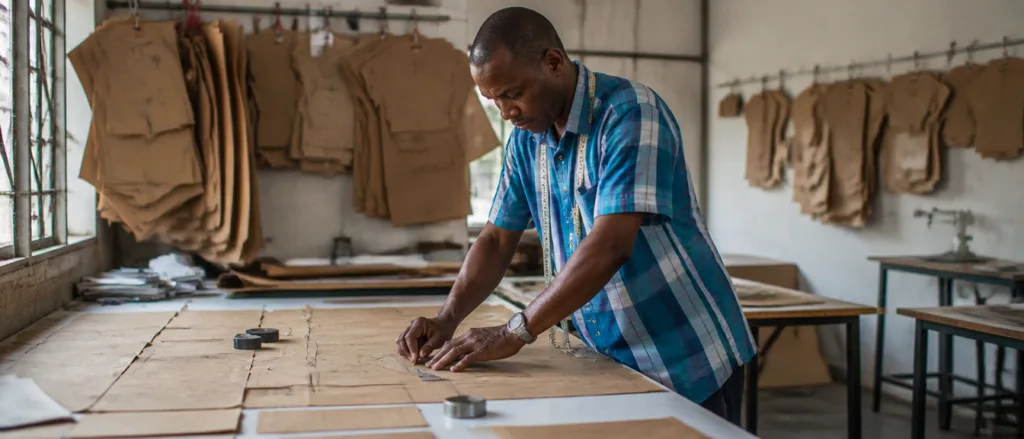
Sampling converts the tech pack into a physical garment and is where most of the learning happens. The usual sequence starts with a proto sample to check the concept and construction, followed by one or more fit samples worn on a fit model, then a size set to confirm the grading across the range. Depending on your needs, there may also be salesman samples for showroom or e-commerce photography. Each round should end with written comments, marked-up measurements and photos, so the factory knows exactly what to change.
The number of fit rounds is the biggest variable in the development calendar, and it is mostly under the buyer’s control. Clear comments, a consistent fit model and quick feedback keep it short. Sampling in the actual production fabric, or a close substitute, also avoids surprises, because the same pattern can fit very differently in a fabric with more or less stretch. Our article on OEM development and sampling explains each sample type in more detail.
Use the sampling stage to test decoration as well. If the program includes screen printing, heat transfers or embroidery, approve a strike-off on the real garment rather than a flat swatch. HANJEN handles printing and embroidery in-house, which makes it practical to adjust placement, size or colors between rounds without waiting on an outside supplier.
Stage 3: Costing and Commercial Terms
A useful quotation is an itemized one. Ask for a costing breakdown that separates fabric, trims, cut-make-trim (CMT), decoration, packaging and any testing, so you can see which decisions drive the price. Fabric is usually the largest component, which is why fabric choice, consumption per garment and fabric minimums deserve close attention. Changes such as reducing the number of colorways, standardizing trims across styles or adjusting a decoration method can often bring a style into its target price without changing what the customer sees.
| Cost driver | What influences it | Levers for the buyer |
|---|---|---|
| Fabric | Composition, weight, finish, consumption, mill minimums | Share fabric platforms across styles, keep core colors consistent |
| Trims and labels | Zippers, drawcords, elastics, branded labels | Standardize trims, consolidate label suppliers |
| Cut-make-trim | Number of operations, seam complexity, line efficiency | Simplify non-visible construction, avoid unnecessary operations |
| Decoration | Method, number of colors, stitch count, placement | Choose the method that suits volume, limit color count |
| Order structure | Quantity per style and per color, number of sizes | Concentrate volume on fewer styles and colors |
Agree commercial terms alongside the price: Incoterms, payment terms, the inspection standard and who approves pre-production samples. Order size is often a concern for newer brands. HANJEN works with a flexible MOQ, suitable for startups and growing brands, and the practical minimum for a style is usually shaped by fabric and trim minimums more than by the sewing line. Remember that for US buyers the landed cost includes duty; qualifying apparel made in Kenya enters the US duty-free under AGOA.
Stage 4: The Compliance Review
Before committing to bulk, most brands complete a social and quality compliance review of the factory. That typically means reviewing recent third-party audit reports, the factory’s policies on wages, hours, health and safety and grievance handling, and any product safety requirements that apply to your category and markets. Two common reference points are the WRAP 12 principles, which cover topics from compliance with laws to environmental practices, and SMETA, which DNV describes as an audit methodology based on the ETI Base Code, run as a 2-pillar or 4-pillar audit. SMETA is an audit, not a certification, so ask for the report and the corrective action plan rather than a certificate.
Ask for documents, check their dates and scope, and confirm that the facility named on the audit is the one that will make your goods. For HANJEN’s current audit and certification information, see our compliance and certifications page or ask our team for the documents. If your brand has its own audit program, plan it into the calendar before the pre-production stage so that results do not hold up bulk.
Stage 5: PP Approval, Bulk Production and Shipping
The pre-production (PP) sample is the final reference before bulk. It should be made with bulk fabric, bulk trims and the bulk decoration method, and once approved it becomes the standard that inline and final inspections are measured against. Approve it in writing, along with any remaining comments, and make sure both sides hold an identical sealed sample. Many quality disputes come down to a PP sample that was approved with open comments that were never closed.
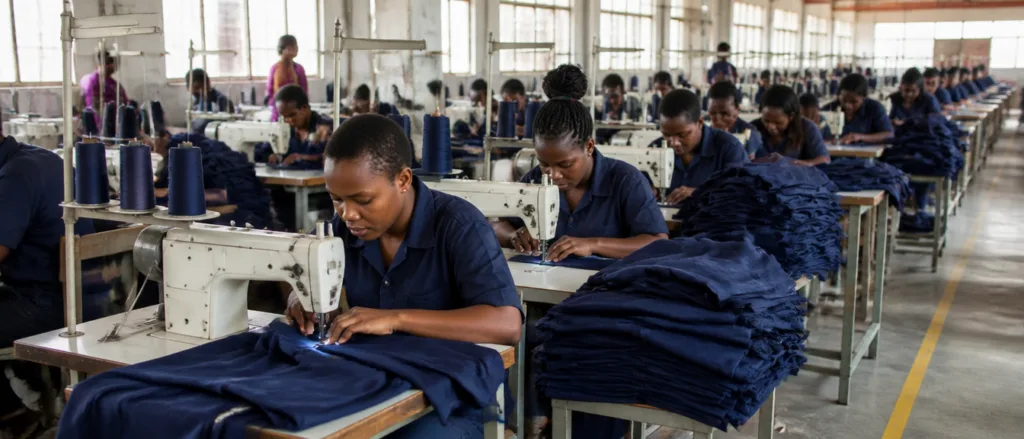
During bulk, expect a structured sequence: fabric inspection and shrinkage testing on arrival, cutting to approved markers, sewing on dedicated lines with inline checks, decoration, finishing, needle detection, final inspection and packing. At HANJEN, cutting uses Docad CAD pattern making, automatic fabric spreaders and dedicated cutting machines, and the factory has needle detectors and tensile testers on site, which supports consistency between the PP sample and bulk. Agree in advance whether you will send your own inspector or a third-party inspection company for the final audit.
Finally, the goods ship. From the factory near Mombasa, sea freight to the US East Coast takes about 25 to 27 days. HANJEN helps customers with AGOA origin documents and customs paperwork, while your US customs broker files the entry and claims the duty-free preference. After the first delivery, hold a short review covering quality, communication and timing, and use it to refine the tech pack and process for the next order.
Frequently Asked Questions
What should we send in the first inquiry for a Kenya OEM partnership?
Include the product type, target fabric, approximate annual volume, target price range, intended markets and launch season, plus any tech packs, sketches or reference garments you already have. The more specific the inquiry, the more useful the first response.
Can the factory help if we do not have a tech pack?
Yes. An OEM/ODM partner with a development team can build a tech pack from reference garments, sketches or a brief, and refine it through sampling.
How many sample rounds should we expect?
It depends on how complex the style is and how clear the feedback is. Most programs move through proto, fit and size set samples before the PP sample; clear written comments are the best way to reduce extra rounds.
What is a PP sample and why does it matter?
The pre-production sample is made with bulk materials and methods and approved before cutting begins. It becomes the reference standard for every inline and final inspection, so it should be approved in writing with no open comments.
Who handles AGOA paperwork?
HANJEN helps prepare AGOA origin documents and customs paperwork on the export side. Your US customs broker files the entry and makes the duty-free claim as the agent of the importer of record.
Conclusion: Start With Clarity, Scale With Confidence
A Kenya OEM partnership moves from first inquiry to bulk production through clear, repeatable stages: a specific inquiry, a complete tech pack, disciplined sampling, itemized costing, a documented compliance review, a firm PP approval and a controlled bulk run with AGOA paperwork prepared for shipping. Brands that invest in clarity at the start save time and cost at every stage after it. If you are ready to explore your first program with a factory in Kenya, HANJEN’s team can review your styles and propose a development plan. Contact us to send your first inquiry.