
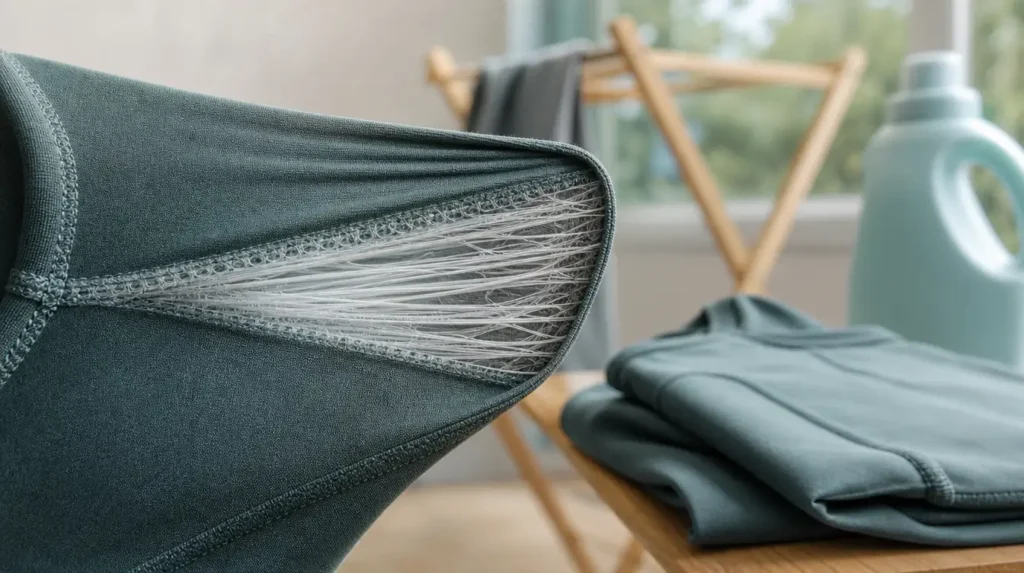
Spandex is the invisible workhorse of modern apparel. The elastic fiber that gives leggings their snap, swimwear its hug, and compression wear its supportive function makes up only 5 to 25 percent of most performance fabrics by weight, yet its degradation alone determines when a garment loses its functional life. A pair of high-performance leggings can retain its color, fabric integrity, and seam construction for years, but if the spandex elasticity collapses after 20 wash cycles, the garment becomes baggy, sagging, and unwearable for the activity it was designed for. Spandex Longevity Management is therefore one of the most consequential topics in performance apparel, affecting consumer perception of quality, brand reputation for durability, and the actual environmental footprint of the products through usable lifespan extension.
The fundamental challenge of working with spandex is that the same elastic chemistry that gives the fiber its remarkable stretch and recovery properties also makes it vulnerable to specific environmental and chemical stressors. Heat, chlorine, ultraviolet radiation, certain laundry chemicals, and mechanical fatigue all degrade spandex elasticity over time. A garment exposed to these stressors during use, washing, drying, and storage can lose 30 to 50 percent of its original elastic recovery within the first 12 to 18 months of regular use, while a garment receiving proper care can retain 80 to 90 percent of its original performance over the same period. The difference between these outcomes depends entirely on how the garment is handled, and brand customers who communicate effective care guidance to consumers see measurable improvements in product satisfaction, return rates, and repeat purchase behavior.
This guide examines the chemistry of spandex degradation, the specific care practices that preserve elasticity, the manufacturing decisions that affect spandex durability, the consumer education strategies that protect brand reputation, and the testing protocols that validate longevity claims. Each topic is examined with the practical detail needed by brand product development teams, OEM manufacturing partners, and quality assurance professionals who make daily decisions affecting spandex durability outcomes. The depth of treatment reflects the complexity of the underlying material science and the importance of the practical applications for performance apparel commercial success. The analysis draws on textile chemistry research, fiber supplier technical guidance, AATCC and ASTM testing standards, and direct manufacturing experience producing performance apparel for global brand customers.
Understanding Spandex Chemistry and Degradation Pathways
Spandex (also known as elastane in Europe and by the brand names Lycra, Creora, Roica, and others) is a synthetic fiber composed of long-chain polyurethane polymers with alternating soft and hard segments. The fiber was first developed in the 1950s by DuPont chemists led by Joseph Shivers, with commercial production beginning in 1958 under the Lycra brand. The original chemistry has been refined and extended over six decades through continued polymer engineering, additive development, and process improvement, producing the diverse modern spandex portfolio that supports applications ranging from casual athleisure to high-performance compression wear. The soft segments provide the elastic stretch behavior, while the hard segments provide the structural integrity that allows the fiber to recover its original dimensions after stretching. The molecular architecture is what enables spandex to stretch up to 5 to 7 times its original length and return to original dimensions, a performance characteristic that no other commercial fiber can match. The same architecture, however, contains specific chemical bonds that are vulnerable to degradation by particular environmental conditions, and Spandex Longevity Management requires understanding which conditions cause the most damage and how to avoid them through manufacturing and care choices. Brand teams developing performance apparel programs benefit from working with technical partners who can translate the polymer chemistry into practical manufacturing specifications and consumer guidance, bridging the gap between fundamental science and the operational decisions that determine product outcomes. The collaboration between brand teams and manufacturing partners on this technical foundation often determines whether the finished product delivers the promised durability or fails to meet consumer expectations despite using nominally appropriate materials.
The Polyurethane Polymer Structure
The polyurethane polymer that forms spandex contains urethane linkages, urea linkages, ether or ester soft segments, and various stabilizers and additives that protect the polymer chain from premature degradation. The specific chemistry varies across spandex producers and grades, with each fiber type optimized for different end-use requirements. According to Textile Exchange industry research, polyether-based spandex (the more common type for apparel applications) provides better resistance to hydrolysis and microbial attack but lower resistance to chlorine and atmospheric pollutants. Polyester-based spandex provides higher resistance to oils and certain chemicals but is more vulnerable to humidity and microbial degradation. The choice between these chemistries affects the long-term durability of the finished garment in specific use environments, and brand customers selecting spandex grades should consider the expected use conditions when making fiber selection decisions, particularly when the product portfolio includes applications with very different stress profiles such as both swimwear and casual leggings. The grade selection process typically begins with the fabric mill engaging the spandex supplier on the application requirements, with the supplier recommending specific grades that match the durability profile, processing requirements, and cost target for the brand customer’s specifications. Mature mills maintain technical relationships with multiple spandex suppliers and can provide comparative samples that allow direct evaluation of grade differences before committing to large-volume production.
The hard segments within the polymer create crystalline regions that act as physical crosslinks, holding the polymer chains together and providing the elastic recovery force. The soft segments form amorphous regions that allow the polymer chains to stretch when force is applied. The balance between hard and soft segments determines the modulus, elongation, and recovery characteristics of the fiber. Higher hard-segment content produces stiffer fibers with stronger recovery but lower maximum elongation, while higher soft-segment content produces softer fibers with greater stretch but slower recovery. Fiber suppliers offer multiple grade variations within each chemistry family, each optimized for specific application requirements including swimwear, athletic wear, intimate apparel, and shapewear. According to technical documentation from The LYCRA Company, the modern fiber portfolio includes specialized variants for chlorine resistance, heat resistance, color preservation, and recycled content applications. The proliferation of specialized grades reflects the maturation of the spandex industry over several decades, with fiber producers progressively addressing application-specific durability challenges through targeted polymer engineering. Brand customers selecting from this expanded portfolio benefit from technical consultation with fiber suppliers and fabric mills to identify the optimal grade for each application rather than defaulting to generic specifications that may not capture the available durability advantages.
Heat Degradation Mechanisms
Heat is one of the most destructive influences on spandex elasticity. The polymer chains that provide the elastic function lose their molecular order when exposed to elevated temperatures, with the damage threshold beginning at approximately 60 degrees Celsius and accelerating substantially above 90 degrees Celsius. The damage occurs through several mechanisms including thermal degradation of the urethane and urea linkages, oxidation of the polymer chains, and physical relaxation of the molecular structure that prevents full recovery after stretching. The cumulative effect of heat exposure during wear (body heat is not a significant factor), washing in hot water, machine drying at high temperatures, ironing, and storage in hot environments produces gradual elasticity loss that becomes noticeable to the wearer within months of exposure to consistent heat stress.
The temperature thresholds for spandex damage have important implications for consumer care guidance and for manufacturing process control. Wash temperatures below 30 degrees Celsius produce essentially no thermal damage to spandex, while wash temperatures of 40 to 60 degrees Celsius produce gradual but measurable damage with each wash cycle. Wash temperatures above 60 degrees Celsius produce rapid damage and should be avoided for any garment containing spandex. Tumble drying at low heat (below 50 degrees Celsius) produces moderate damage that accumulates over multiple cycles, while medium and high heat dryer settings produce rapid damage. The most spandex-friendly drying approach is air drying flat or hung, which avoids both thermal stress and the mechanical fatigue that occurs during tumble drying. Brand care labels should specify cold water washing, low heat or air drying, and avoidance of ironing for products with significant spandex content. The label requirements should be calibrated to the specific spandex content and grade, with higher-content garments warranting more cautious care guidance and chlorine-resistant grades supporting more permissive guidance for swimwear applications. The label content should also consider the consumer’s typical washing and drying environment, with guidance adapted to common consumer equipment rather than assuming professional laundering capabilities. Brands operating in markets where consumers commonly use commercial laundromats may need different guidance than brands serving consumers with home laundry equipment. Brands developing performance apparel can review production capabilities through our Leggings page where spandex applications are common.
Chemical Degradation by Chlorine, Bleach, and UV
Chemical degradation represents the second major category of spandex damage. Chlorine is particularly destructive to most spandex chemistries, attacking the urethane linkages directly and producing rapid elasticity loss in chlorine-exposed garments. The damage is most relevant for swimwear used in chlorinated pools, where consumers expose their garments to chlorine concentrations of 1 to 3 ppm during regular swim sessions. Independent laboratory studies referenced in AATCC technical publications indicate that standard spandex grades show measurable elasticity loss after 20 to 50 hours of chlorine exposure, while specialized chlorine-resistant grades including LYCRA Xtra Life can extend the durable life by 5 to 10 times. The cost premium for chlorine-resistant spandex is typically 20 to 40 percent above standard grades, and the application in swimwear is well justified by the dramatic improvement in product longevity.
Household bleach (sodium hypochlorite) damages spandex through similar chemistry to pool chlorine but at much higher concentration. Even small amounts of bleach in a wash cycle can produce immediate and severe damage to spandex elasticity, often visible as a single use destroying the elastic function. Color-safe bleach products based on hydrogen peroxide produce less spandex damage than chlorine bleach but should still be avoided for performance apparel containing spandex. Ultraviolet radiation from sunlight produces gradual oxidative damage to spandex polymer chains, with the damage rate depending on UV intensity, exposure duration, and the specific stabilizer chemistry in the fiber. Outdoor activewear used regularly in high-UV environments can experience meaningful elasticity loss over a season, and consumers should be guided to store spandex garments away from direct sunlight when not in use. The interaction between chemical and thermal degradation is often additive, with garments exposed to both stressors degrading faster than the sum of either stressor alone. The synergistic damage explains why swimwear that is washed in hot water shortly after pool exposure can show dramatic elasticity loss compared to swimwear that is rinsed in cold water immediately after use, then washed in cold water with appropriate detergents. Consumer education should specifically address these interaction effects rather than only listing individual care practices, helping consumers understand why the sequence and combination of care actions matters as much as the individual choices.
Manufacturing Decisions That Affect Spandex Durability
The choices made during fabric and garment manufacturing have substantial effects on the long-term durability of the spandex content. Fiber selection, blending ratios, knit construction, finishing chemistry, dyeing processes, and seam construction all interact with spandex performance over the garment lifespan. Brand customers and OEM partners making manufacturing decisions can dramatically improve the longevity outcomes for their products by selecting durability-supportive options at each stage, even when the immediate cost or production complexity implications are slightly less favorable. The investment in durability-focused manufacturing typically pays back through better consumer satisfaction, lower return rates, and stronger brand reputation for product quality.
Fiber Selection and Blending Ratios
The selection of spandex grade for a specific application is the foundational manufacturing decision affecting durability. Standard polyether spandex grades suit most general performance apparel applications including leggings, athletic shorts, and athleisure. Chlorine-resistant grades including LYCRA Xtra Life and Roica HF justify their cost premium for swimwear and any application where the garment will be exposed to pool chlorine. Heat-resistant grades suit applications where the garment may be exposed to elevated wash temperatures or commercial laundering, including hospital scrubs and uniform applications. Recycled spandex grades support sustainability narratives while delivering performance comparable to virgin fiber. The grade selection should match the actual end-use environment rather than defaulting to the cheapest option, since the durability difference between grades often produces a higher total cost of ownership through earlier replacement than the upfront fiber cost difference. The procurement teams making fiber selection decisions should explicitly evaluate the total cost of ownership including replacement frequency, return rate impact, and brand reputation effects rather than only the per-unit fiber cost during the initial purchase. The cost-of-ownership analysis should consider both the brand’s perspective (where higher-grade spandex supports premium pricing and lower return rates) and the consumer’s perspective (where longer product life produces lower lifetime apparel spending despite higher upfront cost). Brands communicating the durability advantage in marketing and consumer education can build pricing power that supports the upgraded fiber selection without margin compression. The consumer-facing storytelling about durability also supports the broader sustainability narrative that increasingly influences consumer purchase decisions in performance apparel categories.
The blending ratio between spandex and the dominant fiber (typically polyester or nylon) affects both the immediate stretch performance and the long-term durability. Spandex content of 5 to 8 percent provides moderate stretch and recovery suitable for everyday athleisure and casual performance wear, with relatively long durability since the smaller spandex volume produces less stress concentration during stretching. Spandex content of 10 to 15 percent provides strong stretch and recovery suitable for athletic leggings, sports bras, and performance garments, with durability that depends heavily on the spandex grade and care practices. Spandex content of 18 to 25 percent produces high compression and shaping but accelerates the elasticity loss because the higher stress per fiber during stretching produces more rapid fatigue damage. The blending ratio should match the application requirements, and brands should resist the temptation to over-specify spandex content beyond what the use case actually requires. The over-specification trap is common in development cycles where brand teams optimize for stretch performance during sample evaluation without considering the durability implications. The trap is reinforced when development team incentives focus on initial sample acceptance rather than long-term performance outcomes, since the longer-term outcomes are not visible during the sample evaluation phase that drives most development decisions. The optimal balance between stretch and durability requires testing actual products through realistic use cycles rather than only evaluating initial fabric properties, since the long-term performance differences may not be apparent in samples but become decisive in consumer experience after months of use. Brand product development processes that include extended wear testing on production-equivalent samples produce better optimization outcomes than processes that rely only on initial sample evaluation.
Knit Construction and Stitch Density
The knit construction affects how the spandex fibers experience stress during garment stretching. Single jersey constructions distribute stretch primarily through the length direction with limited width stretch, producing uneven stress on the spandex content. Double knit and interlock constructions distribute stretch more evenly across length and width directions, reducing peak stress on individual spandex fibers and supporting longer durability. Pique knit constructions create textured surfaces that distribute moisture and air flow but can produce higher stress concentration on spandex at the structural points. Warp knit constructions including tricot produce stable structures with even stretch distribution, supporting the durability requirements of swimwear and intimate apparel where spandex performance must remain consistent over many use cycles.
The stitch density and gauge of the knit affect the durability characteristics. Higher stitch density (more stitches per centimeter) produces tighter fabric structures that limit individual fiber displacement during stretching, supporting longer durability but also reducing the perceived softness and drape. Lower stitch density produces looser structures with greater stretch capability and softer hand feel but more vulnerability to spandex damage from extreme stretching. The optimal stitch density depends on the application, with compression wear typically using higher density and casual athleisure using lower density. The interaction between knit gauge, stitch density, and yarn count produces a complex optimization space where small specification changes can produce noticeable differences in fabric performance. Brand customers working with experienced fabric mills can typically iterate through 2 to 3 specification variations during the sampling phase to identify the optimal balance for the specific application, balancing stretch, recovery, hand feel, durability, and cost. The iteration investment during development pays back through better-performing finished products and stronger consumer satisfaction outcomes. The knit gauge (stitches per inch in the machine direction) interacts with stitch density to determine the overall fabric performance, and experienced fabric mills can optimize both parameters for the target application. Brand customers can review production capabilities through our Swimsuit page for high-performance knit applications.
Dyeing and Finishing Chemistry Effects
The dyeing and finishing operations during fabric production can significantly affect spandex durability. Dyeing temperatures can reach 130 degrees Celsius for polyester disperse dyeing, which produces meaningful spandex damage during the dye cycle itself. The damage is partially recoverable through subsequent processing, but cumulative damage from dyeing affects the spandex remaining elasticity at the time of garment construction. Dyeing chemistries that operate at lower temperatures, including specific reactive dyes and pigment printing approaches, produce less spandex damage but may not deliver the color depth required for certain applications. Brand customers concerned about durability should specify dye chemistry and process parameters that minimize spandex stress, working with mills that have experience optimizing the dye process for performance apparel applications. The mill’s process control during dyeing has substantial impact on the final spandex performance, and mills with mature performance apparel programs maintain dyeing protocols specifically calibrated to preserve spandex elasticity through the high-temperature dyeing cycles. The verification of process control can be conducted through testing of fabric samples at multiple points in the production process, providing data that documents the spandex performance retention through each manufacturing stage.
Finishing chemistry including softeners, anti-pilling treatments, moisture management treatments, and antimicrobial treatments can affect spandex durability through chemical interaction or through additional thermal stress during application. Some softeners contain ingredients that accelerate spandex degradation over time, while others are formulated to be spandex-compatible. The choice of finishing chemistry should consider both the immediate fabric performance and the long-term durability implications. Heat setting operations that follow finishing chemistry application produce additional thermal stress and should be optimized to deliver the dimensional stability requirements without over-exposing the spandex to elevated temperatures. The cumulative effect of dyeing and finishing decisions on spandex durability can be measured through standardized stretch and recovery testing on samples drawn from different points in the production process, providing data that supports manufacturing optimization decisions. Industry experience indicates that the dyeing stage produces the largest single impact on spandex performance retention during manufacturing, with well-controlled dyeing processes preserving 95 to 98 percent of original spandex elasticity while poorly controlled processes can reduce elasticity by 10 to 15 percent before the fabric even reaches the cutting and sewing stage. Brand customers operating with mature quality systems often establish minimum spandex performance thresholds at each manufacturing stage, ensuring that the cumulative manufacturing process does not compromise the durability that the spandex grade and fabric construction would otherwise support.
Comparing Spandex Care Practices and Their Effects
The practical impact of different care practices on spandex durability can be quantified through structured testing and field experience. The table below summarizes the relative effects of various care practices on spandex elasticity retention, providing a reference framework that brand customers can use to develop care guidance for consumers and that OEM partners can use to support brand education programs. The values are representative of typical spandex behavior under standard conditions and should be considered directional rather than precise specifications.
| Care Practice | Effect on Elasticity | Cycles Before 20% Loss | Severity Rating | Recommended Practice |
|---|---|---|---|---|
| Cold water wash (under 30C) | Minimal degradation | 100+ cycles | Low | Highly recommended |
| Warm water wash (30-40C) | Slow gradual loss | 60-80 cycles | Low-Medium | Acceptable for non-swimwear |
| Hot water wash (40-60C) | Moderate loss per cycle | 30-50 cycles | Medium | Avoid for spandex content above 10% |
| Very hot wash (above 60C) | Rapid degradation | 15-25 cycles | High | Avoid for all spandex garments |
| Air dry flat | Minimal stress | 100+ cycles | Low | Optimal drying method |
| Tumble dry low (under 50C) | Mild thermal and mechanical | 50-70 cycles | Low-Medium | Acceptable if needed |
| Tumble dry medium-high | Significant thermal damage | 20-30 cycles | High | Avoid for performance apparel |
| Chlorine pool exposure (per hour) | Direct chemical attack | 20-50 hours std grade | Very High | Use chlorine-resistant grade only |
| Chlorine bleach in wash | Severe immediate damage | 1-3 cycles | Critical | Never use with spandex |
| Fabric softener | Variable, can accelerate loss | 30-60 cycles depending | Medium | Avoid or use spandex-safe types |
| Ironing direct contact | Severe localized damage | Permanent damage from single contact | Critical | Never iron spandex content |
| UV exposure (storage in sunlight) | Cumulative oxidation | Months of constant exposure | Medium | Store away from direct sunlight |
The comparison reveals that the cumulative effect of consumer care choices can produce a 4 to 6 times difference in functional garment life between optimal care practices and poor care practices, with the difference becoming most pronounced for garments containing higher spandex content or used in more demanding conditions including swim and high-intensity training applications. A pair of leggings cared for optimally (cold wash, air dry flat, no bleach or fabric softener, no ironing, away from sunlight in storage) can retain 80 to 90 percent of original elasticity through 100 or more wash cycles. The same garment exposed to hot water washing, hot tumble drying, occasional bleach, and ironing can lose 30 to 50 percent of original elasticity within 20 to 30 wash cycles. The difference is dramatic, and brand investment in clear consumer care education produces measurable returns through improved product satisfaction and brand reputation. The returns can be quantified through metrics including average product life cycle in consumer use, reorder rates, return rates, and consumer review sentiment about durability. Brand teams establishing care education programs should set baseline metrics and track improvements over time to validate the investment and identify which education approaches produce the strongest behavior changes. The data-driven approach to care education optimization is more effective than ad-hoc content development without measurement, since different consumer segments respond differently to various educational approaches and the data identifies the most effective combinations. Brand customers can also build product packaging and labeling that reinforces the care guidance at multiple touchpoints during the product lifecycle.
Consumer Education and Care Communication
The effectiveness of Spandex Longevity Management ultimately depends on consumer behavior, since the manufacturer can build the highest-quality product possible but cannot control how the consumer cares for it after purchase. Brand investment in consumer care education therefore produces direct returns through extended product life, lower replacement frequency, and stronger consumer satisfaction with brand quality. The communication channels available include care labels, hangtags, packaging inserts, online product pages, retail staff training, post-purchase email sequences, and consumer-facing content marketing. Each channel has distinct strengths, and the most effective brands integrate care guidance across multiple touchpoints to reinforce key messages.
Care Label Effectiveness and Required Information
The care label sewn into every garment is the most universal communication channel for care guidance, since regulations in most major markets require care labeling and consumers reach the label when they need to wash the garment. The label space is limited and conventionally uses standardized care symbols rather than text, supporting international consumer recognition without language barriers. The standard symbols cover washing, bleaching, drying, ironing, and dry cleaning instructions. For spandex-containing garments, the standard symbols typically specify cold water wash, gentle cycle, no bleach, no ironing, and either tumble dry low or air dry. The label can also include written warnings for critical issues including chlorine pool exposure, fabric softener avoidance, and storage recommendations.
The challenge with care labels is that consumers often ignore them, particularly for non-luxury apparel where the consumer may not perceive the care instructions as important. Research indicates that only 30 to 50 percent of consumers actively read care labels before washing apparel, and even fewer follow the instructions consistently. Brand customers can improve label effectiveness by using clear typography, including brief written explanations alongside symbols, and reinforcing key messages through other channels. The investment in label clarity produces returns through improved consumer compliance with care instructions and reduced product damage from inappropriate care practices. Some brand customers have moved to oversized care labels with extensive written instructions to maximize the educational impact at the moment when consumers are actually making washing decisions, accepting the slight aesthetic compromise in exchange for substantially better consumer behavior outcomes. The label content optimization should be tested with target consumer segments to validate that the messaging actually drives the intended behavior changes. According to guidance from the US Consumer Product Safety Commission, care labeling for apparel sold in the United States must comply with FTC regulations including specific format and content requirements.
Packaging and Hangtag Communication
Product packaging and hangtags provide additional space for care education that consumers see during the purchase decision and immediately after. The pre-purchase exposure to care information sets consumer expectations and signals brand investment in product quality, which can support premium pricing and brand reputation. Post-purchase exposure during unboxing reinforces the care guidance at a moment when the consumer is engaged with the product and willing to absorb information. Brand customers selecting packaging approaches should balance the care education content with brand storytelling, product features, and visual presentation, recognizing that overcrowded packaging can reduce the effectiveness of any single message. The visual hierarchy and information design of care education materials affects consumer engagement substantially, with well-designed materials capturing attention and conveying messaging effectively while poorly designed materials fail to communicate even when the underlying content is accurate. The hierarchy of information should prioritize the highest-impact care guidance for the specific product category, with secondary information on additional channels including digital touchpoints and retailer education materials. Premium product programs sometimes use specialized packaging including reusable garment bags or branded care storage solutions that reinforce the care commitment while extending brand engagement beyond the immediate purchase moment.
Premium brands often include detailed care guides as printed inserts in product packaging, providing space for explanation of why specific care practices matter and how they affect product longevity. The educational approach builds consumer understanding rather than just instructing on actions, and consumers who understand the underlying reasoning are more likely to follow the guidance consistently. Some brands include QR codes on care labels and hangtags that link to online video tutorials demonstrating proper washing, drying, and storage techniques, leveraging the visual learning that reinforces written or symbolic instructions. The investment in comprehensive care education positions the brand as a trusted advisor rather than just a product seller, supporting long-term consumer relationships and repeat purchase behavior. The trust and authority that brands build through quality care education translates into consumer willingness to consider the brand for additional product categories, support price increases on premium products, and tolerate occasional product issues without damaging the overall brand relationship.
Digital and Post-Purchase Communication
Digital communication channels including email sequences, brand websites, social media content, and retailer education materials provide ongoing opportunities to reinforce care guidance throughout the consumer relationship. Post-purchase email sequences can deliver care reminders at strategic moments including immediately after purchase, after the consumer has had time to use the product, and seasonally when usage patterns may change. Brand websites can host detailed care guides, video tutorials, and interactive tools that help consumers identify the optimal care for specific products. Social media content including Instagram stories, TikTok demonstrations, and YouTube tutorials reaches consumers in their preferred content environments and can convey care information in engaging formats.
The integration of care education into broader consumer engagement supports product longevity while strengthening brand relationships. Consumers who receive consistent care guidance from a brand and experience the resulting product longevity become advocates who recommend the brand to others and write positive reviews that influence new consumers. The cumulative effect of care education investment compounds over multiple product cycles and consumer relationships, producing brand value that exceeds the direct return from any single product purchase. Brand teams operating mature consumer education programs typically integrate the care content into broader brand storytelling that connects product quality, manufacturing standards, sustainability commitments, and consumer empowerment into a unified brand narrative. The narrative integration allows brands to reinforce care messaging through marketing channels that consumers engage with for entertainment or inspiration rather than only through utility-oriented care guidance, expanding the reach and impact of the educational investment. The brand engagement metrics around care content typically show stronger consumer interest than initial product marketing predictions suggest, indicating that consumers actively want to extend product life and appreciate brands that support that goal. The integrated approach supports more memorable consumer engagement than isolated care messaging and reinforces the broader brand positioning while delivering the specific care education objective. Brands seeking to develop comprehensive care education programs can leverage manufacturing partner expertise on the technical aspects of fabric care, ensuring that the consumer guidance accurately reflects the product properties. Brand customers can connect with our team through Get A Quote to discuss care guidance development for specific product programs.
Testing Protocols for Spandex Longevity Validation
Validating spandex longevity requires structured testing protocols that quantify elasticity retention through accelerated wear simulation. The standard test methods include initial stretch and recovery measurement, repeated stretch cycling to simulate garment use, wash cycle testing to simulate consumer care, and combined wear-and-wash testing that more accurately predicts real-world durability. Brand customers establishing supplier qualification programs and quality acceptance criteria should specify the testing protocols required for fabric and garment approval, ensuring that suppliers provide documented evidence of the durability claims rather than relying on assertions alone.
Detailed testing methodology is published through ASTM International standards. The ASTM D2594 stretch and recovery test measures the elastic recovery of a fabric specimen after stretching to a specified percentage of original length. The test is typically conducted at 50 percent stretch for performance apparel applications, with recovery measured at multiple time intervals after stretch release. Recovery values above 95 percent at 30 seconds indicate strong elastic performance, values between 90 and 95 percent indicate moderate performance, and values below 90 percent indicate poor performance unsuitable for most performance apparel applications. The recovery measurement at 30 seconds correlates strongly with the wearer perception of fabric snap and shape retention during use, while longer recovery times after garment removal correlate with the perception of permanent fabric stretching that consumers describe as the garment getting baggy. Brand specifications should include recovery thresholds at multiple time points (30 seconds, 5 minutes, and 1 hour) to fully characterize the elastic behavior. The test can be conducted on initial fabric samples to establish baseline performance and on samples after wash cycle testing to quantify the elasticity loss from care practices.
The AATCC 135 wash test specifies standardized washing conditions that simulate consumer care, with the fabric or garment cycled through specified numbers of wash cycles before performance retesting. Performance apparel typically tests through 20, 50, and 100 wash cycles to characterize durability across the expected garment life. The combined wash and stretch testing provides the most accurate prediction of real-world performance, with the test results indicating whether the garment will retain functional elasticity through the intended use period. Brand customers should specify minimum performance thresholds at each test interval, providing clear criteria for fabric and garment acceptance. The thresholds should reflect realistic expectations for the application rather than aspirational targets that no commercial product can meet, supporting practical supplier relationships and rational quality decisions. The supplier relationship benefits from clear specifications and realistic expectations, since suppliers who understand exactly what is required can optimize their processes to meet the requirements consistently rather than guessing at hidden quality preferences. The mutual transparency around testing protocols and acceptance thresholds creates conditions for productive long-term partnerships rather than transactional purchasing relationships. The investment in structured testing pays back through more reliable supplier evaluation, reduced product failures, and stronger documentation supporting performance claims in marketing communications. Brand teams establishing testing programs should consider both internal laboratory capabilities and external accredited testing services, with external accredited laboratories providing independent verification that supports defensible claims and internal testing supporting routine quality monitoring at lower cost per test. The mix between internal and external testing depends on the brand’s volume, internal expertise, and the regulatory environment in target markets.
Risk Considerations and Practical Limitations
An honest assessment of Spandex Longevity Management must acknowledge several practical limitations and risks that affect product outcomes. The first limitation is that consumer care behavior is highly variable, with some consumers following care guidance meticulously while others ignore care labels entirely. Brand investment in care education improves average outcomes but cannot ensure compliance from every consumer, and product specifications should account for the realistic distribution of care behavior rather than assuming optimal care from all users. The second limitation is that even optimal care does not produce indefinite durability, with all spandex eventually degrading through gradual chemical and physical changes that no care practice can fully prevent. Realistic durability expectations should consider the natural aging of the polymer rather than promising durability that exceeds the inherent fiber life.
The third consideration is the trade-off between durability and other product properties including hand feel, drape, recovery, and cost. The most durable spandex configurations may produce stiffer garments with less ideal hand feel for certain applications, requiring brand customers to balance durability against other consumer-perceived quality attributes. Some applications including swimwear strongly favor durability, while other applications including casual athleisure may favor hand feel and drape over absolute durability. The optimization should match the application requirements and the target consumer expectations rather than applying a single durability standard across the portfolio. The fourth consideration is that durability claims in marketing communications must be supported by testing data and worded carefully to avoid creating consumer expectations that the product cannot reliably meet, since unmet durability expectations can produce reputation damage that exceeds the brand benefit of strong durability marketing.
FAQ
Why does spandex lose its elasticity over time?
A1: Spandex loses its elasticity through several physical and chemical mechanisms that affect the polyurethane polymer chains responsible for the elastic function. Heat exposure during washing, drying, and storage causes thermal degradation of the urethane and urea linkages within the polymer, breaking the molecular structure that provides elastic recovery. Chemical exposure to chlorine, bleach, certain laundry chemicals, and atmospheric pollutants attacks the polymer through different chemical pathways, producing similar functional degradation. Ultraviolet radiation from sunlight oxidizes the polymer chains, particularly affecting fibers that lack adequate UV stabilizers. Mechanical fatigue from repeated stretching produces gradual disruption of the molecular crosslinks that hold the polymer chains in their elastic configuration, reducing the recovery force over time. The combined effect of these mechanisms produces the gradual loss of elasticity that consumers observe as garments becoming baggy, sagging, or losing their shape after extended use. The rate of elasticity loss depends on the spandex grade selected, the fabric construction and finishing chemistry, the use environment, and the care practices applied. Specialized spandex grades including chlorine-resistant variants like LYCRA Xtra Life can extend the durable life by 5 to 10 times in chlorine-exposed applications, while heat-resistant grades support applications where elevated wash temperatures are expected. The combination of appropriate grade selection at the manufacturing stage and consumer adherence to spandex-friendly care practices can produce 4 to 6 times longer functional life compared to standard grade selection combined with poor care practices. The compounding effect of these decisions over multiple consumer purchases creates substantial differentiation in brand reputation and consumer perception of value, with the brands investing in both manufacturing quality and consumer education building sustained competitive advantages over brands that focus on either dimension in isolation. The integrated approach recognizes that product durability is a system outcome rather than a single-factor outcome, requiring alignment across material selection, manufacturing process control, garment construction, consumer communication, and ongoing brand engagement throughout the product lifecycle. Brand teams that build organizational capability to manage this integration across functional silos achieve outcomes that brands operating with disconnected functional approaches cannot easily replicate. The organizational investment is meaningful but pays back through compounding advantages that build over multiple product cycles, supplier relationships, and consumer engagement seasons. The cumulative result is a brand position that competitors cannot displace through tactical product or marketing initiatives, since the underlying capabilities span multiple organizational dimensions and require sustained investment to develop. The brands that have built these integrated capabilities over the past decade now occupy strong positions in performance apparel markets that newer entrants struggle to challenge despite aggressive marketing and pricing strategies, demonstrating the durable nature of the competitive advantage that this integrated approach creates. The investment horizon for building these capabilities typically spans three to five years before the full benefits become apparent, requiring patience and committed leadership rather than quarterly optimization mindsets. The brands that have demonstrated this commitment over multiple economic cycles consistently report stronger consumer satisfaction metrics, higher repeat purchase rates, and more resilient market positions during competitive challenges, validating the strategic logic of the patient investment approach.
What are the best practices for caring for spandex-containing garments?
A2: The best practices for caring for spandex-containing garments center on minimizing thermal, chemical, and mechanical stress on the spandex fibers throughout the wash, dry, and storage cycles. Wash garments in cold water (below 30 degrees Celsius) using gentle cycles or hand washing whenever possible. Use mild detergents formulated for performance apparel rather than aggressive cleaning agents, and avoid chlorine bleach and fabric softeners that can damage spandex chemistry. Rinse swimwear thoroughly in fresh water immediately after pool exposure to remove chlorine residue before it produces extended exposure damage. Air dry flat or hung whenever possible, avoiding tumble drying that combines thermal and mechanical stress. If tumble drying is necessary, use the lowest heat setting and remove garments while still slightly damp to minimize cumulative damage. Never iron spandex-containing fabrics, as the direct heat contact produces immediate and severe damage. Store garments folded or hung in cool, dry locations away from direct sunlight to prevent UV-induced oxidation. Avoid pre-soaking in detergent solutions for extended periods, as the chemical exposure compounds during the soak period. Pay particular attention to swimwear care, including thorough rinsing after pool use, hand washing rather than machine washing when possible, and selecting chlorine-resistant spandex grades during the original product purchase. Brand consumer education materials should communicate these practices clearly through care labels, packaging inserts, and digital communication channels to maximize consumer adoption. The challenge of changing established consumer behavior is meaningful, particularly for consumers who have used hot water washing or hot tumble drying for decades without considering the specific implications for spandex-containing apparel. Brand education that explains the underlying reasons for care practice recommendations tends to produce stronger behavior changes than instructions delivered without explanation, supporting the investment in educational rather than purely directive communication.
How long should consumers expect spandex garments to last?
A3: The realistic durable life for spandex-containing garments depends on the fabric construction, the spandex grade selected, the use intensity, and the care practices applied, with significant variation across different combinations of these factors. Premium athletic leggings using high-quality spandex grades and appropriate fabric construction, used 2 to 3 times per week for athletic activities and cared for following spandex-friendly practices, typically deliver 18 to 36 months of functional life before noticeable elasticity loss affects fit and performance. Standard athleisure leggings using standard grade spandex, used daily for casual activities and cared for with average consumer practices, typically deliver 12 to 18 months of functional life. Chlorine-exposed swimwear using standard grade spandex typically experiences functional life of 6 to 12 months with regular pool use, while equivalent swimwear using chlorine-resistant spandex grades can extend the functional life to 18 to 36 months. Compression garments with high spandex content (15 to 25 percent) typically deliver 12 to 24 months of functional life, with the higher stress per fiber producing faster fatigue compared to lower spandex content fabrics. Brand product page descriptions and care guidance should communicate realistic durability expectations rather than overstating product life, since unmet durability expectations damage brand reputation more than appropriately set expectations. Brands committed to product longevity often invest in higher-grade spandex and durability-focused construction, then communicate the longer expected life as a brand value proposition that supports premium pricing. The longevity-focused brand positioning has resonated particularly well with consumer segments that prioritize sustainability and value-conscious purchasing, supporting brand differentiation in markets crowded with similar-priced products that compete primarily on aesthetics and current-season appeal.
Are recycled and sustainable spandex alternatives as durable as virgin spandex?
A4: Recycled and sustainable spandex alternatives have advanced substantially over recent years and now offer durability characteristics comparable to virgin spandex when manufactured with equivalent process control and quality systems. The most established recycled spandex products use mechanical recycling of pre-consumer spandex waste from fiber production and fabric manufacturing, producing fiber that meets the same performance specifications as virgin spandex. Chemical recycling approaches that depolymerize spandex waste back to monomer components and re-synthesize new spandex are emerging but remain at small commercial scale. Bio-based spandex alternatives using polymers derived from renewable feedstocks rather than petroleum are also entering the market, with performance approaching but not yet fully matching the established petrochemical spandex products. Brand customers selecting sustainable spandex options should request technical performance data including stretch, recovery, durability after washing, and chlorine resistance where applicable, ensuring that the sustainable alternative meets the application requirements before committing to large-volume programs. The cost premium for sustainable spandex alternatives has compressed substantially as production scales have increased, typically running 10 to 25 percent above virgin spandex pricing depending on the specific product and volume. The premium is well justified by the sustainability narrative and ESG positioning that supports brand differentiation in markets where consumers increasingly value environmental responsibility, and the durability outcomes from leading sustainable spandex products are sufficient to support most performance apparel applications. Brand portfolios increasingly mix virgin and sustainable spandex across product tiers, deploying the sustainable alternatives where the brand positioning and consumer base most value the environmental story. The mixed portfolio approach allows brands to communicate sustainability progress without committing the entire portfolio to alternatives that may not yet match the cost positioning of certain product tiers. As sustainable spandex production scales further and pricing continues to compress, the percentage of brand portfolios using sustainable alternatives is expected to increase steadily, with industry projections suggesting that recycled and bio-based spandex could represent 30 to 50 percent of total apparel spandex consumption within the next five to seven years. The shift toward sustainable spandex parallels similar shifts in other apparel fiber categories including cotton, polyester, and nylon, reflecting both consumer demand and regulatory pressure for environmental progress in the apparel industry. Brand teams that establish sustainable spandex programs early gain experience with the operational implications and consumer reception, positioning themselves to scale these programs as the supply base matures and consumer expectations evolve. The early-mover advantage in sustainable spandex parallels the patterns observed in recycled polyester adoption over the past decade, where brands that committed early built capabilities that competitors continue catching up to.
How should brands communicate spandex care to consumers effectively?
A5: Effective spandex care communication requires integrating clear messaging across multiple consumer touchpoints throughout the product lifecycle, from purchase consideration through ongoing use and storage. The care label sewn into every garment provides the universal baseline communication, using standardized care symbols supplemented by brief written explanations for critical issues like chlorine pool exposure or fabric softener avoidance. Hangtags and packaging inserts offer space for more detailed care guidance during the purchase decision and post-purchase unboxing experience, with the pre-purchase exposure setting consumer expectations about product quality and care commitment. Digital communication channels including post-purchase email sequences, brand website care guides, and social media content provide ongoing reinforcement of care messaging at strategic moments including immediately after purchase, seasonally when use patterns change, and when consumers may need replacement product purchases. Video content demonstrating proper washing, drying, and storage techniques provides visual learning that complements written instructions, particularly for the next-generation consumers who prefer video content to text. Retail staff education ensures that store associates can answer consumer care questions accurately and reinforce key messages during the in-store purchase experience. Brand investment in comprehensive care education produces returns through extended product life, lower return rates, stronger consumer satisfaction, and the brand reputation for product quality that supports premium pricing and repeat purchase behavior. The investment compounds over multiple product cycles and consumer relationships, building brand value that exceeds the direct return from any single product purchase. Brands operating with mature consumer education programs typically allocate 1 to 3 percent of marketing budget to care and product use education, reflecting the strategic importance of this communication category. The allocation supports content development, channel deployment, and ongoing optimization based on consumer engagement metrics, treating care education as a sustained marketing investment rather than a one-time content creation project. Effective care education programs typically include video tutorials, written guides, retailer education materials, and integration with broader content marketing campaigns that link product care to brand values around quality, sustainability, and consumer empowerment.
Conclusion
Spandex Longevity Management is a foundational discipline in performance apparel that affects consumer perception of product quality, brand reputation for durability, and the actual environmental footprint of products through usable lifespan extension. The chemistry of spandex degradation involves thermal stress, chemical attack from chlorine and bleach, ultraviolet oxidation, and mechanical fatigue from repeated stretching, with each mechanism producing gradual elasticity loss that ultimately determines when a garment loses its functional life. Understanding these mechanisms allows brand customers and OEM partners to make manufacturing decisions and consumer education investments that produce dramatically longer functional product life and stronger consumer satisfaction.
The manufacturing decisions affecting spandex durability include fiber grade selection, blending ratios, knit construction, dyeing chemistry, finishing chemistry, and seam construction. Each decision interacts with the spandex chemistry to either preserve or degrade the long-term elasticity, and brand customers selecting durability-supportive options at each stage produce measurably better outcomes than brands defaulting to lowest-cost alternatives. The investment in durability-focused manufacturing typically pays back through better consumer satisfaction, lower return rates, and stronger brand reputation that supports premium pricing and repeat purchase behavior. The trade-offs between durability and other product properties should be managed through deliberate optimization rather than ignored, with the optimization matching the application requirements and target consumer expectations.
The consumer care practices that preserve spandex elasticity center on minimizing thermal, chemical, and mechanical stress through cold water washing, gentle cycles, air drying, avoidance of bleach and fabric softeners, and protection from UV exposure during storage. The cumulative effect of consumer care choices can produce a 4 to 6 times difference in functional garment life between optimal and poor care practices, making consumer education one of the highest-leverage investments brand customers can make to extend product life. The communication channels available include care labels, hangtags, packaging inserts, digital communication, and retail staff education, with the most effective brands integrating care guidance across multiple touchpoints throughout the consumer relationship.
Brands ready to develop performance apparel programs with comprehensive Spandex Longevity Management can connect with manufacturing partners who maintain the technical expertise, quality systems, and consumer education capabilities required to deliver durable products that consumers value. Our team can support fabric development, garment construction, and care guidance development through our Get A Quote process, drawing on over 50 years of OEM and ODM manufacturing experience and our integrated production capabilities across activewear, performance, and athleisure categories. The combination of manufacturing excellence and consumer education investment is what transforms a fabric specification into a finished garment that delivers durable performance over the full lifecycle, supporting the brand reputation for quality that drives long-term commercial success. Brands operating with this integrated approach typically achieve sustainable competitive advantages that compound over multiple product cycles and consumer relationships, with the cumulative effect on brand value substantially exceeding the direct cost of the durability and education investments. The strategic importance of these investments has increased as consumer awareness of product durability and environmental impact has grown, making spandex longevity a meaningful brand differentiation opportunity rather than just a technical consideration.