
Introduction
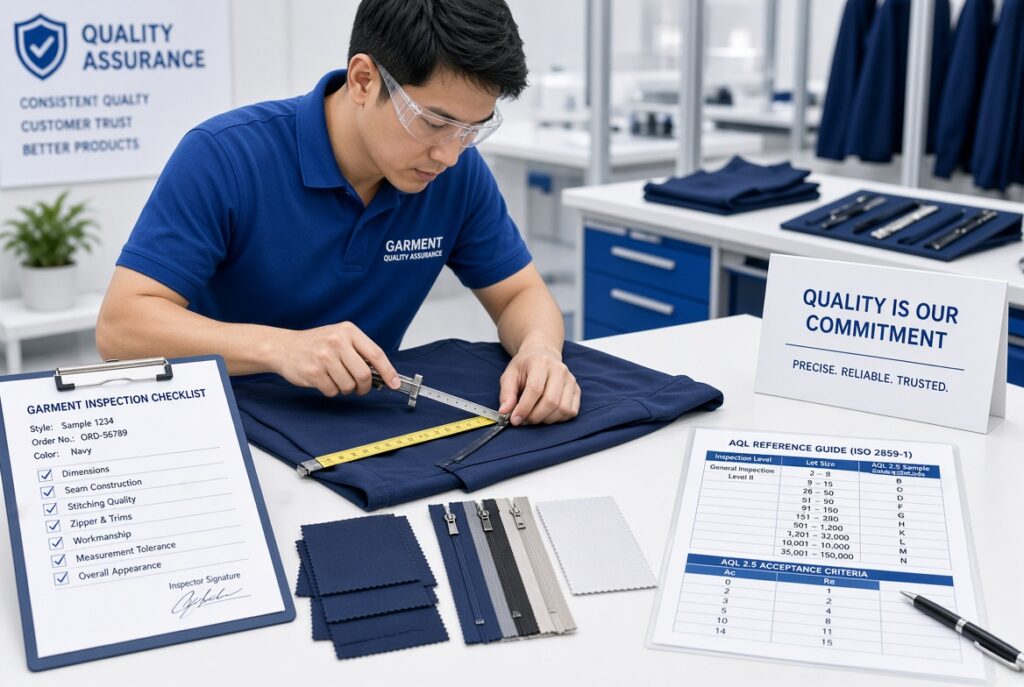
In the competitive global apparel supply chain, discovering defects after shipment can cause returns, financial losses, and reputational damage. Therefore, a complete Apparel Quality Control Checklist helps brands prevent these risks by covering every stage, from fabric inspection to finished goods. Moreover, it combines AQL sampling standards with defect classification, enabling inspectors to make objective pass-or-reject decisions. Without systematic checks during production and final inspection, however, defect rates can increase significantly and erode profits. Consequently, this article explains key inspection priorities, risk factors, alternative approaches, and practical tables and case studies. By continuously improving the Apparel Quality Control Checklist, brands can reduce customer complaints, improve product consistency, and build stronger, more reliable supplier relationships.
Understanding the Core Value and Reasons for Adopting the Apparel Quality Control Checklist
The Apparel Quality Control Checklist is a structured tool that systematically verifies garments meet technical package specifications and brand standards at every production stage. In addition, it combines statistical sampling, defect grading, and measurement tolerances into a complete process. Its main purpose is to reduce uncertainty. High factory volumes and complex processes, however, make experience-based visual checks prone to subjective bias. Therefore, a standardized checklist records fabric GSM, stitch density, size deviations, and accessory function results, creating traceable documentation. Omitting it often allows major defects such as open seams, broken zippers, or incorrect size labels to reach the market. International practice typically sets the AQL for major defects at 2.5. Smaller brands, on the other hand, can start with internal training and a simplified checklist signed jointly with suppliers. Furthermore, prioritize safety items such as metal contamination or drawstring length in children’s clothing. Reference ISO 2859-1 at https://www.iso.org/standard/1141.html. Overall, the checklist turns abstract quality requirements into quantifiable steps while balancing cost and risk.
Key Inspection Items at the Fabric and Raw Material Stage
Fabric forms the foundation of garment quality. Perfect sewing, therefore, cannot fix raw material defects. The Apparel Quality Control Checklist must cover visual defects, physical performance, and chemical compliance. Use the 4-point system on full fabric rolls, scoring 1–4 points by defect length. A total below 40 points per 100 yards is typically acceptable. Common defects include stains, holes, slubs, shade variation, and pilling. Issues found after cutting, moreover, sharply raise scrap costs. Poor colorfastness causes bleeding; excess formaldehyde or azo dyes, in addition, violate regulations. When lab time is limited, run on-site crocking tests first, then confirm externally. Prioritize GSM checks (tolerance usually ±5%), as deviations affect hand feel and drape. Table 1 summarizes core items and acceptance criteria.
| Inspection Item | Method | Acceptance Criteria | Risk Level |
| Visual Defects | 4-point full roll inspection | ≤40 points per 100 yards | High |
| GSM Weight | Sample cutting and weighing | Spec ±5% | Medium |
| Colorfastness | Dry and wet crocking test | Dry ≥4, Wet ≥3 | High |
| Shrinkage | Measure before and after wash | ±3% to ±5% | Medium |
| Odor and Moisture | Sensory and instrument | No chemical odor, moisture qualified | High |
Incorporate this table into daily operations. Reference AATCC colorfastness methods at https://www.aatcc.org/ for consistency. Execute the full checklist on every fabric lot arrival and retain photos plus data as dispute evidence. Thorough inspection, as a result, sharply cuts later rework.
Practical Methods for Size Measurement and Fit Verification
Setting Size Tolerances and Measurement Techniques
Size is the quality indicator consumers feel most directly. The Apparel Quality Control Checklist, therefore, requires sampling measurements against the points of measure in the technical package. Common points include chest, waist, length, sleeve length, and hem. Tolerances are usually set at ±0.25 to 0.5 inches depending on style and age. For children’s wear, stricter tolerances of ±0.125 to 0.25 inches apply to avoid loose fit or restricted movement. Overly wide tolerances, however, increase returns due to poor fit, while overly tight ones reduce factory yield and raise costs. Inconsistent techniques among inspectors create data deviation, so fix the same person for measuring or use a unified measurement board. An alternative is 3D scanning equipment for higher efficiency, though initial costs are higher. Symmetry checks, such as left-right sleeve length differences, often matter more than single measurements because asymmetry directly affects appearance.
Fit Try-On and Dynamic Evaluation
In addition to static sizes, try-on evaluation is needed to confirm shoulder line position, armhole comfort, and whether there is pulling during movement. This step is often overlooked but can detect pattern problems early. Practical experience shows that omitting try-on can lead to major fit defects being reported in large numbers only after shipment. External standards can reference ASTM related apparel sizing methods. Internal resources, meanwhile, can use the company try-on record forms.
Sampling Plan and Data Recording
Combine AQL sampling to determine the number of pieces measured and record deviation values for each piece to form trend analysis. If the same location exceeds tolerance across consecutive lots, the pattern or cutting problem can be reverse-inferred and the factory required to improve. This chapter emphasizes that size checks cannot rely on visual inspection alone and must be quantified to truly leverage the Apparel Quality Control Checklist.
Comprehensive Control of Sewing Workmanship and Structural Strength
Stitch Density and Stitch Quality Checks
Sewing is the core of garment durability. The Apparel Quality Control Checklist, therefore, requires calculating stitches per inch (SPI) and confirming compliance with specifications. Density that is too low easily causes open seams, while too high causes puckering. Primary stress points such as side seams and shoulder seams must consequently receive strengthened checks and pull testing. Insufficient seam strength can cause sudden opening during wear, creating safety hazards especially for children’s or sportswear. An alternative is using a simple pull tester for on-site testing.
Seam Allowance Width and Alignment Accuracy
Seam allowances must be even and correctly aligned, including collar, pockets, and placket. Professional judgment recommends using lighting to check hidden seams for skipped stitches or floating threads. External reference can be made to ISO seam strength standards at https://www.iso.org/standard/60672.html.
Pressing and Finishing Quality
Pressing must be smooth without shine or press marks, and all thread ends cleaned. This step directly affects display appearance. Omitting it can lead to store returns. In summary, sewing checks must combine functional testing with appearance evaluation to ensure structural stability.
Detailed Verification of Accessories, Labels, and Regulatory Compliance
Accessories including zippers, buttons, snaps, and decorations must function properly and be securely attached. The Apparel Quality Control Checklist requires open-close testing and pull testing (usually fixed pull force for 10 seconds). Labels must be verified for fiber content, country of origin, size, and care instructions for accuracy and compliance with target market regulations. Incorrect labels, however, can cause customs holds or consumer misuse. An alternative is first producing label proof samples before bulk production. External literature references CPSC apparel safety guidance at https://www.cpsc.gov/. Professional judgment emphasizes that children’s clothing accessories must pass small parts testing to avoid choking hazards. Although these checks appear detailed, they are often a primary reason for rejection and therefore cannot be omitted.
Final Pre-Shipment Inspection and Packaging Confirmation Process
Executing AQL Sampling and Defect Classification
Final random inspection (FRI) is conducted when production is at least 80 percent complete and packaging is finished. The Apparel Quality Control Checklist combines AQL to determine sample size and classifies defects into critical, major, and minor. Critical defects have zero tolerance, major typically AQL 2.5, and minor AQL 4.0. Statistical sampling can consequently represent the entire lot quality while avoiding the high cost of 100 percent inspection. Non-random sampling, however, may underestimate defect rates.
Packaging and Quantity Verification
Confirm folding method, polybag specifications, carton labeling, and size-color assortment ratios against the order. Packaging errors, moreover, directly affect logistics and shelf efficiency.
Odor, Moisture, and Final Appearance Re-Check
Conduct sensory checks and use needle detectors to exclude metal contamination. External reference can be made to the TradeAider textile inspection guide at https://www.tradeaiders.com/textile-and-apparel-inspection-aql-standards-common-defects-and-what-to-check.html. This process ensures no major omissions before shipment.
Practical Application of Defect Classification and AQL Standards
Defect classification is key to the effectiveness of the Apparel Quality Control Checklist. Critical defects include metal contamination, toxic chemicals, or children’s clothing safety hazards and require full lot rejection. Major defects such as size out of tolerance, broken zippers, or significant shade variation affect salability. Minor defects such as loose threads or slight shade variation are judged according to AQL. Table 2 lists common classifications.
| Defect Type | Examples | Recommended AQL | Handling Method |
| Critical | Broken needles, foreign objects, toxic dyes | 0 | Full lot rejection |
| Major | Open seams, broken zippers, incorrect size | 2.5 | Reject or rework if exceeded |
| Minor | Loose threads, slight stains | 4.0 | Release within acceptable range |
Table 3 further illustrates sampling quantity references.
| Lot Size | Inspection Level II Sample Size | Major Allowable Defects (AQL 2.5) |
| 501-1200 | 80 | 5 |
| 1201-3200 | 125 | 7 |
| 3201-10000 | 200 | 10 |
External standards can be checked in ISO 2859-1. Professional judgment recommends brands adjust AQL according to product positioning. Higher-end brands can tighten to 1.5. Without clear defect classification definitions, however, inspection results easily generate disputes, so the checklist must attach detailed example photos.
Practical Case Studies and Benefit Analysis of Implementation
Case Study 1:
Background was a mid-sized sports brand ordering 5,000 jackets from a Southeast Asian factory. The problem was multiple open seams and zipper failures discovered after the first shipment, causing 30 percent returns. The disposition immediately introduced a complete Apparel Quality Control Checklist requiring the factory to execute AQL inspections at mid-sewing and final stages and strengthen pull testing. As a result, the major defect rate reduced to 1.2 percent in the next lot, return rate dropped over 80 percent, and long-term cooperation trust was established.
Case Study 2:
Background was a fast-fashion brand with multi-style small-batch production. The problem was fabric shade variation and inconsistent sizing causing shelf delays. The disposition adopted 4-point fabric checks and mandatory size recording while sharing the checklist with suppliers. Consequently, on-time delivery rate improved and customer complaints decreased.
Case Study 3:
Background was children’s clothing exported to Europe and the US. The problem was insufficient accessory pull strength and incorrect labels. The disposition added small parts testing and dual confirmation of regulatory labels. The result was successful customs and retailer acceptance with no recall incidents. These cases demonstrate that systematic use of the checklist can quantify quality improvement and reduce risk. Early investment in inspection costs is far lower than after-sales handling expenses. When budgets are limited, first implement for high-risk styles then gradually expand. External reference can be made to the OneSilq related inspection guide at https://www.onesilq.com/blog/apparel-aql-inspection. By continuously accumulating data, brands can optimize checklist content and grow together with suppliers to ultimately build a stable quality moat.
FAQ
Q1 What is the main purpose of the Apparel Quality Control Checklist
A1 The main purpose is to systematically check fabric, sewing, sizing, accessories, and packaging against specifications at every garment production stage and combine AQL sampling to decide full lot pass or reject, thereby reducing the risk of defects reaching the market.
Q2 How to set reasonable AQL levels
A2 For general apparel, critical defects AQL 0, major defects AQL 2.5, and minor defects AQL 4.0 are recommended. Higher-end or children’s products can be stricter. Adjust according to brand positioning and target market regulations and clearly record in the checklist.
Q3 What are the most important items in fabric inspection
A3 The most important include 4-point visual defects, GSM weight, colorfastness, shrinkage, and odor checks because these directly affect subsequent processes and consumer experience. Omitting them will cause large amounts of scrap and complaints.
Q4 When should final inspection be conducted
A4 It is recommended to conduct final random inspection when production is at least 80 percent complete and packaging is finished to ensure the sample represents the entire lot and sufficient time remains for rework or replenishment.
Q5 How can small and medium brands introduce the checklist at low cost
A5 First create a simplified version of core inspection items, train internal staff or jointly sign execution with existing suppliers, then gradually add AQL and third-party sampling to control costs while accumulating experience.
Summary
Establishing and continuously optimizing the Apparel Quality Control Checklist is one of the most effective methods for apparel brands to reduce risk and improve consistency. From fabric incoming to final shipment, every stage requires quantified checks combining defect classification and sampling statistics to make objective decisions. The inspection priorities, cases, and tables detailed in this article can be applied directly, and regular review and updates are recommended to respond to new regulations and market demands. Through professional execution, brands can not only reduce return losses but also build long-term supply chain trust and consumer reputation, ultimately gaining advantages in competition.
Contact Us
If you need customized Apparel Quality Control Checklist implementation assistance or garment quality management consulting, please contact Hanjen International LTD.
Company Name: Hanjen International LTD.,
Address: 5F, No. 657-8 Chung Cheng Road, Hsin Chuang District, New Taipei City, Taiwan, Phone: +886-2-2903 7662,
Email: hanjen.intl.ltd@gmail.com.
We will provide professional evaluation and practical support to help you strengthen supply chain quality control.