
What Is FCCA Factory Capability Guide for Apparel Brands
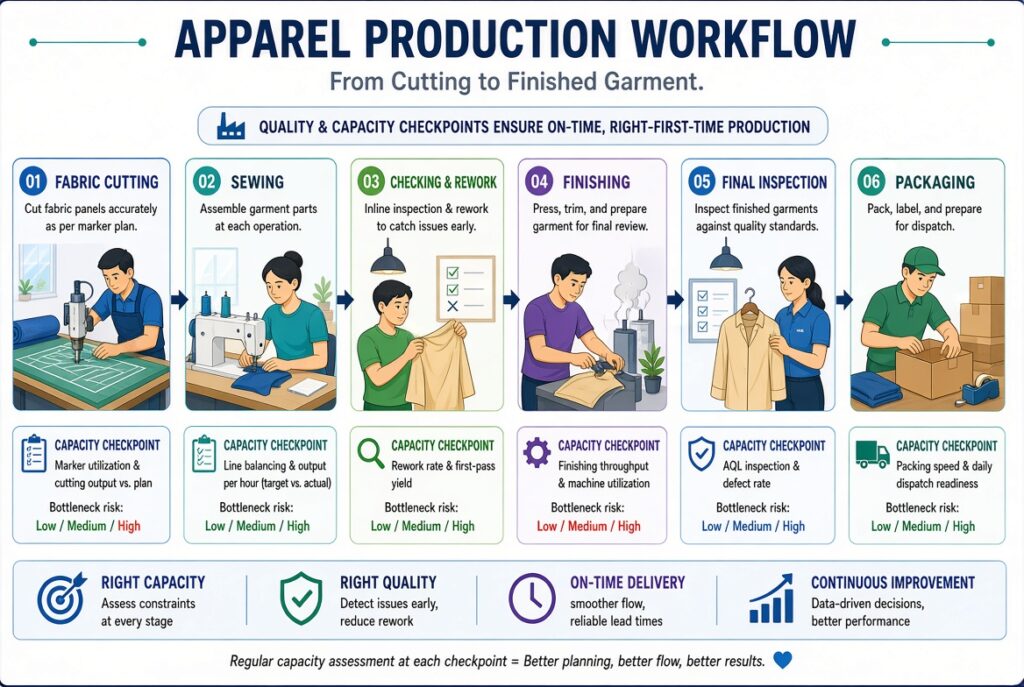
Understanding factory production readiness remains critical for apparel brands seeking reliable suppliers.
This guide explores the core elements of Factory Capability and Capacity Assessment as applied in global supply chains.
It focuses especially on garment producers serving major retailers.
Brands must evaluate whether factories can deliver required volumes safely and on schedule.
They must also meet quality benchmarks.
The assessment process helps identify strengths and gaps before committing to large orders.
External standards and third-party verification play important roles in building trust across the chain.
Professional judgment requires examining both documented systems and actual floor performance.
Risks include overstated capacity claims that lead to delayed shipments or quality failures.
Alternative approaches may involve combining this assessment with other social or environmental audits for fuller visibility.
Supporting references appear in official retailer guidance and accredited auditor materials available online.
Core Principles of Factory Capability Evaluation
Factory Capability and Capacity Assessment verifies whether a production site can manufacture products at the required volume while meeting safety and compliance standards. Auditors typically review facilities, machinery, quality systems, materials, production controls, testing, inspections, and employee training.
For apparel factories, assessments may also cover sample development, pattern making, fabric storage, cutting, sewing, printing, embroidery, washing, finishing, and packaging. Auditors evaluate documented procedures alongside actual factory practices, with critical failures potentially resulting in an unsuccessful assessment.
Preparation requires completing pre-audit questionnaires and providing relevant records, often covering the previous year. For brands, a thorough evaluation helps confirm realistic production capacity, identify risks early, and reduce potential delays. However, even high-scoring factories may require additional product-specific testing and validation before mass production.
Detailed Scope for Apparel Production Lines
Apparel production assessments cover specialized processes often missed by general factory checklists. Key areas include sample development, pattern making, fabric and trim storage, spreading, cutting, sewing, finishing, packaging, printing, embroidery, and garment washing.
Auditors review equipment condition, operator skills, inventory controls, quality checkpoints, chemical handling, and training records. Production capacity is evaluated using machine availability, labor hours, efficiency, historical output, seasonal demand, and style complexity.
Brands should ensure capacity calculations reflect real factory conditions, including downtime and learning curves for new products. Aligning documented procedures with actual production practices is critical for reliable evaluation.
For high-risk or complex products, staged capacity increases and pilot orders can help verify production capability before full-scale production.
Scoring Mechanisms and Validity Periods
Factory assessments typically combine scores across major categories to determine an overall rating. Higher scores may receive longer approval periods, while lower results often require closer monitoring and corrective action.
Critical items receiving a zero score can lead to an unacceptable result regardless of the overall percentage. Validity periods encourage factories to maintain compliance rather than treating audits as one-time events. Follow-up or unannounced reviews may also verify ongoing performance.
For brands, assessment scores indicate factory readiness but do not guarantee product-specific quality or capacity. Historical assessment data and auditor observations provide additional context for decision-making. Even highly rated factories should remain subject to ongoing quality and production monitoring. Independent capacity studies can also supplement formal assessments when brands need faster or more detailed verification.
Practical Preparation Steps for Successful Assessment
Successful assessment preparation should begin months before the scheduled visit. Factories should organize key documents, including business licenses, quality manuals, organization charts, process flows, equipment lists, calibration records, training logs, production plans, and inspection records.
Pre-audit questionnaires should provide accurate information on production capacity, machinery, labor, and processes. Internal mock audits can identify gaps early, while staff should be prepared to explain procedures clearly during interviews.
Facility readiness includes cleanliness, lighting, pest control, clear inspection areas, and properly maintained equipment. Quality systems should demonstrate independent inspections and the authority to stop production when standards are not met.
Capacity calculations should reflect realistic efficiency rather than theoretical maximum output. Early gap analysis and phased preparation can improve pass rates while reducing assessment risks and costs.
Document Checklist Essentials
A complete assessment document package should cover legal, quality, operational, equipment, and training requirements. Key records include business registration, facility plans, quality manuals, inspection procedures, production controls, non-conformance reports, equipment lists, maintenance and calibration logs, and employee training records.
Production plans and historical output data should support capacity claims. Product safety records, including pest control, sharp tool control, and metal detection, may also be required.
Documents should generally cover the most recent 12 months and be organized for quick auditor review. Digital document management can improve accessibility and version control.
Factories should ensure records are complete, accurate, current, and consistent with actual practices, as outdated or missing documentation can lead to non-conformances.
Case Study Analysis of Real Factory Outcomes
Case studies illustrate how structured preparation translates into measurable results.
Background problem disposition and outcome format reveals practical lessons.
Three distinct scenarios cover different product categories and starting maturity levels.
Common patterns include underestimation of documentation effort and overestimation of theoretical capacity.
Successful factories treat the assessment as a continuous improvement opportunity rather than a one-time hurdle.
Brands can adapt these lessons when evaluating or developing their own supplier base.
External validation comes from publicly discussed industry experiences and auditor summary reports.
Professional reasoning extracts transferable principles rather than isolated anecdotes.
Risk disclosure notes that individual results vary with product complexity and local conditions.
Alternatives include using the case insights to design internal readiness scorecards.
Case Study 1:Apparel Factory Capacity Alignment
Background involved a mid-sized garment producer seeking approval for a major retail private-label program.
The problem centered on inconsistent capacity reporting and incomplete process control records for sewing and finishing.
Disposition included a three-month internal audit program equipment calibration drive and staff retraining focused on quality authority.
Result achieved a solid mid-to-high score enabling order placement and subsequent on-time deliveries.
Capacity models were refined using actual efficiency data rather than nameplate ratings.
Follow-up monitoring confirmed sustained performance.
External references to similar apparel modules appear in industry seminar materials.
Professional analysis highlights the value of realistic capacity modeling.
Risks of incomplete preparation include delayed activation and lost sales windows.
Alternatives involve pilot production runs under buyer oversight before full assessment.
Case Study 2: Multi-Process Facility Improvement
Background covered a factory handling both cut-and-sew and specialized printing embroidery processes.
The problem was weak linkage between sample room outputs and bulk production controls plus insufficient in-house testing capability.
Disposition required investment in laboratory equipment updated work instructions and cross-training of quality staff.
Result delivered an improved score with particular strength in process control categories and longer validity period.
Brands gained confidence for more complex style placements.
Supporting data from capacity studies reinforced the numerical outcome.
External literature on multi-process audits provides parallel examples.
Professional judgment emphasizes integration across departments.
Risk disclosure includes capital cost for testing equipment.
Alternatives include reliance on qualified external laboratories when internal capability is still developing.
Case Study 3: Existing Supplier Reassessment
Background concerned a long-term supplier facing an updated assessment version with higher minimum thresholds.
The problem involved several critical questions at risk of zero scores due to outdated sharp-tool and metal-detection procedures.
Disposition focused on procedure revision physical controls and staff awareness training within a tight timeline.
Result secured continued approval after corrective action verification.
Capacity figures remained stable while quality system maturity advanced.
Brands retained supply continuity without disruption.
External updates on standard revisions inform such transitions.
Professional reasoning stresses proactive monitoring of standard changes.
Risks of delayed response include temporary deactivation.
Alternatives include temporary dual sourcing during the remediation window.
Capacity Calculation Methods and Common Pitfalls
Accurate capacity assessment requires transparent formulas that incorporate available machines standard allowed minutes efficiency factors absenteeism and planned downtime.
Simple machine-count multiplication often overstates real output.
Style complexity fabric type and order size distribution further adjust the base figure.
Historical production data provides the most reliable calibration.
Brands should request both theoretical and demonstrated capacity numbers.
Common pitfalls include ignoring learning curves for new styles or seasonal labor fluctuations.
Professional evaluation cross-checks claimed capacity against recent shipment records and current order books.
External technical papers and auditor training materials describe recommended calculation approaches.
One supporting resource is available through industry association publications.
Internal manufacturing data at experienced producers confirm the importance of efficiency tracking.
Risk disclosure covers the commercial impact of optimistic capacity commitments.
Alternatives include capacity reservation agreements with buffer percentages.
Quality System Integration Requirements
Quality management forms the foundation upon which capacity claims rest.
Documented procedures must grant inspection staff clear authority to halt production.
Traceability systems enable rapid containment of non-conforming product.
Complaint handling and corrective action processes demonstrate learning capability.
In-process and final inspection sampling plans require statistical rigor appropriate to product risk.
Independence of the quality function from production pressure is a recurring evaluation point.
Training effectiveness is verified through both records and interviews.
Brands look for evidence that quality metrics influence daily decisions.
External standards such as ISO-based systems provide useful but not identical frameworks.
Professional judgment assesses whether the system is lived rather than merely documented.
Risk disclosure includes the cost of sustaining robust quality infrastructure.
Alternatives involve hybrid models that combine internal controls with third-party inspection during ramp-up.
Risk Disclosure and Mitigation Strategies
Several risks accompany reliance on any single assessment.
Scores reflect a snapshot in time and may not capture subsequent changes in management or equipment.
Product-specific capability may still require separate validation even after a strong overall result.
Geographic and cultural differences can affect interpretation of requirements.
Cost of preparation and audit fees fall on the supplier and may influence pricing.
Brands mitigate these risks through ongoing performance monitoring dual sourcing for critical styles and periodic capacity revalidation.
Professional analysis weighs the assessment result as one input among multiple data sources.
External risk frameworks from supply-chain literature offer complementary perspectives.
Supporting references include general factory assessment guidance from recognized inspection bodies.
Internal experience underscores the value of relationship transparency.
Alternative strategies include progressive order volume increases tied to demonstrated performance.
Comparison with Related Assessment Programs
Factory Capability and Capacity Assessment differs from pure social compliance audits and from broad quality system certifications.
Social programs focus primarily on labor and ethical conditions while this assessment prioritizes production readiness and quality execution.
General quality certifications provide system frameworks but often lack the detailed capacity and process specificity required by major retailers.
Some retailers accept alternative certifications under defined conditions for existing suppliers.
Brands benefit from understanding the distinct purpose of each tool.
External comparison tables appear in consultant and auditor publications.
Professional reasoning recommends a layered approach that combines multiple assessments for comprehensive supplier insight.
Risk disclosure notes potential audit fatigue for factories facing overlapping requirements.
Alternatives include consolidated audit programs that reduce duplication where accepted by buyers.
Implementation Roadmap for Brands and Factories
Brands should embed the assessment into supplier selection and ongoing management processes.
Factories should treat readiness as a continuous discipline rather than a periodic event.
A practical roadmap includes gap analysis resource allocation mock audits document control improvement and capacity model refinement.
Timeline planning accounts for auditor scheduling and potential corrective action cycles.
Communication between brand quality teams and factory management accelerates progress.
Measurement of success includes first-pass rates capacity utilization stability and reduction in production quality issues.
External best-practice guides from accredited bodies support roadmap design.
One additional external reference is available at https://isolution.com.tw/fcca/ providing further process descriptions.
Internal capability statements can be reviewed at https://hanjen.tw/about-us/.
Professional judgment adapts the roadmap to company size and product complexity.
Risk disclosure covers resource demands of rigorous implementation.
Alternatives include staged adoption beginning with highest-volume or highest-risk categories.
FAQ
Q1 What does the core assessment stand for and who requires it
A1 It stands for Factory Capability and Capacity Assessment or Audit.
Major retailers particularly in the apparel and hardgoods sectors require it as a pre-qualification step for new factories supplying private-label or exclusive products.
Third-party auditors conduct the evaluation according to the retailer standard.
Q2 How long does a typical assessment take and what is the cost structure
A2 On-site duration usually spans one to several days depending on factory size and product complexity.
Cost is borne by the supplier and varies by location auditor firm and scope.
Preparation time often exceeds the audit itself.
Q3 What happens if a factory receives a low score
A3 Low scores or critical zero findings typically result in non-approval until corrective actions are implemented and verified.
Some ratings allow limited validity with mandatory follow-up.
Brands may delay or cancel order commitments during the remediation period.
Q4 Can other certifications replace this assessment
A4 In certain cases for existing suppliers retailers may accept alternative recognized certifications as substitutes.
New factories generally face mandatory assessment.
Brands should confirm current policy with the specific retailer.
Q5 How should brands use the results in supplier decisions
A5 Results serve as one important data point alongside commercial terms social compliance records and historical performance.
Strong scores increase confidence but do not replace ongoing monitoring and product-specific validation.
Summery
Factory Capability and Capacity Assessment provides apparel brands with structured insight into supplier readiness for volume quality and compliance.
Core principles cover facilities processes quality systems and realistic capacity modeling.
Preparation documentation accuracy and continuous improvement determine outcomes.
Case examples demonstrate practical paths from gap identification to approved status.
Capacity calculations quality integration risk management and comparison with related programs complete the professional framework.
Brands and factories that treat the process as a capability-building opportunity rather than a compliance hurdle achieve more durable supply relationships.
Supporting external literature and internal experience reinforce the value of disciplined evaluation.
Implementation roadmaps and clear risk disclosure enable informed decisions across the supply chain.
Contact us
Company Name: Hanjen International LTD.
Address: 5F, No. 657-8 Chung Cheng Road, Hsin Chuang District, New Taipei City. Taiwan
Contact Phone: +886-2-2903 7662
Email: hanjen.intl.ltd@gmail.com