
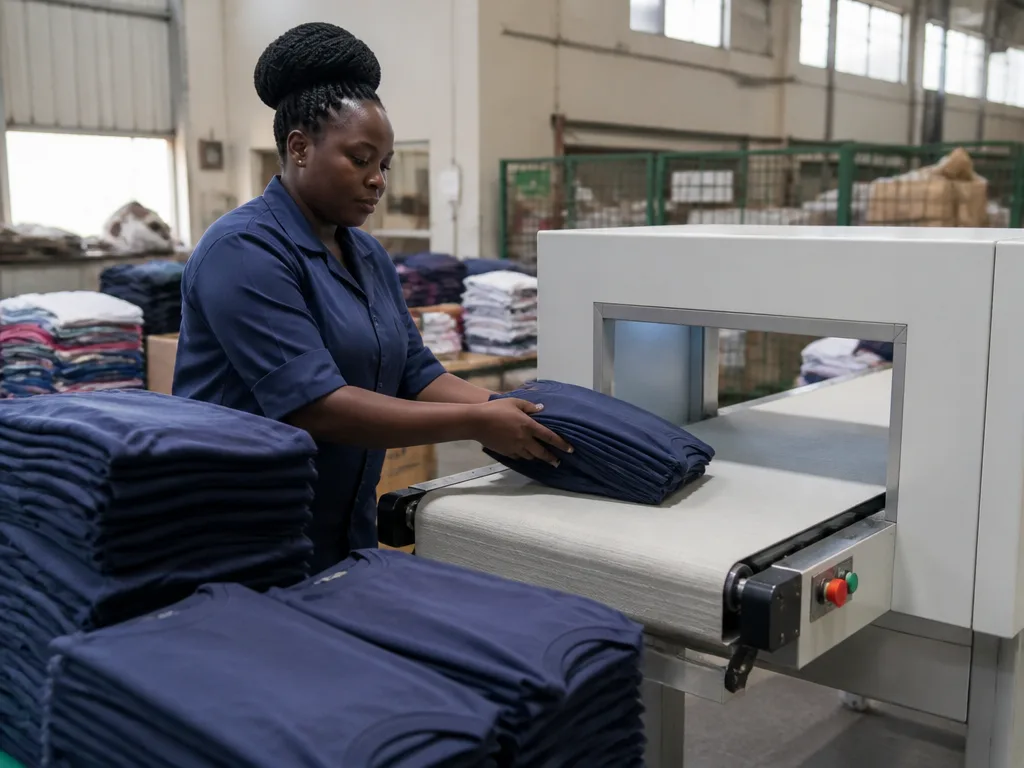
A sewing needle breaks somewhere in almost every garment factory every day. Industrial machines run at high speed, operators handle heavy seams and layered fabrics, and needles bend, blunt and snap. Most of the time the fragments are found immediately. The risk that brands and retailers worry about is the fragment that is not found and ends up inside a finished garment, where it can injure the wearer, damage the brand and trigger a recall or a retailer claim.
Needle detection is the last line of defence against that risk, but it only works as part of a wider metal control system. This article explains how that system fits together: needle control policies, broken needle procedures, sharp tool management, the types of detectors used in garment factories, where detectors should sit in the process, and how calibration and records keep the whole system honest. It is written for brand quality and compliance teams who want to know what to look for when they evaluate a supplier.
Why Needle Detection Matters
The obvious reason is safety. A needle tip in a seam or a broken fragment trapped in a hem can scratch or puncture skin, and the risk is greatest in products worn close to the body and in children’s clothing. The commercial reasons follow from that. Many retailers write metal detection into their vendor manuals, and supplier assessment checklists now ask directly about it. QIMA’s textile supplier assessment, for example, asks whether the supplier runs 100% metal detection through a conveyor-type detector with a suitable aperture, detection limit and maintenance, and whether detected metal and the actions taken are recorded (QIMA textile supplier assessment questionnaire).
There is also a quality-system reason. A factory that controls its needles well usually controls other things well. Needle records show whether procedures are followed on the floor, whether supervisors are engaged, and whether problems are investigated rather than ignored. For that reason, auditors often look at the broken needle log early in a factory visit.

The Needle Control Policy
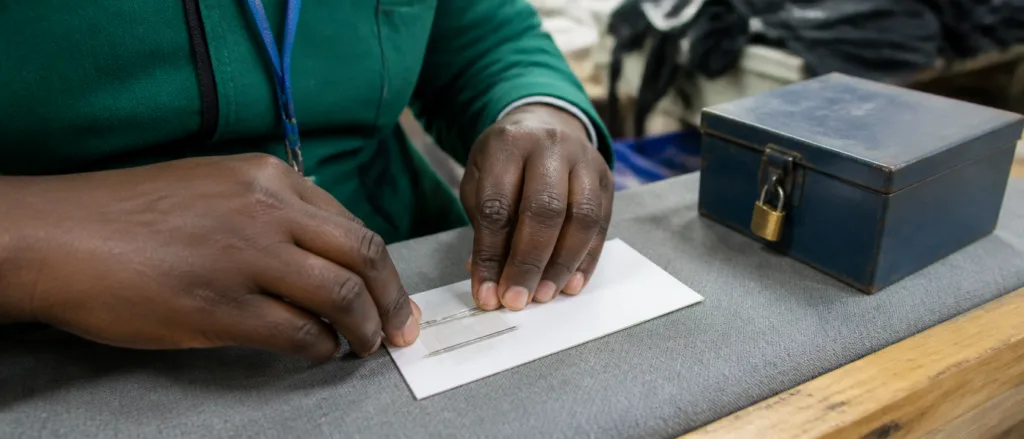
Detection catches problems; control prevents them. A sound needle control policy covers the full life of a needle, from storage to disposal. New needles should be held in a locked store under the control of a designated person, not kept loose at workstations. Operators should receive a replacement needle only in exchange for the old or broken one, on a one-for-one basis, at a designated point. Eurofins’ guidance on managing sharp objects in garment factories makes the same point: new needles are kept away from workstations, and broken needles are exchanged only at designated areas, one by one (Eurofins: managing sharp objects in garment factories).
The policy should extend to other sharp tools. Scissors, thread clippers and seam rippers should be tethered to the workstation so they cannot fall into bundles or cartons, using metal chains or wires because cord wears through. Loose blades, pins, staples and paper clips should be banned from sewing and packing areas, and the cutting room should be kept clean so that blade fragments are easy to spot. Training matters as much as rules: operators should understand why the policy exists and what to do when a needle breaks, and new staff should be briefed before they start on the line.
The Broken Needle Procedure
When a needle breaks, what happens in the next few minutes determines whether a fragment can reach a customer. The procedure should be simple enough that every operator follows it without hesitation. The table below sets out a typical sequence.
| Step | Action | Record kept |
|---|---|---|
| 1. Stop | Operator stops the machine and calls the supervisor; the garment and bundle stay at the workstation | None yet |
| 2. Recover | Operator and supervisor search the machine, garment and surrounding area until every fragment is found | None yet |
| 3. Reassemble | All fragments are laid out to confirm the needle is complete, then taped to the broken needle record | Broken needle log with date, time, line, operator and supervisor |
| 4. Exchange | Replacement needle issued one-for-one from the controlled store | Needle issue log |
| 5. Missing fragment | If any part cannot be found, the line is halted, the garment and bundle are quarantined and checked with a handheld detector, and the area is searched | Incident record with outcome and sign-off |
| 6. Review | Logs reviewed regularly for patterns by machine, operator or fabric | Review notes and corrective actions |
The record itself is the evidence. Supplier assessments commonly ask for broken needle records that have all the pieces of each broken needle stuck to them, kept for a defined period; QIMA’s questionnaire refers to keeping them for at least one year. A log full of complete needles, signed by supervisors and reviewed by quality staff, tells a buyer that the procedure is real.
Needle Detector Types and Where to Use Them
Garment factories use three main types of detector, each suited to a different job. Most are designed to detect ferrous metal, since needles are made of hardened steel, and their sensitivity is set to find fragments much smaller than a full needle.
| Detector type | How it works | Best used for | Limitations |
|---|---|---|---|
| Conveyor (tunnel) detector | Garments pass on a belt through a detection head; the belt stops or alarms when metal is detected | 100% screening of finished, folded or packed garments before cartoning | Aperture limits carton or pack size; needs regular calibration |
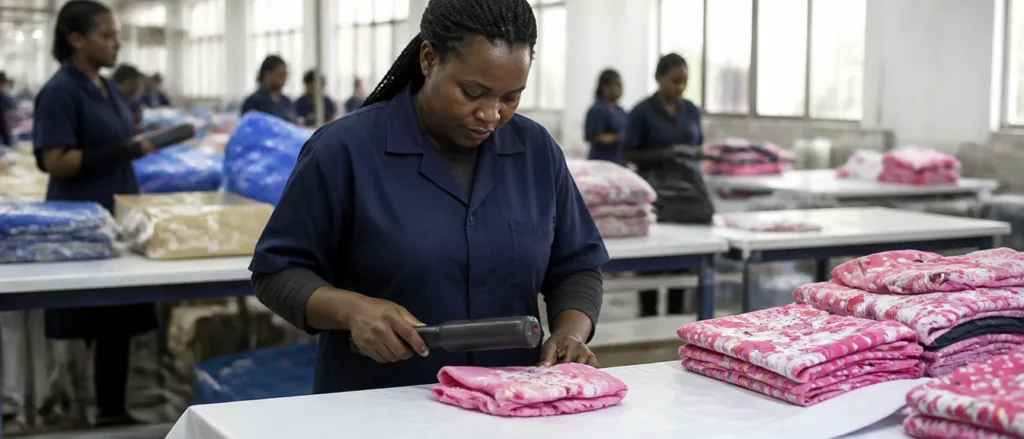
| Handheld detector wand | Operator sweeps the wand over a garment to locate metal | Locating the exact position of metal in a rejected garment; checking quarantined bundles after a missing fragment | Depends on operator technique; not a substitute for 100% screening |
| Table or flat-bed detector | Garments placed on a detection surface | Spot checks at line end or in quality areas | Lower throughput than conveyor detectors |
Placement matters as much as the machine. The ideal position for a conveyor detector is between final quality control and packing, so that every garment is checked after the last handling step that could introduce metal. Eurofins recommends that goods that fail be isolated, searched and rechecked after the metal is removed, and that the packing area be a gated, metal-free zone where tools are replaced with plastic alternatives. Some factories also screen at an intermediate stage, for example after sewing and before washing or finishing, to catch problems earlier.
Trim selection affects detection. If garments carry snaps, rivets or zippers made of ferrous metal, a ferrous-sensitive detector will alarm on every piece and the screening becomes meaningless. Brands that require 100% needle detection therefore usually specify non-ferrous trims, such as brass or aluminium, and confirm detector compatibility during development. Where a ferrous component is unavoidable, the brand and factory need to agree an alternative procedure, such as screening before the component is attached, and document it.
Calibration, Rejects, Records and HANJEN’s Approach
A detector that is not calibrated is a false reassurance. Calibration checks use certified test pieces, usually small ferrous spheres or test cards, passed through the detector at defined positions to confirm that it alarms reliably. QIMA’s questionnaire asks whether detectors are calibrated every time they are switched on using a 1.2 mm test piece and whether a nine-point calibration check is used, which tests detection across different positions in the aperture. Eurofins recommends verifying conveyor detectors several times a day. In practice, many factories check at start-up, at set intervals during each shift, after any stoppage and after maintenance, and record each check.
If a calibration check fails, everything screened since the last successful check should be re-screened once the detector has been repaired or reset. Rejected garments should go to a locked reject box, be examined with a handheld detector to find the metal, and be rechecked through the conveyor after it is removed. Each reject should be logged with what was found and where. Over time, the reject log and the broken needle log together give the quality team data on where metal is coming from and whether controls are improving.
Records for a needle detection program typically include the calibration log, the reject log, the broken needle log, the needle issue log, and training records for operators and detector staff. Buyers can reasonably ask to see recent examples of each during a factory visit.
HANJEN’s Kenyan factory near Mombasa uses needle detectors as part of its quality controls for finished goods, alongside its in-process inspections. For programs where metal detection is a buyer requirement, such as kidswear, we discuss trim choices and detection procedures at the development stage so the specification and the process match. Our quality control page explains how inspections are organised across production, and our compliance and certifications page lists the audits and certifications we can share.
Frequently Asked Questions
Is needle detection a legal requirement for apparel?
There is no single law that requires needle detection for all apparel, but many retailers and brands make it a contractual requirement, and supplier assessments ask about it. It is also a practical way to manage product safety risk, particularly for children’s clothing.
Can a needle detector find non-ferrous metal?
Most garment needle detectors are designed for ferrous metal, which is what needles are made of. Non-ferrous trims such as brass snaps generally pass without alarming, which is why brands requiring 100% needle detection often specify non-ferrous trims.
How often should a needle detector be calibrated?
Good practice is to check calibration at start-up and at regular intervals during each shift, as well as after stoppages or maintenance. Supplier assessments ask whether detectors are verified every time they are switched on, using a defined test piece.
What happens if a broken needle fragment cannot be found?
The line should stop, the affected garment and bundle should be quarantined and checked with a handheld detector, and the area should be searched. The incident should be recorded with its outcome and signed off by a supervisor before production resumes.
Does needle detection replace a needle control policy?
No. Detection is the final check, while needle control, broken needle procedures and sharp tool management prevent metal from entering garments in the first place. Buyers should look for both.
Conclusion: Detection Works Best as Part of a System
Needle detection protects garment quality and safety only when it sits inside a complete metal control system: controlled needle issue, a broken needle procedure that every operator follows, tethered sharp tools, detectors placed after final handling, regular calibration and honest records. When you evaluate a supplier, ask to see each part of that system working on the floor, not just the detector itself.
If you want to discuss metal control and inspection requirements for your next program, contact HANJEN and our team will walk you through how we handle them.