
Optimize Your Apparel Production Timeline
Introduction
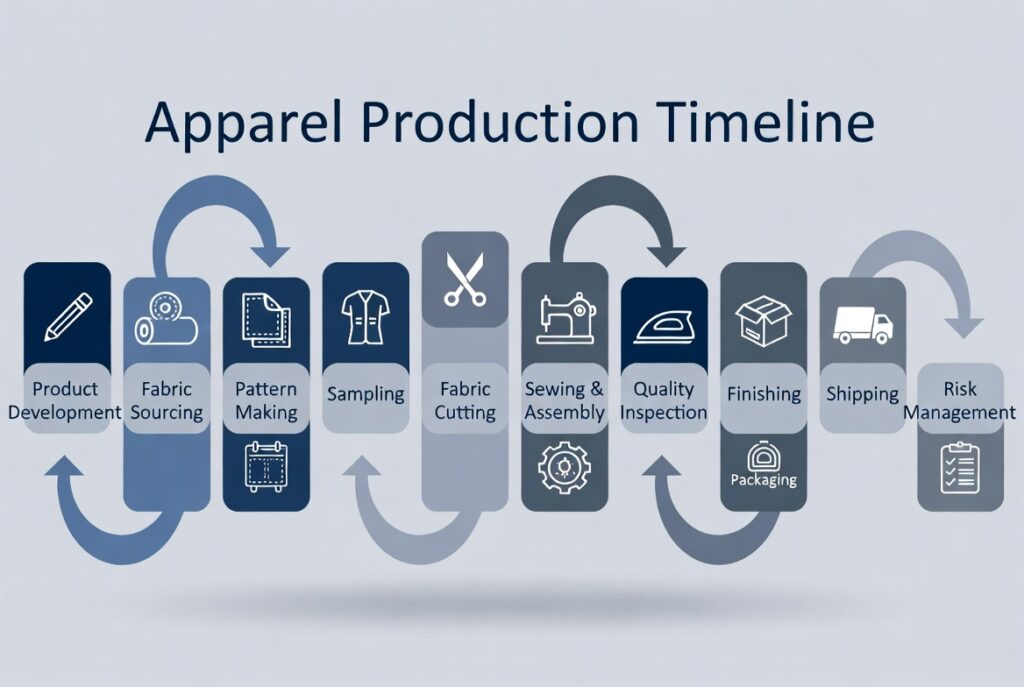
The Apparel Production Timeline is one of the most critical factors determining whether an apparel brand can deliver products on time, maintain consistent quality, and control manufacturing costs. In today’s highly competitive global apparel industry, every stage—from product development and sample making to fabric sourcing, bulk production, quality inspection, and final shipment—must be carefully planned and coordinated. A delay at any point can create a chain reaction, resulting in missed launch dates, excess inventory, increased production costs, and reduced customer satisfaction.
Many apparel brands encounter production challenges due to repeated sample revisions, unstable fabric lead times, or poor capacity planning. Without a structured timeline management strategy, these issues can quickly disrupt an entire production schedule. This guide provides a comprehensive breakdown of the complete Apparel Production Timeline, covering nine key production stages, practical optimization strategies, real-world case studies, risk assessment frameworks, and recommended solutions. By implementing systematic timeline management, apparel brands can reduce production delays, improve quality consistency, optimize costs, and build a more resilient and efficient global supply chain.
Timeline Planning for Product Development and Concept Confirmation
Product development and concept confirmation mark the starting point of the Apparel Production Timeline. This stage determines the direction and feasibility of all subsequent production activities. Brands must first clarify the target market, seasonal theme, price range, and target cost before conducting initial design sketches and fabric direction evaluations. This stage typically takes four to six weeks, depending on design complexity and internal review processes. The development team should simultaneously conduct trend research and competitor analysis to ensure the product direction aligns with market demand. Neglecting early market validation will significantly increase subsequent sample revision rounds and directly compress later production time. Professional judgment is particularly important at this stage, as excessive pursuit of innovation may result in overly complex craftsmanship that affects mass production feasibility. Regarding risk disclosure, if concept confirmation is delayed by more than two weeks, the entire seasonal launch schedule will be forced to shift backward. It is recommended to set clear deadlines and establish cross-departmental review mechanisms. Alternative solutions include using digital design tools to accelerate visual presentation or referencing past best-selling styles for minor adjustments to shorten the development cycle. According to related research from the International Textile Federation, brands with thorough early planning can save approximately 15% of time costs throughout the overall production cycle. At the end of this stage, a complete product specification sheet should be produced, including size charts, process requirements, and preliminary material lists, serving as the baseline for subsequent sample production.
Time Control for Sample Development and Confirmation Process
Sample development is the stage most prone to repetition in the Apparel Production Timeline, usually requiring two to three rounds of samples before finalization. The first round focuses on pattern and basic structure confirmation, the second on fabric effects and detail craftsmanship, and the third on final adjustments and size verification. Each sample round from order placement to receipt typically takes 10 to 15 days, plus internal review and return of revision instructions, making the entire sample stage often last six to eight weeks. Common issues include ill-fitting patterns, imprecise stitching, or fabric effects not matching expectations, leading to multiple revisions. Professional judgment is needed to evaluate revision costs versus time benefits and avoid endless perfectionism delaying progress. The risk is that delayed sample confirmation will cause capacity scheduling conflicts for subsequent bulk production, especially during peak seasons. According to guidelines from the American Apparel & Footwear Association, clear sample review checklists and responsibility assignments can effectively reduce communication errors. After this stage, the final sample should be locked and confirmation documents signed as the sole standard for bulk production.
Strategies for Controlling Sample Revision Rounds
The key to controlling sample revision rounds lies in the completeness of the early specification sheet and precision of communication. Brands should provide detailed size charts, stitching requirements, and fabric characteristic descriptions before the first sample to avoid misunderstandings from vague instructions. After each revision round, change points must be recorded and the factory required to confirm understanding, establishing a written tracking mechanism. In practice, it is recommended to limit revisions to within three rounds. Exceeding this triggers cost re-evaluation because additional sample fees and time costs often exceed expectations. This strategy can keep the average sample stage time within a reasonable range, ensuring the overall Apparel Production Timeline progress is not affected.
Coordination Management of Fabric and Trims Procurement Timeline
Fabric and trims procurement is the stage with the greatest variables in the Apparel Production Timeline. Lead times are heavily influenced by raw material supply, dyeing schedules, and international transportation. Taking transportation to a Kenya factory as an example, fabric from order placement and greige preparation to international ocean shipping arrival at the Kenya factory takes approximately 90 days, while special or customized fabrics may take even longer. Brands need to lock fabric directions in advance and conduct lab dip confirmations before placing orders based on bulk demand quantities. Common bottlenecks include fabric color differences, shrinkage rate mismatches, or delivery delays, which directly impact subsequent cutting and sewing schedules. Professional judgment should establish multi-supplier backup mechanisms to avoid single-source risks. Regarding risk disclosure, if fabric is delayed by more than two weeks, the entire production line will be forced to stop or reschedule other orders, causing additional costs. Alternative solutions include selecting stock fabrics or adjusting designs to fit materials with shorter lead times. According to related data from the International Textile Manufacturers Federation, brands that plan fabrics 12 weeks in advance have significantly higher on-time delivery rates than those placing last-minute orders. This stage requires simultaneous management of trims such as zippers, buttons, and labels to ensure they arrive in sync with fabrics.
Pre-Production Preparation and Technical Document Confirmation
The pre-production preparation stage is the critical bridge connecting samples and bulk production. In the Apparel Production Timeline, all technical documents must be locked at this point. This includes final patterns, process sheets, size charts, fabric test reports, and quality standard documents. The factory needs to produce pre-production samples based on the confirmed sample to verify consistency under mass production conditions. This stage typically takes two to three weeks, during which fabric pre-shrinking, cutting tests, and sewing process verification are conducted. A common issue is technical documents not matching the actual sample, leading to deviations during bulk production. Professional judgment requires brands and factories to jointly sign pre-production confirmation documents to clarify responsibility. The risk is that if document confirmation is done carelessly, large quantities of defects may appear after bulk production, causing rework or scrap. Alternative solutions include adopting standardized technical templates and digital file management systems to reduce human errors. According to related industry research, thorough pre-production preparation can reduce bulk defect rates by approximately 10% to 15%. At the end of this stage, all material arrival confirmations and production schedule locking should be completed.
Bulk Production Execution and Progress Monitoring
Bulk production is the core execution stage of the Apparel Production Timeline. The duration depends on order quantity, process complexity, and factory capacity. Generally, from cutting to completion of sewing including non-packaging inspection takes four to six weeks, while complex styles may extend to eight weeks. Brands need to establish progress tracking mechanisms and regularly obtain factory reports on cutting, sewing, and finishing data. Common bottlenecks include insufficient capacity, worker turnover, or quality issues leading to rework. Professional judgment should set key milestones such as cutting completion date, semi-finished product inspection date, and finished goods warehousing date, while reserving buffer time. Regarding risk disclosure, if production progress falls behind by more than one week, subsequent shipping and logistics will be affected. It is recommended to activate backup production lines or arrange overtime. Alternative solutions include distributing orders to multiple factories or adjusting delivery dates and communicating with customers. According to related literature on global supply chain management, real-time data monitoring systems can effectively improve production transparency. This stage requires simultaneous mid-term quality sampling inspections to prevent problems from accumulating to later stages.
Methods for Optimizing Capacity Scheduling
Capacity scheduling optimization needs to consider the factory’s actual load and seasonal fluctuations. Brands should confirm capacity availability with factories in advance to avoid forcibly inserting orders during peak seasons. Using rolling schedules allows dynamic adjustments based on actual progress, reducing idle time or overload. Practical recommendations include establishing capacity buffer zones, reserving 10% to 15% flexibility to handle unexpected situations. This method can enhance the stability of the Apparel Production Timeline.
Key Points for Executing Mid-Term Quality Sampling Inspections
Mid-term quality sampling inspections should be conducted when sewing is approximately 30% to 50% complete, focusing on pattern, size, stitching, and fabric issues. Sampling ratios are recommended to be adjusted according to order quantity: full inspection for small orders and sampling for large orders. When problems are found, the line must be stopped immediately to analyze root causes and formulate corrective measures. Complete inspection reports should serve as the basis for subsequent shipping decisions.
Contingency Mechanisms for Production Progress Delays
When production progress falls behind, contingency mechanisms should be activated immediately, including negotiating overtime with the factory, reallocating other production lines, or evaluating partial order early shipment. At the same time, transparent communication with customers is required to provide revised delivery date forecasts. Avoiding concealment of problems prevents greater losses.
Quality Inspection and Defect Handling Process
Quality inspection is the final checkpoint in the Apparel Production Timeline to ensure products meet standards. It is usually divided into mid-term inspection and final inspection. Final inspection is conducted after finished goods are completed and covers appearance, size, function, and packaging checks. Inspection time takes approximately one to two weeks, depending on order quantity and the strictness of inspection standards. Common defects include uneven stitching, size deviations, stains, or missing trims. Professional judgment is needed to decide on rework, downgrading, or scrapping based on defect severity. The risk is that if inspection standards are too lenient, market return rates will rise; if too strict, shipping may be delayed. Alternative solutions include introducing automated inspection equipment or third-party inspection agencies to improve fairness and efficiency. According to related international quality management standards, establishing clear defect grading and handling SOPs can effectively reduce disputes. At the end of this stage, complete inspection reports should be produced as the basis for shipping release.
Packaging, Shipping, and Logistics Coordination
The packaging and shipping stage requires completion of final packaging, label attachment, carton packing, and document preparation, taking approximately one to two weeks. In the Apparel Production Timeline, this stage must be tightly linked with logistics schedules to ensure timely boarding of ships or planes. Common issues include packaging specifications not meeting customer requirements, document errors, or tight cabin space. Professional judgment should confirm packaging instructions and logistics arrangements in advance, reserving time for document review. Regarding risk disclosure, shipping delays will generate warehouse fees and customer penalties, and in severe cases affect next-season orders. Alternative solutions include adjusting transportation methods or shipping in batches. According to related international logistics research, brands that lock cabin space three weeks in advance have significantly higher on-time rates. This stage requires completion of commercial invoices, packing lists, and certificates of origin.
Common Delay Causes and Risk Control Strategies
Delays are the most common challenge in the Apparel Production Timeline, mainly arising from repeated samples, unstable fabric lead times, capacity conflicts, and quality issues. Brands need to establish a risk matrix to evaluate the probability and impact degree of each stage. Professional judgment requires setting early warning indicators so that contingency measures are activated when progress falls behind critical points. Risk disclosure includes supplier financial instability or geopolitical impacts on transportation. Alternative solutions include diversified supply sources and inventory buffers. According to industry practical data, systematic risk control can reduce overall delay rates by approximately 20%. This chapter will illustrate actual handling methods through cases.
Real-World Case Studies and Performance Analysis
Planning an Apparel Production Timeline is not only about estimating production days—it directly affects product quality, delivery reliability, and overall manufacturing costs. The following real-world examples demonstrate how apparel brands improved production efficiency by optimizing different stages of the production timeline.
Case Study 1: Reducing Sample Development Delays
A mid-sized casualwear brand experienced repeated sample revisions before production approval. More than five revision rounds delayed bulk production by nearly three weeks, creating pressure on seasonal launch schedules.
The factory introduced standardized technical specification sheets, clarified approval responsibilities, and limited unnecessary revision cycles through structured milestone reviews.
Results
| Improvement Item | Before Optimization | After Optimization |
| Sample Revision Rounds | 5+ rounds | 2–3 rounds |
| Sample Development Time | 8–10 weeks | 5–6 weeks |
| Bulk Production Delay | 3 weeks | Eliminated |
| On-Time Delivery Rate | 82% | 95% |
Case Study 2: Improving Fabric Supply Stability
A fast-fashion brand frequently experienced fabric arrival delays, disrupting seasonal production schedules. Since overseas fabric shipments to the Kenya factory require approximately 90 days, even minor supplier delays significantly impacted manufacturing.
The sourcing team established dual-source fabric suppliers, prepared backup stock for core materials, and incorporated sufficient lead-time buffers into production planning.
Results
| Improvement Item | Before Optimization | After Optimization |
| Fabric Delay Incidents | Frequent | Reduced by 60% |
| Supplier Network | Single Supplier | Multiple Qualified Suppliers |
| Inventory Strategy | None | Safety Stock Available |
| Production Schedule Stability | Low | High |
Case Study 3: Lowering Bulk Production Defect Rates
A sportswear brand struggled with an 8% defect rate during mass production, resulting in excessive rework costs and shipment delays.
The manufacturer strengthened pre-production meetings, implemented in-line quality inspections, and increased mid-production sampling frequency to identify problems before final inspection.
Results
| Improvement Item | Before Optimization | After Optimization |
| Defect Rate | 8% | Below 2% |
| Rework Cost | High | Significantly Reduced |
| Production Efficiency | Moderate | Improved |
| Customer Satisfaction | Average | Higher |
Recommended Apparel Production Timeline
The following timeline represents a typical production schedule for international apparel manufacturing projects.
| Production Stage | Recommended Duration | Primary Activities | Common Risks |
| Product Development | 4–6 weeks | Design confirmation, Tech Pack preparation | Unclear product requirements |
| Sample Development | 6–8 weeks | Prototype creation, fitting, revisions | Excessive sample revisions |
| Fabric Procurement | Approximately 13 weeks (≈90-day shipment to Kenya) | Material ordering, fabric production, ocean freight | Supplier and logistics delays |
| Pre-Production Preparation | 2–3 weeks | PP sample approval, production planning | Specification inconsistencies |
| Bulk Production | 4–8 weeks | Cutting, sewing, finishing, in-line inspections | Capacity constraints, quality variation |
| Quality Inspection | 1–2 weeks | In-line inspection, final inspection, AQL testing | Defect rate exceeding standards |
| Packing & Shipment | 1–2 weeks | Packing, documentation, export logistics | Shipping schedule delays |
FAQ
Q1 How long does the Apparel Production Timeline usually take to complete?
A1 The complete Apparel Production Timeline from product development to shipment typically takes four to six months, depending on product complexity and order quantity. Simple basic styles can be shortened to three months, while complex craftsmanship or special fabrics may extend to more than seven months. It is recommended to reserve buffer time to handle unexpected situations.
Q2 How to effectively shorten sample development time?
A2 Shortening sample time can be achieved through complete specification sheets, limiting revision rounds, and introducing digital sample technology. At the same time, establish clear review processes and responsibility assignments to avoid repeated communication. In practice, the sample cycle can be compressed from eight weeks to around five weeks.
Q3 What alternative solutions are available when fabric procurement is delayed?
A3 Alternative solutions include switching to stock fabrics, adjusting designs to fit materials with shorter lead times, or activating backup suppliers. For the approximately 90-day situation of transportation to the Kenya factory, advance planning and sufficient buffer time reservation are required. At the same time, delivery schedules can be negotiated with customers to reduce losses.
Q4 How to handle bulk production progress falling behind?
A4 Immediately confirm the reasons for the delay with the factory and evaluate the feasibility of overtime or reallocating production lines. At the same time, transparently communicate revised delivery dates with customers and activate enhanced quality monitoring to avoid rush work affecting quality.
Q5 How to establish an effective quality control mechanism?
A5 Establishing the mechanism needs to include pre-production document confirmation, mid-term sampling inspection, and final inspection, along with clear defect grading and handling SOPs. Introducing third-party inspection can improve fairness and reduce disputes.
Summary
Completely mastering the Apparel Production Timeline can help brands shift from passive response to active control. Through systematic management of the nine stages, delay risks can be effectively reduced and quality stability improved. Every stage from product development to shipment requires professional judgment and risk awareness. Combining case experiences and data tracking, brands can build a more resilient supply chain. It is recommended that practitioners adjust timeline planning according to their own scale and product characteristics, continuously optimize efficiency in each stage, and thereby maintain advantages in the highly competitive market.
Contact Us
For further understanding of Apparel Production Timeline optimization services or customized production schedule planning, please contact Hanjen International LTD.
Company Name: Hanjen International LTD.,
Address: 5F, No. 657-8 Chung Cheng Road, Hsin Chuang District, New Taipei City, Taiwan,
Contact Phone: +886-2-2903 7662,
Email: hanjen.intl.ltd@gmail.com.
We provide professional apparel production management consulting to help brands improve on-time delivery rates and quality control capabilities.