
The seam is where most yoga wear failures begin. A pair of leggings can have premium fabric, expert pattern engineering, and elegant aesthetics, but if the seams chafe during downward dog, split during deep squats, or unravel after 30 wash cycles, the wearer experiences a product failure that defines their entire perception of the brand. The seams in yoga wear face conditions unlike any other apparel category. They must withstand four-way fabric stretch up to 50 percent in multiple directions during practice, repeated friction against the skin in sensitive body zones, sustained moisture exposure during intense practice, and the cumulative cycle of stretching, washing, and drying that occurs across the garment lifecycle. Flatseam Stitching Quality is therefore one of the most consequential disciplines in technical yoga apparel manufacturing, with direct effects on consumer comfort, garment durability, and the brand reputation that determines repeat purchase behavior in this premium product category.
The fundamental challenge of flatseam construction is the conflict between aesthetic and functional requirements. The seam must lay completely flat against the body without raised ridges that produce chafing. It must stretch with the fabric without restricting movement or creating pressure points. It must maintain its integrity through hundreds of stretch cycles without unraveling or losing dimensional stability. It must survive the chemical exposure of sweat and the thermal stress of washing and drying without degrading. Achieving these outcomes simultaneously requires precise specification of stitch type, thread selection, machinery configuration, and operator skill across the manufacturing process. The leading yoga and athleisure brands including Lululemon, Athleta, Alo Yoga, Beyond Yoga, and Outdoor Voices have built their reputations partly on the consistent seam quality that distinguishes their products from less expensive alternatives.
This guide examines the engineering decisions that determine flatseam quality, the machinery and stitch types used in technical yoga apparel manufacturing, the testing protocols that quantify seam performance, the manufacturing implications for brands sourcing yoga wear programs, and the practical implementation roadmap for brands seeking to upgrade their seam construction. The analysis draws on textile engineering research, manufacturing experience producing yoga wear and athleisure for global brand customers, and observed market practices across the leading yoga apparel brand portfolios. The depth of treatment reflects the technical complexity of the discipline and the commercial importance of getting seam construction right for brand reputation in the premium yoga apparel category, where small construction differences produce dramatic differences in consumer experience and product longevity. The premium yoga wear category has emerged as one of the most strategically important segments in performance apparel, with the leading brands building sustained competitive positions through technical excellence that supports premium pricing and consumer loyalty. Brand teams operating in this category face increasing competitive pressure from new entrants and from established performance apparel brands extending into yoga categories, making seam construction excellence one of the most defensible differentiators available.
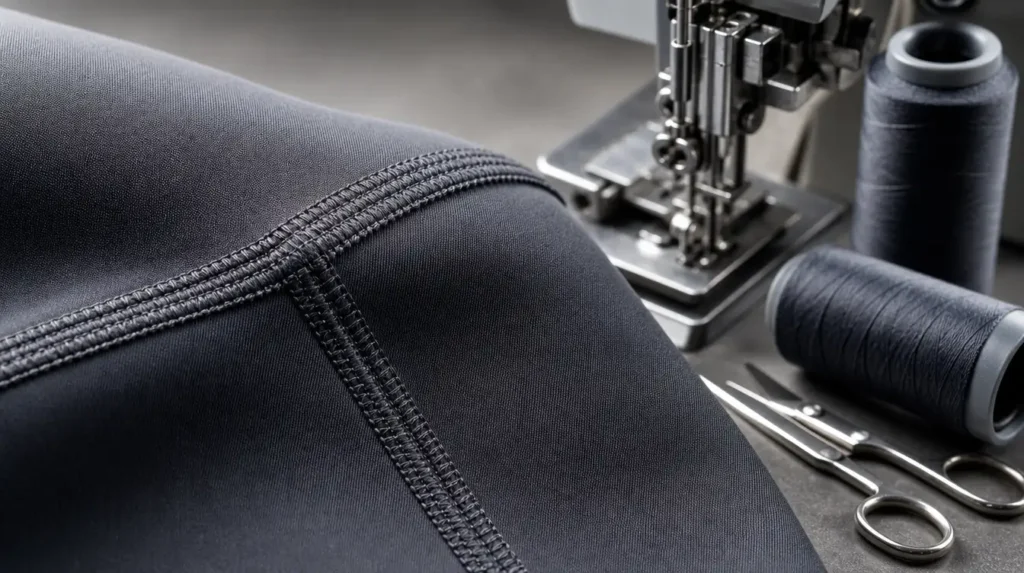
The Anatomy of Modern Flatseam Construction
Before examining the engineering decisions, it is essential to understand the anatomy of modern flatseam construction and the role each element plays in the finished assembly. The flatseam is fundamentally different from traditional sewing constructions because it joins fabric edges without overlapping them, producing a seam that lays flat against the body rather than creating a raised ridge. The visible result is a smoother, more comfortable garment that performs better under conditions of stretch and friction, but achieving this outcome requires specialized machinery, thread, and operator technique. Understanding the anatomy provides the foundation for appreciating why specific construction choices matter and how they interact to produce overall seam performance and durability outcomes.
Stitch Geometry and Thread Architecture
The most common flatseam stitch types used in yoga wear manufacturing are the 605 four-thread flatseam, the 607 six-thread flatseam, and the 602 two-needle flatlock variant. Each type uses multiple needles working with looper threads to produce a stitch that holds the fabric edges in butt configuration (edges meeting without overlap) rather than the traditional lap configuration. The 605 stitch uses two needles creating parallel rows of stitches with looper threads weaving between them on both top and bottom of the fabric, producing a moderately structured flat seam suitable for most yoga wear applications. The 607 stitch adds a third needle for additional security, producing a stronger flat seam suitable for high-stress applications including waistbands, gusseted panels, and inseams that experience extreme stretch. The 602 variant uses two needles with simpler looper architecture, producing a lighter flat seam suitable for less demanding applications.
The thread architecture within each stitch type significantly affects the seam performance and aesthetic appearance. Common thread specifications for yoga wear flatseams include Tex 27 to Tex 35 polyester threads for the needles (producing fine stitches with refined appearance) and Tex 35 to Tex 60 polyester or nylon threads for the loopers (providing the structural foundation for seam integrity). The thread fiber composition affects both the immediate seam appearance and the long-term performance, with polyester threads providing strong dimensional stability and chemical resistance, nylon threads providing superior abrasion resistance and stretch recovery, and polyester-cotton core spun threads providing balanced performance. Brand customers selecting thread specifications should match the choice to the specific seam stress profile and the brand quality positioning, with premium brands typically specifying nylon or premium polyester threads for the most demanding seam applications.
Specialized Machinery Requirements
Producing high-quality flatseams requires specialized industrial sewing machinery that differs substantially from standard lockstitch or overlock equipment. The dominant machinery brands for technical flatseam work include Yamato, Pegasus, Juki, and Brother, each producing flatseam machines with distinct capabilities and characteristics. The Yamato VC2700 series is widely used for premium yoga wear applications, supporting precise stitch length control, adjustable needle and looper tensions, and stable fabric handling for stretch fabrics. The Pegasus W664 and W664A series are common alternatives that offer similar performance with different operator interface and maintenance characteristics. The machinery investment per workstation typically runs 4,000 to 8,000 USD depending on the specific model, configuration, and any automation accessories that support production efficiency.
The machinery configuration must be precisely matched to the fabric specifications and stitch requirements for each product. Adjustments include needle size and type selection (typically ballpoint needles in sizes 65/9 to 80/12 for stretch fabrics), looper threading patterns specific to each stitch type, tension settings that balance the needle and looper threads to produce flat stitches without puckering or distortion, and feed mechanism settings that handle the specific fabric weight and stretch characteristics. The configuration process requires skilled technicians who understand both the machinery and the fabric behavior, and the configuration must be validated through sample production before committing to full production runs. According to Juki industrial machinery technical documentation, the manufacturer-recommended configuration parameters provide a starting point that should be refined through factory-specific validation testing. Brand customers can review production capabilities at our Leggings and Base Layer pages where flatseam construction is standard.
Operator Skill and Production Discipline
The skill of the sewing operator significantly affects the final seam quality, perhaps more than any other single factor in the production process. Producing consistent flatseam quality requires operators who understand the machinery setup, can detect subtle quality variations during production, can maintain consistent fabric handling across full production shifts, and can respond appropriately to fabric variations and machinery deviations as they occur. Mature manufacturing facilities operate with experienced sewing operators specifically trained on flatseam work, with progression systems that develop skills over multiple years before operators are assigned to the most demanding seam applications including premium yoga wear waistbands and gusseted panels.
The production discipline that supports consistent operator output includes regular machinery maintenance, ergonomic workstation design, environmental controls that maintain consistent fabric handling characteristics, structured break schedules that prevent operator fatigue, and clear quality feedback systems that identify issues before they produce defective products. The training investment for skilled flatseam operators is meaningful but pays back through dramatically lower defect rates and higher production yields compared to facilities that treat flatseam work as commodity work. Brand customers selecting manufacturing partners should evaluate the operator skill base and the production discipline systems carefully, since these soft factors often distinguish capable manufacturers from less capable ones more than equipment investment alone. The most reliable manufacturers maintain documented skill matrices for each operator and production line, supporting transparent capacity allocation and quality accountability. The skill matrix documentation also supports succession planning when experienced operators retire or change roles, ensuring that the production capability remains stable through personnel transitions. Mature manufacturers operate with structured operator development programs that progressively build skills from basic seam construction through advanced technical applications, with the most experienced operators reserved for the most demanding premium yoga wear programs that justify the higher labor cost. The skill development typically takes 18 to 36 months from new operator hiring to independent execution on premium technical applications, with intermediate milestones marking progress through increasing skill levels. The structured progression supports both quality outcomes and operator retention, since clear development pathways and meaningful skill recognition reduce turnover compared to facilities that treat all sewing operators as interchangeable commodity workers.
Materials and Construction Decisions
The material selection for flatseam construction interacts with the construction techniques and machinery configuration to produce the finished seam performance. Thread selection, needle specification, fabric pretreatment, and finishing chemistry all affect the durability, appearance, and consumer experience of the finished product. Brand customers and OEM partners working on yoga wear programs should understand these material decisions to make informed specifications that produce the intended seam quality at the target cost position. The interaction between materials and construction is what defines the unique performance signature of high-quality yoga wear, and the decisions cannot be made in isolation from each other.
Thread Selection and Fiber Engineering
The thread selection for yoga wear flatseams requires balancing multiple performance attributes including tensile strength, elongation, abrasion resistance, dimensional stability, chemical resistance, and color matching to the fabric. Polyester threads dominate the category due to their combination of strength, dimensional stability, and resistance to the chemical exposure that yoga wear faces during use and washing. The polyester thread specification should match the fabric color through dye lot management, with premium yoga wear programs using fully matched threads that produce nearly invisible seams against the dominant fabric color. The thread tex (a measure of thread weight) should match the fabric weight, with fine fabrics requiring fine threads and heavier fabrics supporting heavier threads.
Nylon threads offer superior abrasion resistance and elastic recovery compared to polyester, supporting applications where the seam will experience extreme stretch or repeated friction against high-friction fabrics. Nylon thread chemistry interacts with certain dyes differently than polyester, requiring careful color matching during the thread selection process. Polyester-cotton core spun threads combine a polyester core for strength with cotton outer fibers for soft hand feel, supporting applications where the thread may contact sensitive skin areas during wear. The specialty thread categories including monofilament threads for transparent seams and reflective threads for visibility applications round out the thread portfolio available for technical yoga wear construction. Brand customers selecting thread specifications should consider the specific application requirements and the brand quality positioning rather than defaulting to generic specifications across the product portfolio. The thread specification process benefits from collaboration between brand product development teams and manufacturer technical staff, with the manufacturer’s experience with various thread suppliers and grade options providing practical guidance that supplements the brand’s design intent.
Fabric Compatibility and Pretreatment
The fabric compatibility with flatseam construction varies across the major yoga wear fabric categories. Nylon-spandex blends including the Lycra and similar premium spandex variants are the dominant category, supporting strong flatseam construction with proper machinery configuration. Polyester-spandex blends offer cost-effective alternatives with similar seam performance characteristics. Recycled polyester-spandex blends support sustainability narratives while delivering equivalent seam construction outcomes. Specialty fabrics including bamboo blends, modal blends, and merino wool blends each present specific construction challenges that require fabric-specific machinery configuration and operator technique.
The fabric pretreatment can substantially affect seam construction outcomes. Heat setting during fabric finishing produces dimensional stability that supports consistent seam construction, with insufficient heat setting producing fabrics that shrink unpredictably during sewing or washing. Surface finishing including silicone-based softeners can affect needle penetration and thread tension during sewing, requiring machinery adjustment to compensate for the modified fabric handling characteristics. Some performance treatments including DWR (durable water repellent) finishes can interfere with thread bonding and seam integrity, requiring careful coordination between fabric finishing and seam construction to ensure compatible outcomes. Brand customers operating with premium programs typically specify pretreatment requirements in the fabric specification document and require manufacturers to document the actual treatment processes for transparency and quality control. The documentation supports both quality verification and root cause analysis when seam issues develop, allowing the brand and manufacturer to identify whether the root cause lies in fabric pretreatment, machinery configuration, operator technique, or other factors. The systematic approach to root cause analysis distinguishes mature quality management from reactive problem-solving that addresses symptoms without identifying underlying causes, supporting durable improvements rather than temporary fixes that may not prevent recurrence. The investment in root cause analysis methodology pays back through progressively higher quality consistency and lower defect rates over time, with the data-driven approach producing measurable improvements that brand customers can track through ongoing performance metrics. The metric tracking supports both internal accountability and brand communication, allowing the manufacturer to demonstrate quality progress to brand customers and supporting the productive long-term relationships and sustainable competitive positioning that that benefit both parties through more efficient operations, stronger commercial outcomes, and sustained quality improvements over multiple product cycles. The accumulated benefits create durable competitive advantages that compound over time, supporting the brand’s commercial success across multiple product seasons and consumer engagement cycles. The investment perspective on supplier relationships and quality systems produces stronger long-term outcomes than transactional approaches that optimize for short-term cost reduction at the expense of capability development and relationship continuity.
Seam Type Matching to Application
The choice of specific flatseam type within a single garment depends on the stress profile and aesthetic requirements of each seam location. Waistband construction typically uses the most secure flatseam types (607 six-thread or coverstitched constructions) because the waistband experiences extreme stretch during use and supports the entire garment weight. Inseam construction uses similar high-security stitches because the inseam experiences repeated friction and stretch during athletic movement. Side seams in leggings often use moderately secure stitches (605 four-thread) because the stress profile is less extreme but visibility is high. Sleeve seams in yoga tops typically use moderate-security stitches calibrated to the specific garment design and fabric weight.
The mixing of seam types within a single garment is a normal practice that should be deliberately specified rather than left to manufacturer discretion. Brand technical packages should document the specific seam type for each location, the thread specifications, the machinery requirements, and the quality acceptance criteria. This level of specification discipline supports consistent execution across multiple production cycles and supplier relationships, building the institutional knowledge that protects against quality drift over time. Manufacturers operating with mature technical package management can execute complex seam specifications consistently, while less experienced manufacturers may default to simpler constructions that compromise performance. The technical package management capability is itself a meaningful differentiator across the manufacturer base, with the most capable manufacturers maintaining detailed documentation systems that support consistent execution across product variants, seasonal updates, and personnel transitions. The default substitutions are often invisible to brand customers who do not have direct visibility into production operations, making this a particular risk for brands operating with less transparent supplier relationships. Brand teams should establish protocols that ensure specification compliance verification rather than assuming that specifications are followed automatically. The verification protocols should include random inspection of production samples, third-party testing of selected garments, and periodic audit visits to production facilities. The investment in compliance verification protects the brand quality positioning and supports productive supplier relationships through clear accountability rather than ambiguity that can produce drift over time. Brand customers can review premium yoga wear capabilities through our Swimsuit production page where similar flatseam approaches apply to high-stretch applications. The cross-application of seam construction expertise across multiple product categories supports manufacturing efficiency and capability depth, allowing manufacturers with deep technical expertise to serve brand customers across multiple yoga, athleisure, swim, and athletic apparel programs through coordinated production planning and resource allocation.
Comparing Flatseam Construction Approaches
The major flatseam construction approaches produce distinctly different performance and cost outcomes, supporting different brand positioning and price points in the yoga and athleisure category. The table below summarizes the key characteristics of the most common approaches available in the global yoga wear manufacturing market in 2026, providing a reference framework that brand customers can use to specify seams for their product programs. The values are representative of typical commercial conditions and should be validated against current factory quotations and the brand’s specific quality requirements.
| Construction Approach | Stitch Class | Typical Application | Comfort vs Skin | Stretch Capacity | Production Cost Index | Wash Durability | Brand Positioning Fit |
|---|---|---|---|---|---|---|---|
| 602 Two-Needle Flatlock | ISO 602 | Casual leggings, athleisure | Good | Moderate | 1.0x baseline | 40-60 cycles | Mid-market athleisure |
| 605 Four-Thread Flatseam | ISO 605 | Mid-tier yoga wear, athletic | Very good | Strong | 1.1-1.3x | 50-80 cycles | Mid-premium yoga wear |
| 607 Six-Thread Flatseam | ISO 607 | Premium yoga wear, high-stress | Excellent | Strong, fast recovery | 1.3-1.5x | 80-120 cycles | Premium yoga, performance |
| Coverstitch Construction | ISO 406, 605 | Hems, decorative seams | Very good | Strong | 1.1-1.3x | 60-90 cycles | Most yoga wear categories |
| Bonded Seam Construction | Heat or adhesive bonding | Premium swim, swim crossover | Excellent | Moderate to strong | 1.5-2.0x | 50-80 cycles | Premium swim, technical |
| Welded Seam Construction | Ultrasonic welding | Performance swim, technical | Excellent | Limited | 1.6-2.2x | 40-70 cycles | High-performance technical |
| Bonded Plus Stitch | Combined bond and stitch | Premium technical wear | Excellent | Strong | 1.7-2.3x | 80-110 cycles | Ultra-premium performance |
| Hidden Stitch Flatseam | ISO 605 with hidden thread | Premium yoga, refined aesthetic | Excellent | Strong | 1.3-1.5x | 70-100 cycles | Premium yoga, refined |
The comparison reveals that the construction approach should match the yoga wear positioning and target consumer expectations rather than defaulting to a single specification across the portfolio. Premium yoga wear benefits from the superior comfort and durability of 607 six-thread flatseams or coverstitch constructions, while mid-market athleisure can perform well with 605 four-thread or 602 two-needle constructions at lower production cost. The cost premium for premium constructions is moderate (typically 30 to 50 percent above baseline) and is well justified by the consumer-perceived comfort and durability benefits that drive repeat purchase behavior in this premium category. Brand teams developing yoga wear programs should engage manufacturing partners early to identify the optimal construction for the target positioning and to evaluate samples that demonstrate the construction differences before committing to large-volume production. The early engagement supports better technical decisions and stronger long-term outcomes than the alternative of finalizing specifications without manufacturing input, since manufacturing experience often surfaces practical considerations that affect both cost and quality outcomes in ways that are not visible during pure design work.
Manufacturing Process Control for Seam Quality
The execution of Flatseam Stitching Quality in production requires precise process control across multiple manufacturing stages. The variability in finished seam quality even between facilities using nominally similar specifications can be substantial, with mature facilities producing consistently high-quality seams while less mature facilities produce variable quality that disappoints consumers. Brand customers selecting manufacturing partners for yoga wear programs should evaluate the production process maturity and quality systems carefully, since the difference in finished product quality is often more important than the difference in unit cost when total cost of ownership including returns and brand reputation effects is considered.
Setup and First-Article Inspection
The production setup for each new product or material requires careful machinery configuration and validation through first-article inspection. The setup process includes selecting the appropriate machinery models for each seam type, configuring needle and looper threading according to the specifications, adjusting tensions and feed parameters for the specific fabric and thread combination, conducting test sewing on fabric samples that match the production fabric specifications, and validating the seam quality through visual inspection and basic stretch testing before initiating production runs. Mature manufacturing facilities document the setup parameters for each product and maintain the documentation as a reference for future production cycles, supporting consistent reproduction of approved seam quality across multiple production seasons. The setup documentation typically captures not just the basic configuration parameters but also the rationale behind specific choices, allowing future setup operations to benefit from the cumulative learning rather than starting fresh with each new product or season. The systematic approach to setup documentation supports the institutional knowledge that distinguishes mature manufacturing operations from less experienced facilities. The documentation also supports faster setup for repeat orders and seasonal updates, reducing the time and cost associated with each new production cycle. Brand customers operating with mature manufacturing partners typically benefit from these operational efficiencies through faster delivery cycles and more competitive pricing on repeat business. The cumulative effect of these efficiency gains makes mature manufacturer relationships substantially more valuable than the per-unit cost difference might suggest, supporting strategic supplier consolidation around the most capable partners rather than fragmented sourcing across many less capable alternatives. The consolidation approach also supports stronger negotiating positions with the consolidated supplier base, since the larger volume commitments justify the supplier investment in dedicated capability development for the brand customer’s specific requirements.
The first-article inspection examines the initial production garments produced after setup completion, verifying that the actual production output matches the approved sample specifications. The inspection includes detailed measurement of seam dimensions, visual inspection for defects including puckering, skipped stitches, thread breakage, and uneven tension, and basic stretch testing to confirm seam integrity under simulated wear conditions. Any defects identified during first-article inspection trigger immediate corrective action including machinery adjustment, operator coaching, or specification clarification. The first-article approval marks the transition from setup phase to full production phase and establishes the quality baseline against which subsequent production samples are evaluated. According to AATCC technical documentation, standardized seam testing protocols support consistent first-article evaluation across multiple supplier relationships.
In-Line Quality Monitoring
The in-line quality monitoring during production catches defects in real time, preventing the propagation of issues across full production runs. Quality control technicians walk the production lines on regular schedules, inspecting samples from each operator and machine to detect quality drift before it affects significant product volumes. Statistical process control protocols quantify defect rates by line, shift, operator, and machine, supporting data-driven decisions about resource allocation, training needs, and machinery maintenance priorities. The most effective in-line monitoring combines visual inspection by trained technicians with random sampling for laboratory testing of selected garments, providing both qualitative and quantitative quality data.
The defect classification system supports systematic quality improvement by categorizing each identified defect according to type, location, severity, and likely cause. Common flatseam defects include skipped stitches (typically caused by needle deflection or threading issues), thread breakage (caused by tension imbalance, thread damage, or fabric resistance), seam puckering (caused by tension imbalance or incorrect feed mechanism settings), uneven seam width (caused by fabric handling variation), and color mismatch (caused by thread or fabric dye lot variations). Each defect category points to specific corrective actions, with the data trends across multiple production cycles supporting targeted improvement programs that progressively reduce defect rates over time. Industry resources including American Apparel and Footwear Association publications document best practices for quality management systems in apparel manufacturing. Brand customers operating with premium yoga wear programs should request defect rate reporting from manufacturing partners as part of the ongoing quality management process.
Wash Testing and Long-Term Validation
The wash testing during product development and ongoing production validates that the seam construction maintains quality through expected consumer use cycles. The standard wash test protocols cycle the garment through repeated wash and dry sequences using standardized detergents and conditions, then evaluate the seam integrity through visual inspection, dimensional measurement, and basic stretch testing. Yoga wear seams typically should maintain visual integrity through 50 wash cycles, dimensional stability through 30 cycles, and full stretch performance through 50 cycles, with progressive monitoring through 100 cycles to characterize long-term durability. Brand specifications should include minimum performance thresholds at multiple cycle intervals to ensure comprehensive durability characterization.
The wash testing should also include real-world simulation testing that combines wash cycles with stretch cycles to simulate the cumulative stress of regular use. Some testing programs include garments worn during simulated yoga sessions or athletic activities, then washed multiple times, then evaluated for the combined effects of wear and washing. The combined testing produces more accurate predictions of consumer experience than either testing protocol in isolation, supporting more informed brand decisions about product specifications and supplier qualification. Reference standards from ASTM International provide consistent testing methodologies that support comparable evaluation across multiple supplier relationships. The testing investment is meaningful but typically represents less than 1 percent of garment cost, with returns from avoiding quality failures substantially exceeding the testing cost. The testing infrastructure can be maintained internally by brand product development teams or accessed through accredited third-party laboratories, with most brands using a combination of internal and external testing depending on the specific testing requirements.
Implementation Roadmap for Brands Adopting Premium Flatseam Construction
Brands seeking to upgrade their yoga wear seam construction can follow a structured implementation roadmap that balances technical investment with commercial considerations. The roadmap typically extends across two to four product seasons depending on the brand’s volume profile, supplier relationships, and capability development priorities. The first phase focuses on assessment and specification, the second phase on supplier engagement and sample development, the third phase on pilot production and validation, and the fourth phase on full ramp-up and continuous improvement. Each phase builds the capabilities and confidence needed to execute the next, supporting durable transitions rather than one-time tactical changes that may not stick over time. The patient implementation approach also helps brand teams build organizational capability for ongoing seam construction excellence rather than depending on individual heroic efforts that may not scale across product portfolios. The capability-building investment compounds over multiple product cycles, supporting brand resilience and sustained competitive positioning through changing market conditions and competitive challenges. The capability investment becomes a strategic asset that supports the brand’s ability to respond to market opportunities and challenges with greater agility than competitors who lack equivalent capabilities. The agility advantage proves particularly valuable during competitive challenges and market shifts, when brands with strong capability foundations can adapt and respond while competitors struggle to maintain operational stability through the disruption. The cumulative effect over multiple market cycles tends to widen the competitive gap between capable brands and less capable competitors, supporting the strategic logic of investment in fundamental capability development. Brand teams committed to long-term competitive positioning should treat seam construction excellence as a foundational investment rather than as a tactical optimization, building the supplier relationships, technical specifications, and quality systems that produce durable competitive advantages over multiple product cycles and changing market conditions across the long term.
Phase 1: Current State Assessment and Target Specification
The assessment phase begins with detailed evaluation of current product seam construction across the yoga wear portfolio, including documentation of stitch types, thread specifications, machinery requirements, and observed performance against consumer expectations. The assessment should include analysis of consumer reviews and return data to identify specific quality issues and prioritize improvement opportunities, with particular attention to feedback patterns that point to seam-related problems. The current state documentation provides the baseline against which improvements will be measured, supporting clear progress tracking through the implementation timeline. The assessment also identifies the gap between current capability and target capability, informing the magnitude of investment and timeline required to close the gap.
The target specification phase translates the brand quality vision into specific technical requirements that suppliers can execute consistently. The specification document should detail the stitch class for each seam location, the thread tex and fiber composition, the machinery and machinery settings, the operator skill requirements, and the quality acceptance criteria. The specifications should be calibrated to the brand positioning and target consumer expectations, with premium positioning supporting more demanding specifications while mid-market positioning accepting more cost-conscious alternatives. The specification calibration is one of the most important decisions in the implementation roadmap, since over-specification produces unnecessary cost while under-specification fails to deliver the quality improvement that justifies the investment. Brand teams should engage technical experts including manufacturer technical staff during the specification process to ensure that the requirements are achievable and commercially sensible.
Phase 2: Supplier Engagement and Sample Development
The supplier engagement phase identifies and evaluates manufacturing partners capable of executing the target specifications consistently. The supplier evaluation should examine equipment capabilities including specific flatseam machinery models and configurations, operator skill base including documented skill matrices and training programs, quality control systems including in-line monitoring and statistical process control, certification status including WRAP, SMETA, and applicable category certifications, and reference customer feedback including actual production samples and quality history documentation. Brand customers should visit candidate supplier facilities directly during the evaluation process, observing actual production operations rather than relying solely on supplier-prepared materials.
The sample development phase produces initial samples to the target specifications, validating both the supplier capabilities and the specification appropriateness through actual production. Samples should be produced in conditions that match expected production conditions rather than under special development conditions that may not be sustainable in volume production. The sample evaluation should include detailed inspection by brand technical staff, comparative testing against existing product samples and competitive samples, wear testing in realistic conditions, and wash testing through cumulative wash cycles to validate durability. The sample development typically requires 2 to 4 cycles of refinement before producing samples that meet all specifications consistently, and brands should plan adequate time for this iteration rather than rushing to production with samples that have not been fully validated.
Phase 3: Pilot Production and Phase 4: Full Ramp-up
The pilot production phase produces a defined initial volume, typically 10 to 30 percent of the planned annual program, to validate the supplier’s ability to execute at production scale, confirm landed cost economics, and surface any operational issues before full ramp-up. The pilot production exercises the full production cycle including order processing, fabric and trim procurement, production scheduling, manufacturing operations, quality control, and shipping, providing realistic experience that supports informed decisions about full-scale production. The pilot also serves as the basis for ongoing production performance benchmarking, with the pilot production quality serving as the baseline against which subsequent production performance will be compared.
The full ramp-up phase systematically transitions volume from existing supplier relationships into the qualified premium flatseam supplier base, capturing the quality and brand reputation benefits across an increasing share of the total portfolio. Brands should expect that the ramp-up does not proceed in a perfectly linear fashion, with seasonal demand patterns, supplier capacity constraints, and ongoing quality refinement work creating natural variation in the volume transition cadence. Successful programs typically achieve 70 to 90 percent of the targeted annual volume in the first full season after pilot completion, then close the remaining gap in the second season as operational refinements drive consistency improvements. The continuous improvement work continues indefinitely, with regular quality reviews, supplier development activities, and specification refinements supporting sustained quality outcomes over multiple product cycles.
Risk Considerations and Practical Limitations
An honest assessment of Flatseam Stitching Quality must acknowledge several practical limitations and trade-offs that brand customers should incorporate into their decision-making. The first consideration is the fundamental trade-off between seam comfort and seam strength, with the most comfortable flat seams sometimes lacking the structural strength of traditional construction approaches. Brands committed to maximum comfort positioning may need to accept moderate compromises in pure tensile strength to achieve the chafing-free experience that defines premium yoga wear, requiring careful matching of construction choice to garment design and use case rather than pursuing maximum performance on a single dimension.
The second consideration is that even excellent flatseam construction does not produce indefinite durability, with all yoga wear seams eventually showing signs of wear after extended use. Realistic durability expectations should consider the natural aging of the materials and the cumulative stress of repeated stretch and wash cycles, with the goal being graceful aging rather than indefinite preservation. The third consideration is that flatseam construction interacts with other garment elements including the fabric specifications, the pattern engineering, the trim and elastic specifications, and the finishing operations. Optimizing one element in isolation can produce unexpected effects on the integrated garment performance, requiring holistic design thinking rather than component-by-component optimization.
The fourth consideration is that consumer care practices substantially affect seam longevity, and brand investment in manufacturing quality should be matched by investment in consumer care education to maximize the return on the manufacturing investment. The fifth consideration is that supplier capabilities for flatseam construction vary substantially across the industry, with the cost difference between capable and less capable manufacturers often smaller than the quality difference, making capable manufacturer selection one of the highest-leverage decisions in yoga wear program management. Brand customers should not assume that all manufacturers can execute premium flatseam construction at consistent quality levels, since the equipment investment, operator training, and quality systems required for consistent results represent meaningful capability gaps in the industry. The capability evaluation during supplier qualification should be rigorous and evidence-based, with brand teams verifying actual production capabilities rather than relying on supplier marketing materials or generic facility certifications that may not reflect specific yoga wear manufacturing capabilities. The evaluation should include direct observation of production operations, examination of recent production samples, review of quality history documentation, and conversations with reference customers who have worked with the supplier on similar product categories. The investment in thorough evaluation produces more reliable outcomes than purely document-based assessments. The investment in thorough supplier evaluation pays back through more reliable quality outcomes and stronger long-term commercial results.
FAQ
What is the difference between a flatseam and a regular sewn seam?
A1: A flatseam differs from a regular sewn seam in both construction technique and finished performance characteristics. Regular sewn seams use lap construction where two fabric edges are placed on top of each other and stitched together, producing a seam with raised ridges where the fabric layers overlap. The lap construction creates a structurally strong seam but produces visible ridges against the body that can cause chafing during athletic activity, particularly in body areas with skin-on-skin contact or where garments fit closely against the skin. Flatseam construction uses butt configuration where the two fabric edges meet without overlapping, joined by stitches that span across the gap between edges to hold them together. The butt configuration produces a seam that lays completely flat against the body with no raised ridges, eliminating the chafing risk that affects traditional construction in active wear applications. The flatseam construction requires specialized machinery (typically using stitch classes 602, 605, or 607 according to ISO standards) and produces seams that perform exceptionally well under conditions of stretch and friction. The trade-off is that flatseam construction typically requires moderately higher production cost due to the specialized machinery and operator skill requirements, but the comfort and durability benefits justify the cost premium for yoga wear and athletic apparel where direct skin contact and stretch performance are critical to consumer experience. Brand customers selecting between construction approaches should consider the application requirements and target consumer expectations rather than defaulting to the lowest-cost option, since the construction choice substantially affects consumer perception of garment quality and brand reputation in performance apparel categories. The visual differences between flatseam and traditional construction become apparent to consumers within seconds of physical inspection, making seam construction one of the quality cues that consumers can recognize even without specific apparel manufacturing knowledge.
How does Flatseam Stitching Quality affect yoga wear durability?
A2: Flatseam Stitching Quality affects yoga wear durability through several interconnected mechanisms that determine how long the garment maintains its performance and appearance under regular use. The primary durability factor is seam integrity through repeated stretch cycles, since yoga and athletic movements create cumulative stress that progressively weakens seams in lower-quality constructions. Premium flatseam construction can withstand 80 to 120 wash cycles plus regular stretch cycling while maintaining full seam integrity, while lower-quality construction may show seam failure after 40 to 60 cycles. The thread quality contributes substantially, with premium polyester or nylon threads providing superior elastic recovery and abrasion resistance compared to budget threads that may break or stretch permanently under sustained use. The needle and looper tension calibration during machinery setup determines whether the seam stitches lay flat without creating stress concentration points that fail prematurely, with proper setup producing balanced stitches that distribute stress evenly along the seam length. The operator skill level during production affects the consistency of stitch quality across the full seam length, with skilled operators producing uniform stitches while less experienced operators may produce variable quality that creates weak spots vulnerable to early failure. The machinery maintenance discipline ensures that timing, tension, and feed mechanisms remain calibrated through full production runs, preventing the gradual quality degradation that occurs when machinery drifts out of specification. Brand customers seeking maximum yoga wear durability should specify premium thread types and high-end flatseam constructions (607 six-thread or hidden stitch variants) for high-stress seam locations, then validate the supplier’s capability through detailed quality audits and ongoing production testing to confirm consistent execution against the specifications. The validation protocols should test seam performance under conditions that simulate actual consumer use rather than only standardized laboratory conditions, since real-world stress profiles often differ meaningfully from idealized test conditions in ways that affect seam durability outcomes.
Why do some yoga wear brands use bonded seams instead of stitched flatseams?
A3: Bonded seam construction has emerged as an alternative to stitched flatseam construction for certain premium yoga wear and swimwear applications, with each approach offering distinct advantages and trade-offs. Bonded seams use heat-activated adhesives or ultrasonic welding to join fabric edges without stitching, producing seams that are even smoother against the skin than stitched flatseams and that have no thread that could potentially cause irritation. The bonded construction is particularly well-suited for swim crossover applications where the garment may be worn in chlorinated water that can degrade thread chemistry over time, and for ultra-premium yoga wear applications where the brand positioning emphasizes maximum comfort and refined aesthetic. The trade-offs include higher production cost (typically 50 to 100 percent above stitched flatseam construction), longer development cycles due to specialized adhesive selection and process validation, and somewhat reduced repair options if seam issues develop after consumer use. The bonded construction also has limitations in stretch capacity, with most bonded seams providing less stretch than stitched flatseams, which can affect performance in extreme stretch applications. Some premium brands use combined bonded plus stitch construction that integrates both technologies for maximum durability and comfort, accepting the higher cost in exchange for superior performance across multiple dimensions. Brand customers selecting between bonded and stitched flatseam approaches should consider the specific application requirements, target consumer expectations, brand positioning, and cost target rather than defaulting to a single technology across the portfolio. Different applications within a single brand portfolio may benefit from different seam construction approaches, with premium technical wear using bonded construction and casual yoga wear using stitched flatseam construction at lower price points. The portfolio-level optimization recognizes that different products serve different consumer needs and command different price positions, allowing the brand to deploy premium construction technologies where they create the most consumer-perceived value while using cost-effective alternatives where the construction differentiation is less commercially important. The mixed approach also supports manufacturing flexibility and supply chain resilience.
What testing protocols validate yoga wear seam quality?
A4: Validating yoga wear seam quality requires structured testing protocols that quantify the performance attributes that consumers actually experience during regular use. The standard test methods address tensile strength, stretch capacity, abrasion resistance, dimensional stability through wash cycles, and overall appearance grading. The seam tensile strength testing applies progressive force to the seam until failure, quantifying the force required to break the seam compared to specifications appropriate to the application. Yoga wear seams typically should support tensile loads of 50 to 100 N for casual applications and 100 to 200 N for high-stress applications including waistbands and inseams. The stretch capacity testing measures how far the seam stretches before showing damage, with quality seams supporting 50 to 70 percent stretch without permanent damage and 80 percent stretch without immediate failure. The abrasion resistance testing simulates the friction that seams experience against skin and other fabric during wear, with proper testing using standardized abrasion equipment that produces quantified results comparable across different fabrics and constructions. The dimensional stability testing through wash cycles uses AATCC 135 or equivalent protocols to quantify any seam shrinkage or distortion through repeated washing, with quality seams showing less than 3 percent dimensional change through 5 wash cycles. The visual appearance grading provides subjective but important characterization of seam aesthetic quality after wear and washing, with trained graders evaluating finished garments using standardized scales. Brand customers should specify minimum performance thresholds at multiple test points to ensure comprehensive characterization, and should require manufacturers to provide certified test data from accredited laboratories. The combination of testing protocols supports informed brand decisions about supplier qualification and ongoing quality monitoring. Brand teams operating with mature quality systems often establish specific test result targets at multiple wash cycle and stretch cycle intervals, providing clear performance benchmarks that suppliers can use to calibrate their internal quality systems. The standardized targets also support objective supplier comparison during the qualification process, supporting data-driven supplier selection rather than relationship-based decisions that may not produce optimal outcomes.
How can brands ensure that suppliers consistently deliver premium flatseam quality?
A5: Verifying supplier flatseam quality consistency requires structured evaluation protocols that combine sample testing, manufacturing audits, ongoing production monitoring, and consumer wear testing. The most reliable approach starts with detailed specifications in the product technical document, including the exact stitch class for each seam location, the thread tex and fiber composition, the machinery requirements, the operator skill level expectations, and the quality acceptance criteria for finished seams. Each fabric and thread submission should be accompanied by supplier certification documentation, with the specifications matched to the brand requirements. Manufacturing audit visits during the supplier qualification process should examine the flatseam machinery inventory and configuration, the operator skill matrices and training programs, the quality control systems and defect classification protocols, and the wash testing capabilities for ongoing validation. Brand customers should observe production operations directly during audit visits to verify that the actual production practices match the documented procedures, since supplier documentation can sometimes diverge from actual practice over time without proactive monitoring. Ongoing production monitoring should include periodic sample testing through standardized seam protocols, with results compared against the original qualification samples to detect any drift in supplier performance. The data-driven approach to supplier monitoring builds accountability and supports productive long-term relationships rather than purely transactional purchasing arrangements. Brand customers should also establish clear corrective action procedures with manufacturing partners, ensuring that any quality issues identified through monitoring trigger immediate analysis and corrective action rather than being absorbed into ongoing production. The structured verification approach supports the long-term supplier relationships that produce the consistent quality outcomes that brand customers ultimately need for sustained competitive positioning in the premium yoga wear category. Brand teams should view supplier verification as relationship-building rather than purely as quality protection, recognizing that suppliers who understand and respect the brand’s quality standards become better partners over time. The mutual investment in transparency and accountability creates conditions for productive long-term collaboration that benefits both parties through more efficient operations, stronger commercial outcomes, and the sustained brand reputation that supports premium positioning across multiple product seasons. The relationship maturity also supports faster response to quality issues when they do occur, since established communication patterns and mutual trust accelerate problem resolution compared to relationships that lack these foundations.
Conclusion
Flatseam Stitching Quality is one of the most consequential disciplines in technical yoga apparel manufacturing, with direct effects on consumer comfort, garment durability, and the brand reputation that determines repeat purchase behavior in this premium product category. The seams in yoga wear face conditions unlike any other apparel category, requiring precise specification of stitch type, thread selection, machinery configuration, and operator skill across the manufacturing process. The difference between excellent and mediocre seam construction is dramatic and consumer-perceptible, even when consumers cannot articulate the specific quality differentiators they are responding to during purchase decisions and product use.
The engineering decisions affecting seam quality span multiple construction stages and material choices. Stitch type selection determines the fundamental architecture of the seam, with options including 602 two-needle, 605 four-thread, 607 six-thread, coverstitch, bonded, and welded constructions each producing distinct performance characteristics. Thread selection affects both immediate performance and long-term durability, with polyester, nylon, and core spun thread options each offering specific advantages. Machinery configuration determines whether the production execution matches the specification intent, requiring skilled technicians and disciplined setup procedures. Operator skill ultimately determines whether the production output meets the specification requirements, making operator training and skill development critical to consistent quality outcomes.
The major construction approaches available in the global yoga wear manufacturing market support different brand positioning and price points, with premium yoga wear typically using 607 six-thread flatseams or coverstitch constructions, mid-market athleisure using 605 four-thread or 602 two-needle constructions, and ultra-premium technical wear using bonded or combined bonded plus stitch constructions. The cost premium for premium constructions is moderate and is well justified by the brand differentiation and consumer-perceived quality benefits. Brand teams developing yoga wear programs should engage manufacturing partners early in the design process to identify the optimal construction for the target positioning and to evaluate samples that demonstrate the construction differences before committing to large-volume production.
Brands ready to develop yoga wear programs with engineered Flatseam Stitching Quality can connect with experienced manufacturing partners who maintain the technical capabilities, quality systems, and category expertise required for the major yoga wear segments. Our team can support program development, sampling, and production through our Get A Quote process, drawing on over 50 years of OEM and ODM manufacturing experience and our integrated production capabilities across yoga, athleisure, athletic, and performance categories. The combination of engineered seam construction and disciplined manufacturing execution is what transforms a yoga wear specification into a finished garment that delivers the comfort and durability experience consumers expect from premium yoga apparel brands. The investment in quality flatseam engineering produces returns through stronger consumer satisfaction, lower return rates, and sustained brand reputation that supports long-term commercial success in this competitive product category. Brands committed to premium yoga wear positioning should prioritize Flatseam Stitching Quality as a foundational competitive differentiator and should invest in the manufacturing partnerships, specifications, and quality systems that support consistent delivery of the seam quality that defines the premium category. According to ISO standards documentation, the international classification of stitch types provides the common language that supports consistent specification and execution across global supply chains. Brand investment in seam engineering excellence represents one of the highest-leverage opportunities to differentiate yoga wear products in retail environments where consumers compare multiple options on subtle quality cues that drive purchase decisions and long-term brand loyalty patterns. The brands that have invested most heavily in seam engineering excellence have built durable competitive positions in the premium yoga wear category that cost-driven competitors cannot easily challenge through pricing strategies alone. The investment horizon for building these capabilities typically spans multiple product cycles and supplier relationships, requiring committed leadership and sustained organizational focus rather than tactical optimization mindsets. The brands that maintain the commitment over time consistently achieve outcomes that competitors operating with shorter time horizons cannot replicate, building cumulative competitive advantages that compound across product seasons and consumer relationships in ways that produce sustained commercial success. The competitive advantages include not only product quality and brand reputation but also operational efficiency, supply chain resilience, and the organizational learning that supports rapid response to market changes. The integrated nature of these advantages makes them particularly difficult for competitors to replicate through targeted initiatives, since the underlying capabilities span multiple organizational dimensions and require sustained investment over multiple years to develop fully.