
The cutting room is where every garment program either succeeds or fails before a single stitch is sewn. For elastic fabrics, the cutting operation faces challenges that do not exist in stable woven materials, with the inherent stretch and recovery properties that make these fabrics ideal for performance apparel also creating obstacles to consistent cut piece accuracy. A pair of leggings cut with even a 2 millimeter dimensional variation across the front and back panels will produce visible asymmetry that consumers register without articulating, while a swim brief cut from inconsistent panels will show fit variations that affect both comfort and aesthetic outcomes. Elastic Fabric Cutting represents one of the most consequential disciplines in performance apparel manufacturing, with direct effects on garment fit consistency, fabric utilization efficiency, production yield, and ultimately the brand reputation that determines repeat purchase behavior in competitive product categories where consumer perception of quality drives purchase decisions.
The fundamental challenge of cutting elastic fabrics is the conflict between dimensional stability requirements and the inherent stretch behavior of the materials. Performance fabrics including nylon-spandex blends, polyester-spandex blends, and engineered four-way stretch knits can deform substantially during the cutting process if not properly tensioned, supported, and managed. The same fabric can produce panels of different sizes depending on how it is spread, how the marker is positioned, how the cutting blade engages the fabric, and how the cut pieces are handled after cutting. Achieving consistent cut piece accuracy requires precise specification and disciplined execution across spreading, marker making, cutting, and bundling operations. The leading performance apparel brands have built portions of their competitive positioning around the consistent fit quality that disciplined elastic fabric cutting enables, distinguishing their products from competitors whose less rigorous cutting operations produce variable fit outcomes that disappoint consumers across multiple touchpoints.
This guide examines the engineering principles that enable precision cutting of elastic fabrics, the equipment and process choices that determine cutting quality, the testing protocols that quantify cutting accuracy, the manufacturing implications for brands sourcing performance apparel programs, and the practical implementation roadmap for brands seeking to upgrade their cutting room capabilities. The analysis draws on textile engineering research, manufacturing experience producing performance apparel for global brand customers, and observed market practices across the leading performance apparel brand portfolios. The depth of treatment reflects the technical complexity of the discipline and the commercial importance of getting cutting right for brand reputation in performance apparel categories where small dimensional variations produce visible quality differences that consumers compare across competing products in retail environments.
The Engineering Principles of Elastic Fabric Cutting
Before examining specific cutting techniques, it is essential to understand the engineering principles that govern how elastic fabrics behave during cutting operations. These principles affect every decision in the cutting room from spreading speed to blade selection to bundle handling, and understanding them helps brand customers communicate effectively with manufacturing partners about the technical requirements that produce consistent results. The principles also help brand teams calibrate their expectations about cutting accuracy and yield outcomes, supporting realistic specification setting that aligns with practical manufacturing realities rather than aspirational targets that no commercial operation can deliver consistently. Elastic Fabric Cutting requires balanced attention to multiple variables that interact in complex ways, making this discipline more technically demanding than cutting of stable woven materials. The shared technical language between brand and manufacturer accelerates problem resolution when issues arise and supports more productive collaborative development of new product programs across multiple product seasons. The investment in building shared technical understanding pays back through more efficient operations and stronger long-term partnership outcomes that benefit both parties.
Fabric Behavior Under Tension
The fundamental behavior that distinguishes elastic fabrics in the cutting room is their response to tension during spreading and cutting operations. When fabric is pulled taut during spreading to lay flat on the cutting table, the elastic content stretches in proportion to the applied tension, producing fabric pieces that are dimensionally smaller than the relaxed fabric state. When the tension releases during cutting or after cutting, the fabric returns toward its relaxed dimensions, producing finished panels that are larger than the cut shape on the marker. The magnitude of this dimensional change depends on the fabric construction, the spandex content, the spreading tension applied, and the time the fabric remains under tension before cutting. Performance fabrics with 8 to 15 percent spandex typically experience 3 to 7 percent dimensional change between tensioned and relaxed states, producing meaningful variation in finished panel dimensions if not properly managed.
The implication for cutting room operations is that elastic fabrics must either be cut in the relaxed state (preferred for accuracy) or cut with controlled and consistent tension that can be incorporated into the marker dimensions. Cutting in the relaxed state produces the most accurate dimensional outcomes but requires longer relaxation times after spreading and may produce slight variations across the spread depending on fabric handling. Cutting with controlled tension produces faster operations but requires precise tension control across the spread and consistent timing between spreading and cutting to prevent dimensional drift. Mature cutting operations typically combine relaxation periods of 4 to 24 hours after spreading with controlled spreading techniques that minimize tension variation across the spread, producing cut piece dimensional consistency within 1 to 2 millimeters across the panel area. According to AATCC dimensional stability testing protocols, the dimensional behavior of fabrics can be quantified through standardized testing that supports informed cutting room decisions and consistent supplier evaluation. Brand customers can review production capabilities at our Leggings production page where elastic fabric cutting is foundational to consistent fit quality. The interaction between fabric behavior and cutting room conditions also affects the practical accuracy that manufacturers can achieve consistently across production cycles. Mature manufacturers maintain detailed records of fabric-specific behavior across temperature, humidity, and time conditions, supporting the institutional knowledge that drives cutting accuracy outcomes.
Bias Distortion and Pattern Orientation
The bias distortion behavior of elastic fabrics adds another dimension to the cutting challenge. Elastic fabrics typically show different stretch and recovery characteristics in the length direction (machine direction) compared to the width direction (cross direction), with the bias direction (45 degrees off-grain) showing yet different behavior. The pattern orientation on the marker determines how each panel will behave during finishing operations, washing, and consumer use, with proper grain alignment supporting the intended fit characteristics and improper alignment producing fit variations that may not be apparent in the cutting room but become visible after finishing or consumer use.
The marker making process for elastic fabrics requires explicit grain line specification for each panel, with the grain direction matched to the intended fit performance. Compression panels in athletic apparel typically use the maximum stretch direction across the panel width, supporting the body-hugging fit that defines compression wear. Yoga leggings typically use balanced stretch in both directions, supporting comfort across multiple movement patterns. Swimwear panels often use specific bias orientations to balance fit and shape retention through pool exposure. The pattern orientation specifications must be communicated precisely to the marker making operation and verified through quality control during cutting setup. Brand technical packages should document the grain line specifications using clear visual notation that prevents misinterpretation across multiple production teams and seasons. Mature cutting operations maintain documented grain line standards for each fabric and pattern, ensuring that the orientation decisions made during pattern engineering are preserved through the cutting process and into finished garment construction. The grain line documentation also supports faster setup for repeat orders and seasonal updates, reducing the time and quality risk associated with each new production cycle.
Layer Count and Spread Height
The decision about how many fabric layers to spread for cutting affects both the production economics and the cutting accuracy. Single-ply cutting produces the most accurate dimensional results because the cutting blade engages only one fabric layer at a time, with no interference from adjacent layers and no compression effects that distort cut shapes. However, single-ply cutting is dramatically slower than multi-ply cutting and produces higher per-unit cutting cost, making it commercially viable only for very low volume production runs or for the most demanding accuracy requirements. Multi-ply cutting with 20 to 60 layers produces dramatically faster production but introduces accuracy challenges including layer-to-layer dimensional variation, blade deflection through the spread, and compression effects that distort cut shapes especially in the bottom layers of the spread.
The optimal layer count depends on the specific fabric, the production volume, the accuracy requirements, and the cutting equipment capability. Premium performance apparel programs typically use 30 to 50 layers for body fabrics and 20 to 40 layers for technical fabrics with higher spandex content, balancing efficiency with accuracy. Value-tier programs may use 60 to 100 layers to maximize cutting speed at acceptable accuracy levels for the price tier. The spread height also affects accuracy because tall spreads can shift during the cutting process, and the cumulative weight of multiple layers can compress the fabric in ways that affect dimensional outcomes. Brand customers should specify maximum layer counts in their technical packages for high-precision applications, ensuring that suppliers do not optimize for production speed at the expense of finished product quality. The layer count specification should be calibrated to the specific fabric and accuracy requirements rather than applied uniformly across the portfolio, supporting both production efficiency and quality outcomes that match the brand positioning.
Equipment and Technology Choices for Elastic Fabric Cutting
The cutting equipment selection has substantial impact on the achievable accuracy, production speed, and operational flexibility of elastic fabric cutting operations. Modern cutting room equipment ranges from manual hand-held knives for sample cutting through computer-controlled automated systems for high-volume production, with each technology offering distinct capabilities and economic characteristics. Brand customers and manufacturing partners selecting cutting technology should match the equipment to the specific application requirements rather than defaulting to the lowest-cost option, since the cutting equipment investment substantially affects both immediate production outcomes and long-term operational capability. The interaction between equipment, fabric, operator skill, and process discipline produces the integrated cutting room performance that defines manufacturer capability levels. The integrated capability is itself a meaningful differentiator across the manufacturer base, with the most capable manufacturers maintaining all four dimensions at high levels rather than excelling in one or two while being weak in others.
Manual Cutting Methods and Applications
Manual cutting using hand-held electric knives, scissors, or rotary cutters remains common for sample production, very small production runs, and specific applications requiring maximum operator control. The advantages include flexibility across different fabric types, low equipment investment, and direct operator response to fabric behavior during cutting. The disadvantages include slow production speed, dependency on individual operator skill, and inconsistency across operators producing variable results that complicate quality control. Manual cutting works best for applications where the production volume does not justify automated equipment investment or where the specific fabric characteristics require operator judgment that automated systems cannot replicate consistently.
Hand-held electric straight knives are the most common manual cutting tools for production applications, supporting cutting through 5 to 20 fabric layers depending on the fabric weight and the specific knife capability. Round knives offer better maneuverability for curved cuts but support fewer layers than straight knives. Rotary cutters provide good accuracy for individual fabric pieces but are typically too slow for production volumes. Manual cutting also includes specialized techniques including band knives for cutting deeper cuts on prepared blocks, hot wire cutters for synthetic fabrics where seam sealing is desired, and laser cutting for highly specialized applications requiring extreme precision or specific edge effects. According to ISO documentation on industrial cutting equipment, the manufacturer specifications for each tool category provide the technical baseline that supports informed equipment selection. Manufacturers seeking to upgrade their cutting capabilities can use these standards as a reference framework for capability development planning and supplier evaluation.
Automated Computer-Controlled Cutting Systems
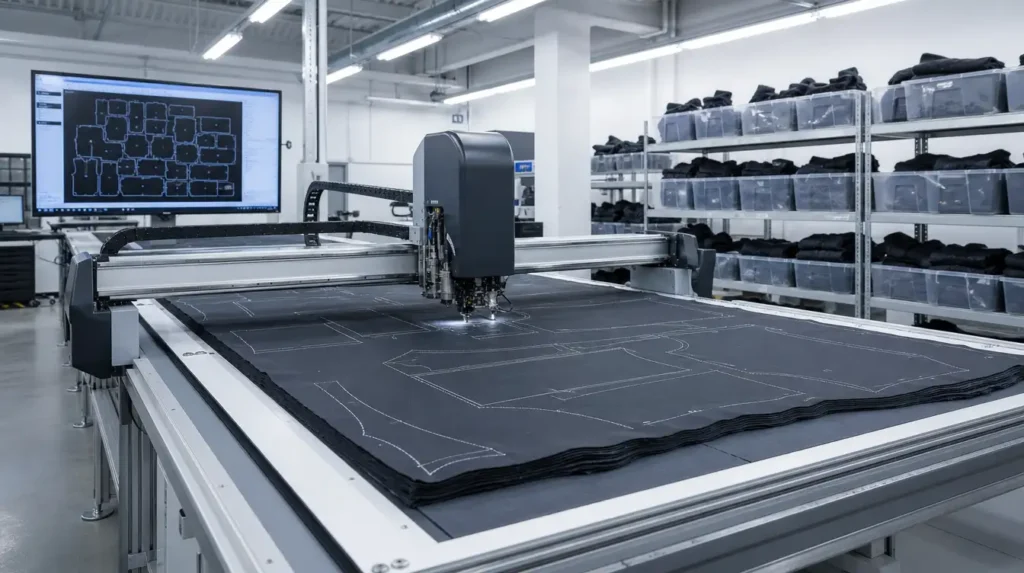
Automated computer-controlled cutting systems represent the standard for modern performance apparel manufacturing at production volumes. The dominant manufacturers including Lectra, Gerber Technology, Investronica, and Bullmer produce systems that vary in cutting speed, accuracy capability, supported layer counts, and operational interface. Modern systems typically include automated spreading machines that lay fabric on the cutting table with controlled tension and temperature, computer-controlled cutting heads that follow patterns from digital marker files, and integrated quality systems that verify cut accuracy through measurement and visual inspection. The automated systems can produce cutting accuracy within 0.5 to 1 millimeter across the panel area when properly configured and operated, dramatically better than manual cutting outcomes.
The system selection should match the specific production requirements including volume, fabric range, accuracy requirements, and integration with other manufacturing operations. Premium performance apparel programs typically use the latest generation Lectra Vector or Gerber GTxL systems, supporting the demanding accuracy requirements of yoga wear, athletic compression wear, and swim wear. Mid-tier programs can use older system generations or alternative manufacturer systems at lower investment levels. Brand customers operating with high volumes across multiple supplier facilities should establish equipment standards that ensure consistent capabilities across the supplier base, supporting reliable quality outcomes regardless of which specific facility produces a given order. The standards should include both equipment specifications and process protocols, supporting the integrated manufacturing capability rather than focusing on equipment alone. Brand customers can review production capabilities through our Swimsuit page where automated cutting supports consistent panel accuracy.
Specialty Cutting Technologies for Technical Applications
Beyond standard automated cutting, specialty technologies support specific applications requiring unique capabilities. Laser cutting using CO2 or fiber lasers produces extremely precise cuts with sealed edges that prevent fraying, supporting bonded seam construction and other premium technical applications. The laser cutting also produces no fabric distortion since the cutting mechanism is non-contact, supporting maximum accuracy for the most demanding programs. Ultrasonic cutting uses vibration to cut through synthetic fabrics with sealed edges, supporting similar applications to laser cutting but at lower equipment investment. Water jet cutting uses high-pressure water to cut fabric without thermal effects, supporting heat-sensitive materials but with higher operational complexity than other technologies.
The specialty technologies typically command premium pricing reflecting both the equipment investment and the operational complexity. Laser cutting systems range from 200,000 USD for basic CO2 systems to over 1 million USD for advanced fiber laser systems with full automation. The cost premium per cut piece ranges from 30 to 80 percent above standard automated cutting depending on the specific application and volume. Brand customers selecting specialty cutting technologies should validate the cost-benefit analysis through realistic production scenarios rather than relying on theoretical advantages that may not translate into commercial value at their specific volume and quality positioning. The technologies are most appropriate for premium technical applications where the specialty capabilities justify the cost premium through superior product performance or unique design execution that cannot be achieved through standard cutting approaches.
Comparing Elastic Fabric Cutting Approaches
The major elastic fabric cutting approaches produce distinctly different performance and cost outcomes, supporting different brand positioning and price points in the performance apparel category. The table below summarizes the key characteristics of the most common approaches available in the global performance apparel manufacturing market in 2026, providing a reference framework that brand customers can use to specify cutting requirements for their product programs. The values are representative of typical commercial conditions and should be validated against current factory quotations and the brand’s specific quality requirements.
| Cutting Approach | Equipment Type | Typical Layer Count | Accuracy | Production Speed | Cost Index per Piece | Best Application | Brand Positioning Fit |
|---|---|---|---|---|---|---|---|
| Manual Hand Cutting | Electric straight knife | 1-10 layers | 2-5 mm variation | Slow | 3.0-5.0x baseline | Sample production, very small runs | Sample, prototype work |
| Manual Multi-Ply Cutting | Heavy-duty hand knife | 10-20 layers | 1.5-3 mm variation | Moderate | 1.5-2.0x | Small production runs | Small batch, niche programs |
| Standard Automated Cutting | Lectra Vector or equivalent | 30-50 layers | 0.8-1.5 mm variation | Fast | 1.0x baseline | Mid-tier performance apparel | Mid-market athleisure |
| Premium Automated Cutting | Lectra Vector latest, Gerber GTxL | 20-40 layers | 0.3-0.8 mm variation | Fast | 1.1-1.3x | Premium yoga, performance | Premium performance apparel |
| Single-Ply Automated Cutting | Spec automated system | 1 layer only | 0.2-0.5 mm variation | Slow | 2.0-3.0x | Ultra-premium, custom programs | Ultra-premium technical |
| Laser Cutting (CO2) | CO2 laser system | 1-3 layers | 0.1-0.3 mm variation | Moderate | 1.4-1.8x | Bonded seams, sealed edges | Premium swim, technical |
| Laser Cutting (Fiber) | Fiber laser system | 1-3 layers | 0.1-0.2 mm variation | Fast for tech | 1.6-2.2x | High-precision technical | Premium technical, swim |
| Ultrasonic Cutting | Ultrasonic blade system | 1-2 layers | 0.3-0.5 mm variation | Moderate | 1.3-1.7x | Sealed edge synthetic fabric | Technical performance |
The comparison reveals that the cutting approach should match the performance apparel positioning and target accuracy requirements rather than defaulting to a single specification across the portfolio. Premium yoga and performance apparel benefit from premium automated cutting at 0.3 to 0.8 millimeter accuracy, while mid-market athleisure can perform well with standard automated cutting at 0.8 to 1.5 millimeter accuracy. Specialty applications including bonded seam swim and ultra-premium technical wear may justify laser or ultrasonic cutting despite the cost premium. Brand teams developing performance apparel programs should engage manufacturing partners to identify the optimal cutting approach for the target positioning and to evaluate samples that demonstrate the accuracy differences before committing to large-volume production. The early engagement supports better technical decisions and stronger long-term outcomes than the alternative of finalizing specifications without manufacturing input. The collaborative approach also surfaces practical considerations that affect both cost and quality outcomes in ways that are not visible during pure design work, ensuring that the final specifications reflect both the brand’s quality vision and the manufacturing realities that determine commercial feasibility.
Manufacturing Process Control for Cutting Quality
The execution of Elastic Fabric Cutting in production requires precise process control across multiple operational stages from fabric receipt through cut piece bundling. The variability in finished cutting quality even between facilities using nominally similar equipment can be substantial, with mature facilities producing consistently high-accuracy cut pieces while less mature facilities produce variable accuracy that affects downstream sewing operations and finished garment quality. Brand customers selecting manufacturing partners should evaluate the cutting process maturity and quality systems carefully, since the difference in cutting quality often determines downstream production yield and finished garment consistency more than any other single manufacturing variable.
Fabric Receipt and Conditioning
The fabric receipt and conditioning stage establishes the foundation for accurate cutting outcomes. Fabrics should be inspected upon receipt for defects, dimensional verification, and color matching against approved samples, with documentation maintained that links each fabric lot through subsequent production stages. The conditioning step allows fabrics to relax in the cutting room environment for 24 to 72 hours before spreading, releasing internal tensions that developed during shipping and storage and producing more dimensionally stable cutting outcomes. The conditioning environment should maintain controlled temperature and humidity, with target conditions of 20 to 22 degrees Celsius and 60 to 65 percent relative humidity supporting consistent fabric behavior across production runs.
The conditioning process can be accelerated for production efficiency through controlled relaxation under specific temperature and humidity, but the acceleration should be validated through dimensional testing to ensure that the accelerated conditioning produces equivalent results to extended natural conditioning. Mature cutting operations document the conditioning protocols for each fabric type and maintain the documentation as a reference for ongoing production. Brand customers should specify conditioning requirements in the production specifications and require manufacturers to maintain conditioning records that support quality verification and root cause analysis when accuracy issues develop. Industry resources from American Apparel and Footwear Association document best practices for fabric handling and conditioning that support consistent manufacturing outcomes. The conditioning protocols also support faster setup for repeat orders, since fabric that has been properly conditioned during initial production cycles develops predictable behavior patterns that can be replicated efficiently in subsequent runs.
Spreading Quality and Tension Control
The spreading operation places fabric layers on the cutting table in preparation for cutting, with the spreading quality directly affecting the achievable cutting accuracy. Manual spreading uses operators who unroll fabric and lay it flat on the cutting table with appropriate tension and alignment. Automated spreading machines provide more consistent results through controlled tension, automatic edge alignment, and precise layer positioning. The spreading speed must be matched to the fabric characteristics, with faster speeds producing more efficiency but potentially introducing tension variations that affect dimensional accuracy. Mature cutting operations maintain documented spreading protocols for each fabric type, with parameters including spreading speed, tension settings, and inter-layer relaxation requirements.
The tension control during spreading is particularly critical for elastic fabrics. Tension that is too high stretches the fabric beyond its natural relaxed dimensions, producing cut pieces that grow larger than the marker after cutting and tension release. Tension that is too low produces wrinkles and fabric instability that affect cutting accuracy. The optimal tension range varies by fabric construction and spandex content, with experienced manufacturers maintaining tension specifications calibrated to each fabric type through prior validation testing. The spreading equipment should include tension monitoring that allows operators to verify the actual tension applied during spreading, supporting consistent execution across multiple production cycles. Brand customers operating with premium performance apparel programs should specify tension requirements in technical packages and require manufacturers to document the actual tension applied during production for verification. The documentation supports both quality verification and root cause analysis when accuracy issues develop, allowing the brand and manufacturer to identify whether the root cause lies in fabric properties, conditioning, spreading parameters, or other factors.
Cutting Operation and Quality Verification
The cutting operation itself transforms the spread fabric into individual cut pieces according to the marker pattern. Modern automated cutting systems follow digital marker files with high precision, but the actual cut piece accuracy depends on the spreading quality, the cutting parameters (blade angle, cutting speed, vibration management), the equipment maintenance status, and the operator monitoring of the cutting process. Mature cutting operations include scheduled equipment maintenance, calibration checks, and operator training that maintain consistent cutting performance across production cycles. The quality verification during cutting should include sample measurements at regular intervals throughout each cutting operation, with statistical process control protocols that detect quality drift before it produces significant volumes of inaccurate cut pieces. The frequency and rigor of verification should be calibrated to the application and the brand quality requirements, with premium programs supporting more intensive verification while value-tier programs accept lighter verification protocols to manage operational costs.
The post-cutting handling affects the dimensional integrity of cut pieces between the cutting room and the sewing line. Cut pieces should be bundled with care that maintains their shape and prevents stretching or compression that would affect the eventual sewn garment dimensions. Bundle labeling should support clear traceability through subsequent production stages, with documentation that links each bundle to the specific cutting batch, fabric lot, and production order. The bundle storage between cutting and sewing should maintain controlled conditions, with bundles supported flat or hung in ways that prevent dimensional distortion during the inevitable storage period before sewing operations. Mature manufacturers operate with documented post-cutting handling protocols that protect the cutting accuracy investment through the subsequent production stages. The post-cutting handling discipline often distinguishes capable manufacturers from less capable ones more than the cutting equipment itself, since even excellent cutting can be undermined by poor handling that introduces dimensional variations between cutting and sewing operations. Brand customers should evaluate the post-cutting handling capabilities during supplier qualification and should require documentation of the handling protocols in production specifications. The handling protocols often represent meaningful differentiators between capable and less capable manufacturers, supporting the comprehensive supplier evaluation framework that produces optimal sourcing decisions for performance apparel programs. The investment perspective on supplier relationships produces stronger long-term outcomes than transactional approaches that optimize for short-term cost reduction at the expense of capability development and relationship continuity. Brand teams committed to long-term competitive positioning should treat cutting precision as a foundational investment rather than a tactical optimization, building the supplier relationships, technical specifications, and quality systems that produce durable competitive advantages over multiple product cycles and changing market conditions across the long term in the global performance apparel industry where consumer expectations continue evolving and competitive pressure remains substantial across multiple market segments and geographic regions of activity throughout the foreseeable strategic planning horizon for performance apparel category brands and their manufacturing partners operating worldwide in this competitive and rapidly evolving industry.
Implementation Roadmap for Brands Adopting Premium Cutting Capabilities
Brands seeking to upgrade their performance apparel cutting capabilities can follow a structured implementation roadmap that balances technical investment with commercial considerations. The roadmap typically extends across two to four product seasons depending on the brand’s volume profile, supplier relationships, and capability development priorities. The first phase focuses on assessment and specification, the second phase on supplier engagement and sample development, the third phase on pilot production and validation, and the fourth phase on full ramp-up and continuous improvement. Each phase builds the capabilities and confidence needed to execute the next, supporting durable transitions rather than one-time tactical changes that may not stick over time. The patient implementation approach also helps brand teams build organizational capability for ongoing cutting excellence rather than depending on individual heroic efforts that may not scale across product portfolios. Brand customers can review additional category capabilities through our Swimsuit and Jacket production pages where elastic fabric cutting expertise applies broadly.
Phase 1: Current State Assessment and Capability Audit
The assessment phase begins with detailed evaluation of current cutting outcomes across the performance apparel portfolio, including documentation of typical cutting accuracy, fabric utilization rates, dimensional consistency in finished garments, and observed performance against consumer expectations. The assessment should include analysis of consumer reviews and return data to identify specific quality issues and prioritize improvement opportunities, with particular attention to feedback patterns that point to fit inconsistency or dimensional issues. The current state documentation provides the baseline against which improvements will be measured, supporting clear progress tracking through the implementation timeline. The assessment also identifies the gap between current capability and target capability, informing the magnitude of investment and timeline required to close the gap. The capability audit should examine multiple dimensions including equipment inventory, environmental control systems, conditioning protocols, operator skill base, quality control systems, and management commitment to cutting excellence. The audit findings should be documented in a structured format that supports comparison across multiple supplier candidates and supports objective decisions about supplier selection and capability development priorities.
Phase 2: Supplier Engagement and Specification Development
The supplier engagement phase identifies and evaluates manufacturing partners capable of executing the target cutting specifications consistently. The supplier evaluation should examine equipment capabilities including specific automated cutting system models and configurations, environmental control systems including temperature and humidity management, conditioning protocols including dwell times and storage conditions, operator skill base including documented training programs, quality control systems including dimensional measurement protocols, certification status, and reference customer feedback including actual production samples and quality history documentation. Brand customers should visit candidate supplier facilities directly during the evaluation process, observing actual cutting room operations rather than relying solely on supplier-prepared materials. The specification development phase translates the brand quality vision into specific technical requirements that suppliers can execute consistently, including cutting accuracy thresholds, layer count limits, conditioning requirements, and quality acceptance criteria. The specifications should be calibrated to the brand positioning and target consumer expectations, with premium positioning supporting more demanding specifications while mid-market positioning accepting more cost-conscious alternatives.
Phase 3: Pilot Production and Phase 4: Full Ramp-up
The pilot production phase produces a defined initial volume, typically 10 to 30 percent of the planned annual program, to validate the supplier’s ability to execute at production scale, confirm landed cost economics, and surface any operational issues before full ramp-up. The pilot production exercises the full cutting cycle including fabric receipt, conditioning, spreading, cutting, quality verification, and bundle handling, providing realistic experience that supports informed decisions about full-scale production. The full ramp-up phase systematically transitions volume from existing supplier relationships into the qualified premium cutting supplier base, capturing the quality and brand reputation benefits across an increasing share of the total portfolio. Brands should expect that the ramp-up does not proceed in a perfectly linear fashion, with seasonal demand patterns, supplier capacity constraints, and ongoing quality refinement work creating natural variation in the volume transition cadence. Successful programs typically achieve 70 to 90 percent of the targeted annual volume in the first full season after pilot completion, then close the remaining gap in the second season as operational refinements drive consistency improvements. The continuous improvement work continues indefinitely, with regular quality reviews, supplier development activities, and specification refinements supporting sustained quality outcomes over multiple product cycles. The compounding nature of the capability investment makes the early-mover advantage substantial, with brands that established premium cutting programs early continuing to benefit from accumulated learning that newer entrants struggle to replicate. The accumulated organizational knowledge spans multiple dimensions including supplier relationships, technical specifications, quality systems, consumer communication approaches, and the operational patterns that support consistent execution across product seasons. The integrated knowledge becomes a strategic asset that supports brand resilience through competitive challenges and market shifts in the global performance apparel industry.
Risk Considerations and Practical Limitations
An honest assessment of Elastic Fabric Cutting must acknowledge several practical limitations and trade-offs that brand customers should incorporate into their decision-making. The first consideration is the fundamental trade-off between cutting accuracy and production economics, with the most accurate cutting approaches typically requiring slower production speeds, higher equipment investment, or both. Brands committed to maximum accuracy positioning may need to accept moderate cost premiums to achieve the dimensional consistency that defines premium performance apparel, while brands operating in cost-sensitive segments need to accept dimensional tolerances that match the commercial constraints. The optimization should match the brand strategy and target consumer expectations rather than pursuing maximum accuracy on every product.
The second consideration is that cutting accuracy alone does not determine finished garment dimensional consistency, with subsequent operations including sewing, finishing, washing, and packaging each contributing to the final dimensional outcomes. Brand investment in cutting accuracy should be matched by appropriate investment in subsequent operations to capture the full potential of the cutting investment. The integrated investment approach recognizes that finished product quality is the cumulative result of multiple manufacturing stages working together rather than the outcome of any single operation considered alone, requiring balanced attention across the production value chain. The brands that have built integrated capability across multiple manufacturing stages typically achieve outcomes that exceed what any single optimization can deliver in isolation, supporting the systematic approach to manufacturing excellence over piecemeal improvement initiatives. The systematic approach also supports more efficient resource allocation, since coordinated improvements across multiple stages produce stronger combined outcomes than equivalent investments distributed across uncoordinated initiatives. Brand customers selecting manufacturing partners should evaluate the systematic capability rather than focusing on individual operations in isolation, since the integrated capability determines finished product outcomes more than any single stage taken in isolation. The cumulative effect over multiple market cycles tends to widen the competitive gap between capable brands and less capable competitors, supporting the strategic logic of investment in fundamental capability development across the manufacturing value chain. The third consideration is that fabric behavior during cutting depends on multiple variables including fabric construction, spandex content, finishing chemistry, and storage conditions, with the same nominal fabric specification potentially producing different cutting outcomes depending on these variables. Quality systems that include incoming fabric testing, conditioning verification, and ongoing dimensional monitoring through the production process catch these variations before they affect significant production volumes. The quality system investment is meaningful but produces compounding returns through reduced defect rates, lower rework costs, and stronger consumer satisfaction outcomes that drive brand reputation and repeat purchase behavior.
The fourth consideration is that supplier capabilities for elastic fabric cutting vary substantially across the industry, with the cost difference between capable and less capable manufacturers often smaller than the quality difference. Brand customers should not assume that all manufacturers can execute premium cutting at consistent accuracy levels, since the equipment investment, operator training, and quality systems required for consistent results represent meaningful capability gaps in the industry. The fifth consideration is that cutting room capabilities interact with the entire manufacturing operation, with even excellent cutting being undermined by poor handling, inadequate sewing, or insufficient quality control in subsequent stages. Brand teams should evaluate manufacturing partners holistically rather than focusing on cutting capability in isolation, recognizing that the integrated manufacturing capability determines finished product outcomes. The holistic evaluation should examine cutting capability, sewing capability, finishing capability, quality control systems, and management commitment to consistent execution, with each dimension contributing to the overall manufacturing partner value proposition. The investment in holistic supplier evaluation pays back through more reliable production outcomes and stronger long-term commercial results.
FAQ
Why is precision cutting more challenging for elastic fabrics than for stable wovens?
A1: Precision cutting is more challenging for elastic fabrics than for stable wovens because of the inherent stretch and recovery behavior of elastic fabrics during cutting operations. When fabric is pulled taut during spreading to lay flat on the cutting table, elastic fabrics stretch in proportion to the applied tension, producing fabric pieces that are dimensionally smaller than the relaxed fabric state. When the tension releases during or after cutting, the fabric returns toward its relaxed dimensions, producing finished panels that are larger than the cut shape on the marker. The magnitude of this dimensional change depends on the fabric construction, the spandex content, the spreading tension applied, and the time the fabric remains under tension before cutting, with performance fabrics containing 8 to 15 percent spandex typically experiencing 3 to 7 percent dimensional change between tensioned and relaxed states. Stable wovens including most cotton wovens and stable polyester wovens do not exhibit this behavior because they have minimal stretch in any direction, allowing them to be cut at any tension without significant dimensional consequences. The implication is that elastic fabrics require specialized cutting approaches including extended relaxation times after spreading, controlled spreading tension, careful cutting parameter selection, and disciplined post-cutting handling that preserve the cutting accuracy through subsequent operations. Mature cutting operations have developed these specialized approaches over decades of accumulated experience with elastic fabrics, building the institutional knowledge that distinguishes capable manufacturers from less experienced operations. Brand customers seeking consistent dimensional accuracy in finished garments should select manufacturing partners with proven experience in elastic fabric cutting and should specify cutting requirements precisely in their technical packages to ensure that accuracy expectations are met consistently across production cycles. The investment in capable manufacturing partners pays back through more consistent finished product quality and stronger consumer satisfaction outcomes that drive brand reputation and repeat purchase behavior. The cumulative returns over multiple product cycles substantially exceed the upfront investment in supplier qualification and development, supporting the strategic logic of patient supplier relationship building. Brand teams that have made these investments consistently over multiple seasons typically report stronger consumer satisfaction metrics, higher repeat purchase rates, and more resilient market positions during competitive challenges. The integrated investment approach also supports brand resilience through changing market conditions, since the underlying capabilities provide stable foundations that adapt to evolving consumer preferences and competitive dynamics. The strategic patience required to build these capabilities is meaningful, but the resulting competitive positions tend to prove more durable than positions built on shorter-term tactical advantages, justifying the investment for brands committed to sustained leadership in performance apparel categories. The brands that have demonstrated this commitment over multiple economic cycles consistently report stronger consumer satisfaction metrics, higher repeat purchase rates, and more resilient market positions during competitive challenges.
What is the typical cutting accuracy that performance apparel programs should expect?
A2: The typical cutting accuracy for performance apparel programs depends on the cutting approach, the fabric characteristics, and the production volume profile. Standard automated cutting using systems like Lectra Vector or Gerber GTxL typically achieves 0.8 to 1.5 millimeter dimensional variation across the panel area when properly configured and operated, supporting most mid-tier performance apparel applications including casual yoga wear, athleisure, and athletic basics. Premium automated cutting using the latest generation systems with optimized parameters can achieve 0.3 to 0.8 millimeter accuracy, supporting premium yoga wear, athletic compression wear, and high-performance applications where the dimensional consistency directly affects fit and aesthetic outcomes. Single-ply automated cutting can achieve 0.2 to 0.5 millimeter accuracy at substantially higher cost per piece, justifying the investment only for ultra-premium technical applications or custom programs where the volume does not support multi-ply efficiency. Laser cutting can achieve 0.1 to 0.3 millimeter accuracy with the additional benefit of sealed cut edges, supporting bonded seam construction and other premium technical applications. Manual cutting produces 1.5 to 5 millimeter accuracy depending on the operator skill and the specific cutting tool, making it appropriate primarily for sample production and very small runs. The accuracy specification should match the application requirements and the brand quality positioning, with premium positioning supporting more demanding accuracy requirements while value positioning accepting more practical accuracy levels. Brand customers should specify minimum accuracy requirements in their technical packages and require manufacturers to demonstrate the achievable accuracy through sample testing before committing to production. The accuracy specification combined with disciplined process control during production produces the consistent dimensional outcomes that drive finished garment quality and consumer satisfaction in performance apparel categories. The accuracy outcomes also affect production yield, with higher accuracy supporting fewer rejected pieces and lower fabric waste, contributing to both quality and economic outcomes that benefit both the manufacturer and the brand customer.
How does cutting room temperature and humidity affect elastic fabric outcomes?
A3: Cutting room temperature and humidity affect elastic fabric outcomes through multiple mechanisms that influence fabric behavior, dimensional stability, and cutting equipment performance. Temperature affects fabric stiffness and recovery, with elastic fabrics generally becoming more pliable at moderate temperatures (20 to 25 degrees Celsius) and stiffer at lower temperatures or after extended exposure to higher temperatures. Humidity affects the fabric moisture content and dimensional behavior, with elastic fabrics typically expanding slightly at higher humidity and contracting at lower humidity. The optimal cutting room conditions for elastic fabrics typically maintain 20 to 22 degrees Celsius temperature and 60 to 65 percent relative humidity, supporting consistent fabric behavior and predictable cutting outcomes. Temperature variations of more than 3 to 5 degrees Celsius from the target range can produce measurable accuracy effects, while humidity variations of more than 10 percentage points can affect dimensional consistency. The cutting equipment also responds to environmental conditions, with cutting blade performance and automation system precision both affected by temperature variations. Mature cutting operations maintain controlled cutting room environments through HVAC systems calibrated to the target conditions, with monitoring that detects deviations and triggers corrective action before they affect production quality. Brand customers selecting manufacturing partners should evaluate the cutting room environmental control capabilities during facility audits, since this often-overlooked factor substantially affects the cutting accuracy that the partner can deliver consistently. The investment in environmental control is meaningful but pays back through more consistent quality outcomes across production cycles and seasonal variations in external conditions. The environmental control also supports operator working conditions and equipment reliability, producing returns that extend beyond direct cutting accuracy to include broader operational benefits that compound across the production operation.
What testing protocols validate cutting accuracy?
A4: Validating cutting accuracy requires structured testing protocols that quantify the dimensional consistency of cut pieces against the marker specifications. The standard test methods include direct measurement of cut piece dimensions at specified points using calibrated measurement tools, comparison of measured dimensions against the marker specifications and tolerance limits, statistical analysis across multiple cut pieces to characterize the dimensional distribution, and cumulative measurement through subsequent production stages to track dimensional changes through finishing and washing. The direct measurement protocols typically use calibrated measuring tape, ruler, or digital measurement systems that produce dimensional data at multiple points across each cut piece, with measurement accuracy of 0.1 to 0.5 millimeter depending on the equipment and the measurement protocol. The statistical analysis quantifies the mean dimensional accuracy, the variation across cut pieces, and the proportion of cut pieces that fall outside tolerance limits, supporting data-driven decisions about cutting process performance and quality acceptance. The cumulative tracking through subsequent production stages provides insight into how cutting accuracy translates into finished garment dimensions, accounting for the dimensional changes that occur during sewing, finishing, washing, and packaging. Brand customers should specify minimum accuracy requirements at multiple measurement points and tolerance levels appropriate to the application, supporting comprehensive quality verification rather than single-point measurement that may not capture the full dimensional behavior. The testing protocols should be documented and applied consistently across production cycles, building the data foundation that supports continuous improvement programs and supplier evaluation. Brand teams operating with mature quality systems often integrate cutting accuracy testing with broader quality measurement programs, leveraging the data investment across multiple business functions including supplier qualification, product development, and ongoing production monitoring. The integrated approach supports more efficient operations and stronger commercial outcomes than fragmented quality measurement that requires duplicate investment to support each business function separately. Brand teams should establish clear test result documentation requirements that suppliers must provide for each fabric submission and production lot, supporting the audit trail that defends marketing claims and supports productive relationships with both retail partners and consumers.
How can brands ensure consistent cutting quality across multiple suppliers?
A5: Ensuring consistent cutting quality across multiple suppliers requires structured systems that combine specification clarity, supplier qualification, ongoing monitoring, and continuous improvement. The most reliable approach starts with detailed technical specifications that document the cutting accuracy requirements, equipment standards, environmental control requirements, conditioning protocols, layer count limits, marker grain specifications, and quality acceptance criteria. The specifications should be precise enough to produce consistent results across different manufacturing partners but flexible enough to accommodate the natural variation in equipment and operator capabilities at different facilities. Supplier qualification should verify each candidate manufacturer’s capability through facility audits examining cutting equipment inventory, cutting room environmental control, operator training programs, and quality control systems, sample production through complete cutting cycles to validate execution capability, and reference customer feedback to confirm consistent performance over time. Brand customers operating with multiple suppliers should establish standardized quality protocols that apply consistently across the supplier base, supporting direct comparison and equitable treatment of supplier relationships. Ongoing quality monitoring should include regular sample testing through standardized accuracy protocols, third-party audits at appropriate intervals, and consumer feedback analysis to identify quality issues that may not be apparent through laboratory testing alone. The monitoring data supports both supplier accountability and continuous improvement programs that progressively elevate quality across the supplier base. Brand customers should also establish clear corrective action procedures with manufacturing partners, ensuring that any quality issues identified through monitoring trigger immediate analysis and corrective action rather than being absorbed into ongoing production. The structured verification approach builds supplier accountability and supports the long-term supplier relationships that produce the consistent quality outcomes that brand customers ultimately need for sustained competitive positioning. Brand teams should view supplier verification as relationship-building rather than purely as quality protection, recognizing that suppliers who understand and respect the brand’s quality standards become better partners over time and contribute to the brand’s competitive position through their own continuous improvement efforts. Reference standards from ASTM International support consistent measurement protocols across multiple supplier relationships and brand portfolios. Industry research from Textile Exchange documents the connection between manufacturing quality and consumer satisfaction in performance apparel categories. The mutual investment in transparency and accountability creates conditions for productive long-term collaboration that benefits both parties through more efficient operations, stronger commercial outcomes, and the sustained brand reputation that supports premium positioning across multiple product seasons and consumer engagement cycles.
Conclusion
Elastic Fabric Cutting represents one of the most consequential disciplines in performance apparel manufacturing, with direct effects on garment fit consistency, fabric utilization efficiency, production yield, and ultimately the brand reputation that determines repeat purchase behavior in competitive product categories. The fundamental challenge is the conflict between dimensional stability requirements and the inherent stretch behavior of elastic fabrics, which can deform substantially during the cutting process if not properly tensioned, supported, and managed. Achieving consistent cut piece accuracy requires precise specification and disciplined execution across spreading, marker making, cutting, and bundling operations.
The engineering decisions affecting cutting quality span multiple operational stages and technology choices. Fabric behavior under tension determines the relaxation times and tension control requirements that produce dimensional consistency. Bias distortion behavior affects pattern orientation decisions that preserve intended fit characteristics through finishing and consumer use. Layer count and spread height decisions balance production economics with cutting accuracy. Equipment selection ranging from manual cutting through automated systems to specialty laser and ultrasonic technologies offers distinct capabilities for different applications. Process control across fabric receipt, conditioning, spreading, cutting, and post-cutting handling determines whether the technology investment produces consistent results in production volumes.
The major construction approaches available in the global performance apparel manufacturing market support different brand positioning and price points, with premium yoga and performance apparel typically using premium automated cutting at 0.3 to 0.8 millimeter accuracy, mid-market athleisure using standard automated cutting at 0.8 to 1.5 millimeter accuracy, and ultra-premium technical wear potentially using single-ply automated or laser cutting for extreme accuracy requirements. The cost premium for premium cutting approaches is moderate and is well justified by the brand differentiation and consumer-perceived quality benefits. Brand teams developing performance apparel programs should engage manufacturing partners early in the design process to identify the optimal cutting approach for the target positioning and to evaluate samples that demonstrate the accuracy differences before committing to large-volume production.
Brands ready to develop performance apparel programs that capture the full benefits of disciplined Elastic Fabric Cutting can connect with experienced manufacturing partners who maintain the technical capabilities, quality systems, and category expertise required for the major performance apparel segments. Our team can support program development, sampling, and production through our Get A Quote process, drawing on over 50 years of OEM and ODM manufacturing experience and our integrated production capabilities across yoga wear, athleisure, athletic, performance, and swim categories. The combination of engineered cutting precision and disciplined manufacturing execution is what transforms a performance apparel specification into a finished garment that delivers the fit consistency consumers expect from premium performance brands. The investment in quality cutting engineering produces returns through stronger consumer satisfaction, lower return rates, and sustained brand reputation that supports long-term commercial success in this competitive product category. Brands committed to premium performance apparel positioning should prioritize cutting precision as a foundational competitive differentiator and should invest in the manufacturing partnerships, specifications, and quality systems that support consistent delivery of the dimensional consistency that defines the premium category. The accumulated organizational knowledge in cutting room operations becomes a barrier to entry for competitors seeking to challenge the brand position through similar product approaches, since replicating the depth of capability requires committing similar resources over equivalent time horizons. This dynamic creates structural advantages for brands that began their capability development early, with the head start widening into substantial competitive separation as additional capability layers accumulate over time. The compounding nature of these advantages makes them particularly valuable for long-term commercial planning, supporting the strategic logic of investment in fundamental capability development that drives sustained competitive positioning across multiple product cycles and changing market conditions in the global performance apparel industry. Brand teams committed to long-term competitive positioning should treat cutting precision as a foundational investment rather than a tactical optimization, building the supplier relationships, technical specifications, and quality systems that produce durable competitive advantages over multiple product cycles. The brands that have demonstrated this commitment over multiple economic cycles consistently report stronger consumer satisfaction metrics, higher repeat purchase rates, and more resilient market positions during competitive challenges, validating the strategic logic of the patient investment approach. The investment horizon for building these capabilities typically spans multiple product cycles and supplier relationships, requiring committed leadership and sustained organizational focus rather than tactical optimization mindsets. The brands that maintain the commitment over time consistently achieve outcomes that competitors operating with shorter time horizons cannot replicate, building cumulative competitive advantages that compound across product seasons and consumer relationships in ways that produce sustained commercial success in the global performance apparel market.