
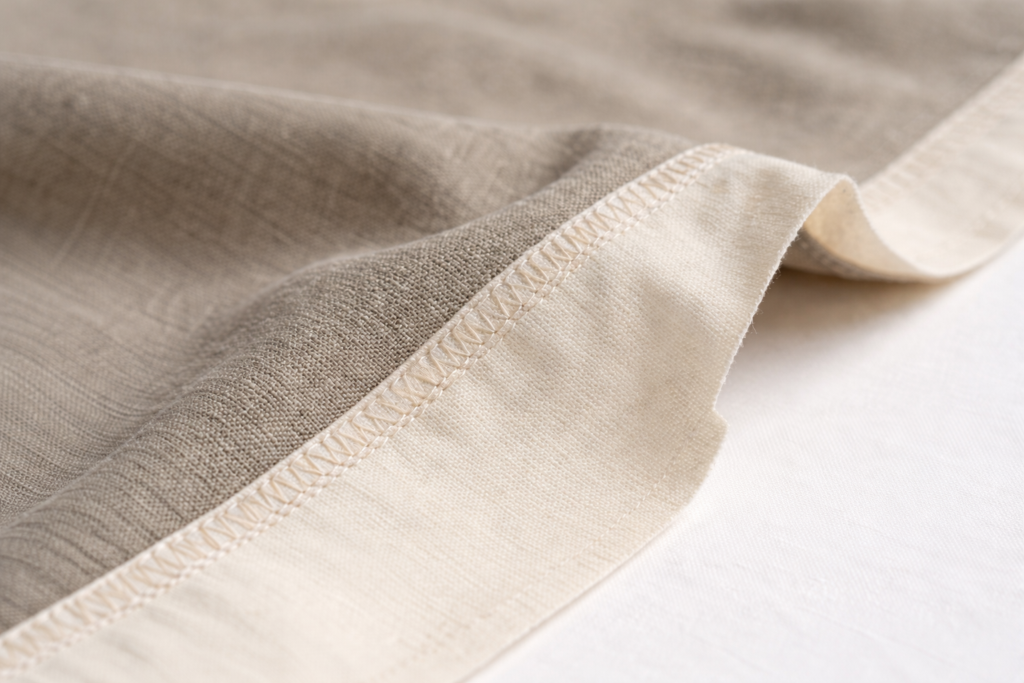
What Is Stitch Density Quality and Why It Is a Manufacturer’s Core Competency
In garment manufacturing, “quality” is often discussed but rarely defined. A customer may pick up a jacket and immediately notice that it feels stronger and more refined than a similar product, even if they cannot explain why. One key reason is a technical factor called Stitch Density Quality.
Stitch Density refers to the number of stitches per inch (SPI), while Stitch Density Quality also includes stitch uniformity, thread tension, thread balance, and how well the stitch configuration matches the fabric. These factors directly affect a garment’s durability, appearance, comfort, and wash performance.
There is no universal SPI that works for every garment. Knits, wovens, lightweight fabrics, and stretch materials all require different settings. Understanding the correct density for each fabric is what separates a professional manufacturer from a basic contract factory.
For mid-to-high-end apparel, the common production range is 10–13 SPI. This range balances strength, appearance, and production efficiency. The real challenge is not achieving a specific SPI once, but maintaining it consistently across every garment and every production batch. Consistency is the true measure of Stitch Density Quality.
Controlling Stitch Density Quality requires a systematic approach. Machine calibration, operator skill, quality inspections, and fabric expertise all play important roles. A weakness in any area can affect product quality and damage brand reputation. The goal is not to produce the highest stitch density, but to deliver the exact density specified by the client with reliable consistency.
As global supply chains become more complex, many brands rely on overseas manufacturing partners. Maintaining consistent Stitch Density Quality across remote production facilities is a major challenge for sourcing and quality teams. Professional manufacturers must combine technical expertise with standardized quality control processes and traceable inspection records.
According to research from the International Textile and Apparel Association (ITAA), nearly 30% of garment defects are linked to sewing workmanship, with inconsistent stitch density among the most common causes. This highlights why Stitch Density Quality should be treated as a core production metric rather than a secondary inspection item.
It is also important to recognize that higher stitch density is not always better. Excessive stitching can create too many needle perforations, weakening lightweight or stretch fabrics. True Stitch Density Quality means selecting the optimal SPI for each fabric and design, then maintaining that standard consistently throughout production. This commitment to precision is the foundation of HanJen’s manufacturing philosophy.
Technical Parameters of Stitch Density and Industry Standards
A thorough understanding of Stitch Density Quality requires familiarity with the technical parameter framework that underpins it. In industrial garment manufacturing, these parameters form an essential component of quality specification documents and serve as the shared technical language between buyers and factories. Fluency in this language is the first marker of a manufacturer’s professional credibility.
Core Measurement Indicators and Calculation Methods
SPI (Stitches Per Inch) is the most fundamental unit of measurement, while SPcm (Stitches Per Centimetre) is commonly encountered in European markets. The measurement method involves placing a one-inch or one-centimetre gauge along a seam line and counting the number of complete stitches visible within that span. Modern quality laboratories typically use magnifying loupes or digital microscopes for precise counting, eliminating the judgement errors inherent in unaided visual inspection and ensuring the objectivity and repeatability of measurement results.
Beyond SPI, stitch tension is another critical parameter. Uneven tension causes the stitch line to alternate between tight and loose, producing a wavy or puckered appearance on the surface while also creating inconsistency in seam strength. The ideal tension setting should result in the upper and lower threads interlocking at the centre of the fabric, with neither thread visible from the opposite face of the material. In mid-range production environments, the consistency of tension control often distinguishes factory capability more reliably than the SPI value itself.
Stitch type also directly influences the appropriate density standard. According to the ISO 4915 Stitch Types Standard, commonly used stitch types include the lockstitch (Type 301), the chainstitch (Type 401), and the overedge stitch (500 series), each of which corresponds to different density requirements and application contexts.
| Stitch Type | Code | Recommended SPI | Applicable Fabrics | Primary Applications |
| Lockstitch | 301 | 10-14 SPI | Woven fabrics | Main seams, patch pockets |
| Chainstitch | 401 | 10-13 SPI | Woven fabrics | Denim construction |
| Overedge stitch | 504/514 | 12-16 SPI | Knitted fabrics | Side seams, sleeve seams |
| Two-needle stitch | 406 | 8-12 SPI | Stretch fabrics | Hems, cuffs |
| Safety stitch | 516 | 11-14 SPI | All fabric types | High-stress seam points |
Density Standards for Different Fabric Types
Medium-weight fabrics — including standard cotton, linen, lightweight wool, and blended materials — are the backbone of mid-to-high-end apparel production. Their optimal density range is typically 10 to 13 SPI, which is also HanJen’s primary production range for the majority of client orders. Within this range, seam structural strength is sufficient to withstand daily wear and repeated laundering, without the risk of excessive perforation weakening the fabric’s fibre integrity. Lightweight fabrics such as silk, chiffon, and fine cotton require higher density — typically 13 to 16 SPI — to distribute the stress of the stitch line evenly across the fabric surface. Heavy fabrics such as thick denim and wool coating can be reduced to 8 to 11 SPI; excessively high density on these materials can cause the fabric to lose flexibility or develop stress fractures at the seam.
Stretch fabrics present the most complex challenge, as the stitch must possess sufficient elasticity to move with the fabric as it extends. Overedge or elastic stitch types are the standard solution, and density settings must account for the fabric’s maximum extension rate to ensure the seam does not fail under full stretch.
The Role of Machine Calibration and Operator Training
Even with identical machine settings, operators at different skill levels can produce significantly different quality outcomes. Sewing speed, the manner in which fabric is fed through the machine, and the technique used to begin and end a seam all affect the actual stitch density and uniformity of the finished seam line. In mid-to-high-end garment manufacturing, operator training encompasses not only basic technical skills but also the cultivation of quality awareness — ensuring that every operator understands how their individual work affects the overall quality of the finished product. According to research published by the Sewn Products Equipment and Suppliers of the Americas (SEAMS), systematic quality training for operators can reduce sewing defect rates by 30% to 50%, representing significant cost savings and brand reputation protection for large-scale production operations.
Quality Expectations in the Mid-to-High-End Market and the Commercial Significance of SPI Consistency
The mid-to-high-end apparel market demands better durability, craftsmanship, and comfort than fast fashion while still maintaining competitive pricing. As a result, brands must balance quality expectations with production efficiency.
For manufacturers, Stitch Density Quality is not about achieving the highest SPI. It is about maintaining the specified SPI consistently across every garment and production batch. A brand may approve a 10 SPI standard, but it cannot accept significant variations within the same order.
SPI consistency delivers important business benefits. First, it protects brand reputation by ensuring consumers receive the same quality every time they purchase a product. Second, it reduces costs associated with returns, repairs, and replacement orders caused by quality issues. Third, it strengthens long-term supplier relationships, as brands increasingly favor manufacturers that can deliver reliable results at scale.
Industry research shows that quality stability has become a key factor in supplier selection. According to the McKinsey Global Fashion Report, more than 65% of mid-to-high-end apparel buyers rank quality consistency as the most important criterion when choosing a long-term manufacturing partner, ahead of initial sample quality.
| Evaluation Dimension | Fast Fashion | Mid-to-High-End (Primary Market) | Top Luxury |
| Typical SPI Range | 7-9 SPI | 10-13 SPI | 14-18+ SPI |
| Batch Consistency Requirement | General (±2 SPI) | Strict (±1 SPI) | Extremely strict (±0.5 SPI) |
| QC Sampling Rate | 1-2% | 3-5% | 5-10%+ |
| Thread Tension Control | Basic setting | Standard control | Precision control |
| First Article Inspection | Simplified or omitted | Standard process | Rigorous multi-round confirmation |
| Fabric-Specific Customisation | Fixed settings | Partial customisation | Full customisation |
| Quality Record Requirements | Basic | Complete batch reports | Piece-level traceability |
This comparison makes clear that for mid-to-high-end brands, consistency between batches and the rigour of systematic quality control processes are more pressing priorities than the pursuit of absolute SPI values. A manufacturer that can reliably deliver finished goods within ±1 SPI of a 10 to 13 SPI standard, batch after batch, possesses the core competitive advantage that this market segment genuinely demands.
Three Case Studies: Real-World Analysis of Stitch Density Quality Management
Case Study:
1: European Brand Improves Quality Through Supplier Consolidation
A Stockholm-based casual apparel brand producing 250,000 units annually required strict SPI standards of 11–13 for main seams and 12–14 for overedge seams. While working with three Asian factories, the brand discovered batch-to-batch SPI variations of up to ±2.5, exceeding its ±1 tolerance and causing customer complaints about inconsistent quality.
After auditing suppliers for SPI measurement capability, process controls, quality records, and operator training, the brand consolidated production with two qualified factories and implemented quarterly quality audits.
As a result, SPI variation improved to ±0.8, customer complaints dropped by 61%, return rates fell from 1.4% to 0.5%, and annual orders to approved suppliers increased by 40%.
2: US Lifestyle Brand Restores Consumer Trust
A US lifestyle brand sourcing approximately 180,000 units annually required 10–12 SPI and batch-level stitch density reports. After changing factories, the brand received growing complaints about seam appearance and puckering after washing.
Investigation revealed that while initial samples met specifications, production SPI drifted to 8–9 in some batches, with inconsistent thread tension. The factory lacked in-process monitoring, allowing defects to go undetected until products reached the warehouse.
The brand introduced mandatory SPI checks every two hours, required immediate corrective action when deviations exceeded ±1 SPI, and demanded detailed measurement reports for all future orders.
Following implementation, SPI variation stabilized within ±0.7, return rates fell to 0.3%, and positive quality-related customer reviews increased from 52% to 83%. The case highlights the importance of continuous process monitoring rather than relying solely on initial sample approval.
3: Taiwan Factory Builds an SPC-Based Quality System
A mid-sized garment factory in New Taipei City serving European and US brands needed to meet a German client’s requirement of maintaining batch SPI variation within ±1 and providing Statistical Process Control (SPC) records.
To comply, the factory upgraded its quality system by introducing digital SPI measurement equipment, standardized operating procedures, two-hour inspection intervals, and SPC trend monitoring.
Within three months, the factory passed the client’s audit, achieving SPI variation of ±0.6. The client increased annual orders by 35% and referred a second brand. Meanwhile, the factory reduced sewing defects from 1.6% to 0.7%, generating annual quality cost savings exceeding NT$3.5 million.
Key takeaway: Consistent Stitch Density Quality is not just a technical requirement—it directly impacts customer satisfaction, supplier selection, order growth, and long-term profitability.
Systematic Methods for Managing Production Consistency
In mid-to-high-end garment production, ensuring Stitch Density Quality has never been a matter of any single isolated quality action. It requires a systematic control framework — interconnected, covering the entire production process — built simultaneously across three dimensions: equipment, process, and people.
At the equipment level, regular machine calibration is the physical foundation for maintaining SPI stability. After extended use, wear in the feed mechanism and microscopic displacement of the needle bar can cause the actual SPI to drift away from the dialled setting. Establishing a scheduled calibration programme and recording measurement data both before and after each calibration session is an essential measure for ensuring equipment stability. The stitch density measurement instruments themselves also require periodic verification to ensure the accuracy of measurement results.
At the process level, every control point — from first article inspection through in-process sampling to finished goods inspection — must carry explicit stitch density measurement requirements and documentation standards. First article inspection cannot be limited to visual review; measurement instruments must be used to confirm that SPI meets specification, and actual measured values must be recorded. In-process sampling frequency should be determined by order volume and fabric type, with a general recommendation of once every two hours; higher-risk fabrics or new styles may warrant hourly sampling. All measurement records should be systematically retained to form a traceable quality history archive.
At the people level, the measurement skills and data interpretation capability of QC personnel are the core of the entire system. Equipment without personnel who know how to use it renders the quality system functionally inoperative. QC personnel must receive standardised measurement operation training to ensure that readings taken by different individuals on the same seam line produce highly reproducible results. Additionally, operator understanding of quality standards directly influences their daily motivation to maintain SPI consistency through mindful working practice.
According to the ASTM D1683 Seam Strength Test Standard, quality testing for sewn products should encompass not only density measurement but also seam strength testing, verifying that seam lines can withstand the stresses of actual use. Combining density measurement with strength testing enables a more comprehensive evaluation of sewing quality in practice, and provides brand clients with more persuasive quality assurance data.
| Control Stage | Control Items | Recommended Frequency | Record Requirement | Deviation Response |
| First Article Inspection | SPI measurement, tension confirmation | Before each style commences | Written confirmation form | Re-confirm after adjustment |
| In-Process Sampling | SPI measurement | Every 2 hours / per shift | Control log sheet | Stop line immediately if out of spec |
| Thread/Fabric Change | SPI recheck | After each material change | Record in changeover log | Confirm before resuming production |
| Shift Handover | SPI spot-check | Each shift change | Handover record | Anomalies must be documented in handover |
| Finished Goods Receiving | SPI re-verification | 5% per batch | Batch quality report | Non-conforming batches quarantined |
HanJen’s Manufacturing Philosophy and Stitch Density Quality Control System
Within Taiwan’s garment manufacturing industry, HanJen International LTD. has established a distinctive market position through its rigorous commitment to Stitch Density Quality consistency. Located in Xinzhuang District, New Taipei City, HanJen has spent many years serving European and American mid-to-high-end brand clients, accumulating deep professional capability in quality management within the 10 to 13 SPI primary production range.
The core of HanJen’s quality philosophy is “precise specification matching and stable delivery.” This means that whether a client’s quality specification calls for 10 SPI or 13 SPI, HanJen’s objective remains the same: to minimise batch-to-batch deviation within the client’s specified density range, and to express that quality commitment in concrete, verifiable measurement data. This pursuit of consistency, more than any claim about workmanship standards, is what builds the long-term trust of brand clients.
HanJen’s quality management system is built on three core pillars. The first is precise technical specification management: when onboarding a new client order, HanJen’s technical team conducts a thorough review of the client’s quality specification, translating stitch density requirements into concrete machine setting parameters and operating standards, and conducting multiple rounds of first article confirmation before full-scale production begins to ensure that workmanship settings meet the client’s expectations. The second is systematic process control: HanJen has established a stitch quality monitoring mechanism based on Statistical Process Control (SPC) principles; in-process stitch density sampling is conducted regularly on the production line, with test data recorded in real time and analysed for trends, and any deviation triggering an immediate adjustment response to prevent non-conforming product from advancing to subsequent operations. The third is sustained investment in skills training: HanJen conducts regular sewing quality training for QC personnel and key operators, with particular emphasis on measurement operation consistency and the development of quality awareness, ensuring that the human factor’s contribution to quality variation is minimised.
HanJen also places significant emphasis on a deep understanding of fabric characteristics. Before commencing production on a new style, technical personnel conduct a basic fabric property assessment covering weave density, elasticity coefficient, and fibre composition, then adjust stitch density settings and thread selection accordingly. This fabric-specific workmanship judgment ensures that even two orders both specifying 11 SPI will achieve equally excellent results when the fabrics involved have different properties.
For clients who require quality report submissions, HanJen is able to provide complete batch quality reports containing actual measurement data as well as stitch density trend control charts, giving clients immediate visibility into the quality status of every production batch. This data transparency is a key instrument through which HanJen builds sustained client relationships in the mid-to-high-end manufacturing market.
To learn more about HanJen’s manufacturing capabilities and quality management system, please visit our Services page and Quality Standards overview, or contact our technical team directly using the information provided at the end of this article.
A Practical Guide to Evaluating Supplier Stitch Density Quality During Procurement
For brand procurement teams, evaluating a supplier’s Stitch Density Quality capability is a task that requires a systematic approach. Visual inspection and tactile judgement alone are rarely sufficient; a combination of technical testing and process auditing is needed to form a complete picture of a supplier’s true capability. In the mid-to-high-end market in particular, brands need more than a one-time exemplary sample — they need a long-term partner capable of delivering stable results season after season.
Major Audit Items for Technical Assessment
When conducting a supplier technical audit, the following items are critical for evaluating stitch density consistency capability. First, verify whether the factory is equipped with stitch density measurement tools and whether measurement operations are standardised. Second, understand the in-process QC sampling plan, including sampling frequency, recording method, and the process for handling deviations. Third, confirm whether the factory has established a Statistical Process Control mechanism capable of tracking and providing early warning of SPI trend drift. Fourth, review machine calibration records — calibration frequency and before/after measurement data should be available for inspection. Fifth, confirm whether QC personnel competency assessments are conducted on a regular basis to ensure measurement operation consistency across the team.
During the audit, it is advisable to ask the factory to demonstrate the stitch density measurement operation on-site and to provide batch quality reports from the past three months, with particular focus on the distribution of actual SPI measured values and the degree of batch-to-batch deviation. These objective records are a far more reliable indicator of a factory’s genuine quality management capability than verbal representations or display samples prepared specifically for the visit.
Technical Considerations for Sample Evaluation
Upon receiving samples submitted by a supplier, the following approach can be used to evaluate Stitch Density Quality. Use a graduated magnifying loupe to measure the SPI of the primary seam lines and compare the results against the quality specification. Apply light finger pressure along the seam to feel whether tension is uniform, and whether there is any localised tightening or loosening. Examine the seam from both the face and reverse side to confirm that the upper and lower thread interlock is occurring at the centre of the fabric, ruling out tension bias. Subject samples to a wash test and assess whether seam lines exhibit shrinkage, distortion, or reduction in strength after laundering. Mid-to-high-end brands may further require suppliers to provide a stitch density test report for the submitted samples, confirming that measured values align with visual assessment and eliminating the possibility that samples have been specially prepared outside normal production parameters.
Building a Long-Term Quality Partnership
Rather than treating suppliers purely as service procurement counterparts, brands that build long-term quality partnerships generate significantly better outcomes. This means being willing to invest in a supplier’s quality management development — sharing the reasoning behind the brand’s quality standards, providing clear and complete technical specification documentation, and reflecting quality stability in the commercial terms of the relationship. Building this kind of partnership requires procurement teams to establish regular technical communication channels with suppliers, jointly reviewing quality data, sharing improvement feedback, and working collaboratively to identify root causes and solutions when quality issues arise. The quality stability and supply chain reliability that a genuine long-term partnership creates will consistently outperform the short-term cost savings that frequent factory switching appears to offer.
The New Meaning of Stitch Density Quality in the Age of Sustainable Manufacturing
In a global fashion landscape where the sustainable fashion movement is accelerating, Stitch Density Quality has taken on a significance that extends well beyond traditional quality management. High-quality sewing workmanship is no longer exclusively the province of luxury brand craft traditions — it has become one of the key solutions the entire apparel industry must deploy in responding to environmental challenges. For the mid-to-high-end apparel market, this connection is particularly direct and commercially compelling.
The apparel industry is the world’s second-largest polluting industry, generating approximately 92 million tonnes of textile waste annually. Among the contributing factors, garments that deteriorate prematurely due to insufficient construction quality and are discarded before the end of their intended useful life represent a significant and addressable source of waste. Sewing quality consistency — in particular whether stitch density is reliably maintained at the designed specification — directly determines a garment’s durability through daily wear and repeated laundering. Even a mid-range sewing standard of 10 to 13 SPI, if every finished piece reliably meets that specification, already delivers durability that substantially exceeds that of products made with unstable, inconsistent sewing quality.
Research demonstrates that garments whose sewing quality consistently meets and maintains the designed specification have measurably longer average usable lifespans than comparable products with variable sewing quality. According to a report by the Ellen MacArthur Foundation, doubling the usable lifespan of a garment can reduce the associated resource consumption and carbon emissions by approximately 44%. This figure provides mid-to-high-end brands with powerful material for sustainability communications, and gives manufacturing operations a meaningful framework — beyond commercial self-interest — for investing in quality management.
Many leading European Union brands have already begun incorporating sewing durability standards into their sustainable procurement policies, requiring suppliers to provide stitch density and seam strength test data as part of sustainability compliance documentation. This trend signals that a manufacturer’s Stitch Density Quality management capability will increasingly become a prerequisite for entry into the supply chains of sustainability-conscious brands, not merely a differentiating advantage.
Taiwan’s garment manufacturing industry holds a distinctive competitive position in this transition. The technical capability and quality management experience accumulated over decades enables Taiwanese manufacturers to respond quickly to client upgrades in sewing quality standards and to provide the complete quality record documentation that sustainable procurement requirements demand. According to a report published by the Global Fashion Agenda, more than 70% of global apparel brands plan to strengthen durability requirements in their procurement specifications by 2030 — representing a significant commercial opportunity for manufacturers that have already built systematic quality management capabilities.
At HanJen, the philosophy of sustainable manufacturing has long been embedded in our quality management thinking. Our rigorous commitment to Stitch Density Quality consistency is both a service promise to our brand clients and a concrete expression of environmental responsibility. Every seam that is produced to specification, consistently and reliably, is a contribution to a garment’s longer life — and a reduction in the burden placed on the planet’s resources.
FAQ
Q1 What SPI range do mid-to-high-end brands typically require, and what standards can HanJen reliably deliver?
A1 The primary stitch density range for mid-to-high-end apparel brands typically falls between 10 and 13 SPI. This range represents a professionally optimised balance among seam structural strength, fabric compatibility, and production efficiency, and is the most widely applied workmanship standard in the global mid-to-high-end apparel market. HanJen’s primary production range is precisely 10 to 13 SPI. Within this range, HanJen operates a comprehensive quality management capability that includes first article inspection, in-process sampling, SPC statistical process control, and complete batch quality reporting, ensuring that batch-to-batch SPI deviation is held within the tolerance specified in the client’s quality requirements. For clients with specific requirements outside this range, HanJen is also able to provide alternative stitch density configurations based on fabric characteristics and design specifications.
Q2 Why is batch SPI consistency so important to brand clients, and what happens when it breaks down?
A2 Batch SPI consistency matters to brand clients in ways that go beyond the absolute value of the SPI number itself. When different batches of the same style exhibit noticeable variation in stitch density, consumers who purchase the style at different times will perceive a quality difference — directly undermining the brand’s credibility with its most loyal customers. Beyond the reputational dimension, the returns, rework, and replacement orders generated by quality inconsistency represent some of the most expensive costs in the supply chain, with the burden falling directly on the brand’s margin. From a partnership development perspective, only factories capable of delivering stable, consistent quality are in a position to earn the increased order allocations and preferred supplier status that represent the genuine long-term commercial rewards of a manufacturing relationship. For the majority of mid-to-high-end brand procurement teams, batch-to-batch consistency is the single most weighted criterion in evaluating a supplier’s suitability for long-term partnership.
Q3 How can a garment factory prevent SPI drift from occurring during full-scale production?
A3 In-production SPI drift is one of the most frequently encountered challenges in sewing quality management. The primary causes include setting drift in machines after extended use, failure to re-verify settings after thread or fabric changes, and minor variations in operator technique. Effective prevention measures include establishing a timed in-process sampling system — with SPI measurement and recording recommended every two hours — and requiring an immediate SPI recheck after every thread or fabric change, with production resuming only after the setting is confirmed correct. Implementing SPC control charts to track daily SPI data trends enables proactive machine recalibration before drift develops into a systematic deviation pattern. Establishing a scheduled machine maintenance and calibration programme, with before-and-after measurement data recorded for each session, addresses the physical root cause of drift at the equipment level. The underlying logic of all these measures is that prevention consistently outperforms correction — quality problems are far less costly when eliminated within the production process than when identified at finished goods inspection.
Q4 What is the most effective approach for brand procurement teams to assess a supplier’s Stitch Density Quality capability?
A4 The most effective approach combines three dimensions: sample measurement, process auditing, and historical data review. For sample measurement, use a magnifying loupe or stitch density counter to physically measure the SPI of submitted samples and compare the results against specification, while requesting that the supplier simultaneously provide their own measurement records for the samples. For process auditing, ask the supplier to demonstrate their in-process QC sampling operation during a site visit, review the measurement equipment available and the documented operating procedure, and confirm that the deviation response process is clearly defined. For historical data review, request batch quality reports from the preceding three months, with particular focus on the distribution of actual SPI measured values and the magnitude of batch-to-batch variation. Cross-referencing all three dimensions enables an effective assessment of whether the factory possesses genuine and sustained Stitch Density Quality management capability, as distinct from a capability limited to producing specification-compliant first article samples.
Q5 How is the sustainable fashion trend changing requirements for sewing quality standards?
A5 The sustainable fashion trend is reshaping sewing quality requirements along two converging trajectories. The first is an elevation of durability requirements: an increasing number of European and American brands are explicitly specifying minimum seam strength and stitch density standards within their sustainable procurement policies, with the goal of ensuring products possess sufficient usable lifespan to reduce premature disposal. Consistently meeting the designed sewing specification is the foundational requirement for delivering that durability guarantee. The second is an increase in supply chain transparency demands: sustainability procurement audits are progressively requiring suppliers to provide traceable quality records, including stitch density test data, as part of compliance documentation packages. Manufacturers that have already established comprehensive Stitch Density Quality record systems will hold a significant competitive advantage as these requirements become standard across the industry, while simultaneously conveying to brand clients a clear message of accountability and professional seriousness in quality management practice.
Summary
Stitch Density Quality is one of the most fundamental quality indicators in mid-to-high-end garment manufacturing. Its genuine competitive value lies not in the pursuit of the highest possible SPI figure, but in the ability to deliver consistent, verifiable results within the client’s specified density range — season after season. That consistency is what brand clients are truly looking for when they select a long-term manufacturing partner, and it is the core of the differentiated competitive advantage that a serious manufacturer builds in the mid-to-high-end market.
This article has explored Stitch Density Quality from its technical foundations through to the quality expectations of the mid-to-high-end market, systematic management methods, and the direct commercial impact of SPI consistency management capability, illustrated through three real-world case studies. Against the backdrop of sustainable fashion’s continued rise, the importance of sewing quality management will only intensify — becoming simultaneously a supply chain compliance requirement and a foundational element of brand reputation protection.
For brand procurement teams, selecting a manufacturing partner with a well-established Stitch Density Quality control system is the critical decision that underpins product quality stability and brand reputation. For manufacturers, sustained investment in building systematic sewing quality management capability is the most direct path to earning the long-term trust and expanding order volumes of mid-to-high-end clients.
HanJen International LTD. remains deeply committed to Stitch Density Quality consistency, and continues to provide reliable garment manufacturing solutions to mid-to-high-end brand clients. We believe that every seam produced to specification — consistently and without compromise — is the most concrete expression of our commitment to the brands we serve.
Contact Us
If you would like to learn more about HanJen’s specific capabilities in Stitch Density Quality management, or have any enquiry regarding mid-to-high-end garment manufacturing partnerships, we welcome you to reach out through the contact information below. Our technical team will respond at the earliest opportunity and provide professional consultation tailored to your needs.
Company Name: Hanjen International LTD.
Address: 5F, No. 657-8 Chung Cheng Road, Hsin Chuang District, New Taipei City. Taiwan
Tel: +886-2-2903 7662
Email: hanjen.intl.ltd@gmail.com
Whether you are a brand procurement team in search of a reliable manufacturing partner, or an industry professional conducting in-depth research into mid-to-high-end garment manufacturing workmanship, HanJen welcomes your enquiry. Let us work together — with consistent, precision sewing — to protect the quality commitments your brand makes to its customers.