
Moisture management is the single most important performance attribute in modern athletic and active apparel. Whether the end use is endurance running, high-intensity training, yoga, swimming transitions, or all-day workwear in hot environments, the wearer’s perception of comfort and the garment’s actual functional performance both hinge on how effectively the fabric handles perspiration. Moisture Wicking Fabric Technology has evolved from a simple marketing claim in the 1990s into a sophisticated engineering discipline that combines fiber chemistry, yarn architecture, knit structure, and chemical finishing to deliver measurable performance outcomes that can be tested in laboratories and felt by the wearer within seconds of physical exertion. For brand customers selecting fabrics for activewear collections and for OEM manufacturing partners building production capability, understanding the underlying physics of how moisture moves through textiles is essential to making informed decisions about fabric construction, supplier selection, and quality testing protocols.
The fundamental challenge that moisture management fabrics solve is the conflict between two physiological functions of clothing: thermal insulation and evaporative cooling. The human body produces sweat as its primary mechanism for thermal regulation during exertion, and the effectiveness of this cooling depends on how rapidly the sweat can evaporate from the skin surface. A fabric that traps moisture against the skin defeats the cooling mechanism, leaving the wearer hot, heavy, and chafed. A fabric that wicks moisture away from the skin and spreads it across a larger surface area for evaporation supports the body’s thermal regulation while keeping the skin-facing surface dry. The engineering of this moisture transport function is what modern moisture wicking science is fundamentally about, and the science has advanced to the point where the best modern fabrics can move moisture from skin to outer surface in under 30 seconds while maintaining a dry skin-side feel that lasts through hours of sustained exertion. The advancement has been driven by collaboration between fiber suppliers, fabric mills, finishing chemistry providers, brand product development teams, and academic textile research institutions. Each constituency has contributed specialized knowledge that enables the integrated performance outcomes available in modern activewear. The pace of advancement continues, with new fiber technologies, knit constructions, and finishing chemistries entering the market regularly and pushing the performance frontier further.
This guide examines the physics of moisture transport through textiles, the fiber and yarn engineering choices that determine performance, the testing standards that quantify moisture management capability, the practical category-specific applications across activewear and performance categories, and the manufacturing implications for brands sourcing performance apparel from production partners. The analysis draws on textile engineering research, AATCC and ASTM testing standards, and direct manufacturing experience producing performance apparel for global brand customers.
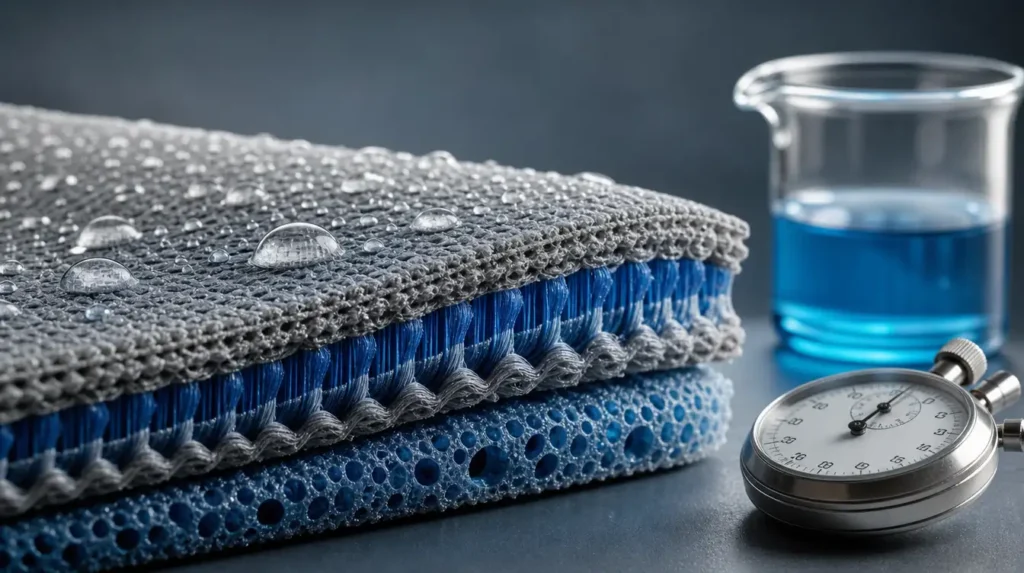
The Physics of Moisture Transport in Textiles
The movement of moisture through a textile is governed by three primary physical mechanisms that operate simultaneously and interact in complex ways. Understanding these mechanisms is essential to appreciating why modern wicking fabric design requires such careful engineering and why some fabrics dramatically outperform others despite appearing similar on the surface. The three mechanisms are capillary action, evaporative diffusion, and absorption-desorption cycles, each of which can be optimized through specific fiber and construction choices. The interaction between these mechanisms determines the fabric’s overall moisture management profile, including the rate of moisture transport from skin to outer surface, the distribution of moisture across the fabric area, and the rate of evaporation to the surrounding air.
Capillary Action and Wicking Speed
Capillary action is the dominant mechanism for moving liquid moisture through a fabric structure. The phenomenon occurs when liquid is drawn through narrow channels by surface tension and adhesion forces between the liquid molecules and the channel walls. In a textile, the channels are formed by the spaces between fibers within yarns and between yarns within the fabric structure. The narrower the channels and the more strongly the liquid adheres to the channel walls, the faster the capillary movement. This explains why fabrics constructed from fine-denier filament yarns with hydrophilic surface treatments often outperform fabrics made from coarser yarns with hydrophobic surfaces, even when both are constructed from polyester or other synthetic base fibers.
The geometry of capillary channels can be deliberately engineered through fiber cross-section design. Round-section fibers produce relatively uniform capillary spaces between adjacent fibers, while engineered cross-sections including trilobal, hexagonal, channeled, and gear-shaped profiles create asymmetric channels that promote directional moisture transport. The patented Coolmax fiber developed by Invista uses a tetrachannel cross-section that creates four parallel grooves running the length of each fiber, dramatically increasing the surface area available for moisture transport while maintaining mechanical properties suitable for high-volume knitting. According to official technical documentation from Invista, the engineered cross-section produces moisture transport rates approximately three to five times faster than equivalent fabrics made from round-section polyester fibers. The speed advantage translates directly into the dry-skin sensation that wearers associate with high-performance activewear. Other major fiber suppliers have developed competing engineered cross-section technologies including Toray’s hexagonal cross-section polyester, Asahi Kasei’s channeled fiber profiles, and Hyosung’s gear-shaped polyester variants. Each design produces a similar performance objective through different geometric approaches, and the choice between them often depends on the fiber supplier relationship of the fabric mill rather than on dramatic performance differences between the alternatives. Brand customers selecting fabrics should evaluate the actual performance through standardized testing rather than relying on the brand name of the underlying fiber technology, since the fabric construction and finishing chemistry often have larger effects on the finished fabric performance than the specific fiber technology selection. The fiber technology choice also affects the cost positioning, with proprietary engineered fibers typically commanding a 20 to 40 percent premium over standard round-section polyester at the fiber level, though this premium translates to a smaller percentage at the finished fabric level after accounting for yarn texturing, knit construction, and finishing chemistry costs.
Evaporative Cooling and Surface Area Distribution
Once moisture has been transported away from the skin to the outer fabric surface, the second critical performance dimension is the rate of evaporation to the surrounding air. Evaporation depends on the surface area of moisture exposed to the air, the temperature and humidity of the surrounding air, the air velocity at the fabric surface, and the vapor pressure differential between the wet fabric and the air. The most effective Moisture Wicking Fabric Technology designs maximize the spreading of moisture across the outer fabric surface, increasing the evaporation surface area and accelerating the cooling effect. This spreading function is sometimes called moisture transport area expansion or wicking spread, and it is measured through standardized laboratory tests that quantify the area of fabric reached by a measured volume of moisture within a specific time interval.
The construction features that promote moisture spreading include differential capillary structures where the outer fabric layer has finer capillary channels than the inner layer, creating a gradient that pulls moisture from inside to outside. Bicomponent fiber blends combining hydrophilic and hydrophobic fiber types in specific arrangements also support directional moisture transport. The two-layer pique knit structures common in performance polo shirts deliberately create a hydrophobic inner face and a hydrophilic outer face, producing a moisture pump effect that keeps the skin dry while spreading moisture across the larger outer surface for evaporation. The engineering of these multi-layer structures represents a more advanced level of textile design than single-construction fabrics, and the resulting performance differential is substantial across most activity profiles.
Absorption-Desorption and Hydrophilic Treatments
The third moisture management mechanism involves chemical absorption of moisture vapor by the fiber substance itself, followed by desorption to the surrounding environment as the fabric dries. Natural fibers including cotton, wool, and silk absorb moisture vapor up to 8 to 16 percent of their dry weight before reaching saturation, while synthetic fibers including polyester and nylon absorb less than 1 percent of their weight in moisture. The absorption capacity affects both the perceived comfort during low-intensity activity and the recovery time after sweating. Cotton’s high absorption capacity feels comfortable for short periods but becomes problematic during sustained exertion because the saturated fabric stays wet for extended periods and loses its insulating properties.
Modern Moisture Wicking Fabric Technology often combines synthetic substrates with hydrophilic surface treatments that encourage moisture spreading without the saturation problems of natural fibers. Common treatments include polyethylene glycol grafting, low-surface-tension finishing chemistry, and plasma surface modification. These treatments are typically applied at the dyeing and finishing stage of fabric production and can survive 50 or more home laundering cycles when properly applied. The treatments fundamentally change the surface chemistry of the fibers, converting hydrophobic polyester surfaces into hydrophilic surfaces that attract and spread water rather than repelling it. The durability of the surface treatment varies across treatment chemistries, with some treatments showing performance degradation after 20 to 30 wash cycles while premium treatments maintain performance through 50 or more wash cycles. Brand specifications should include wash durability requirements appropriate to the expected garment life, and verification testing should include performance evaluation after the specified wash cycle count to confirm the treatment delivers the claimed durability. The interaction between fiber chemistry, yarn structure, fabric construction, and surface treatment is what defines the overall moisture management performance of the finished fabric. Brands developing performance apparel can review our category capabilities through our Leggings and Base Layer production pages.
Fiber and Yarn Engineering for Performance Apparel
The selection of fibers and yarn structures forms the foundation of fabric performance. Each fiber type carries inherent properties that affect moisture management, durability, hand feel, drape, and thermal characteristics. The yarn architecture, including filament count, twist, and texturing, further modifies these inherent properties to deliver the desired performance profile. Understanding the fiber and yarn engineering choices available helps brand customers specify fabrics that match their performance requirements while balancing cost, sustainability, and manufacturing considerations. The leading fiber suppliers including Invista, Toray, Asahi Kasei, and Hyosung have developed proprietary fiber technologies that provide differentiated performance, with the engineering choices ultimately determining whether the finished garment delivers on its performance claims.
Polyester Variants and Performance Characteristics
Polyester is the dominant fiber in performance apparel due to its combination of moisture management capability, durability, dimensional stability, dye affinity, and cost. Standard round-section polyester delivers moderate moisture management when combined with appropriate yarn structure and surface treatment, and it remains the most cost-effective option for entry-level performance fabrics. Engineered-section polyesters including Coolmax, Coolplus, and Wickron use modified cross-sections to create internal capillary channels that accelerate moisture transport. Hollow-section polyesters reduce yarn weight while improving thermal insulation through trapped air, supporting cold-weather base layer applications. Microfiber polyester at deniers below 0.8 dpf produces fine yarn structures with high surface area, enhancing moisture spreading and producing the soft hand feel associated with premium activewear. Recycled polyester from PET bottles or chemically recycled polyester from textile waste provides similar performance to virgin polyester while supporting sustainability goals, and is now widely available across the major performance fiber suppliers.
The moisture regain of polyester is approximately 0.4 percent at standard conditions, which means polyester fibers themselves do not absorb meaningful amounts of moisture. The moisture management performance therefore depends entirely on the yarn structure, fabric construction, and surface treatment rather than fiber absorption. This makes the engineering of capillary channels through fiber cross-section, yarn texturing, and knit structure particularly important for polyester-based fabrics. Well-engineered polyester performance fabrics can transport moisture from skin to outer surface in 5 to 30 seconds and dry completely in 15 to 45 minutes after saturation, depending on the specific construction and ambient conditions. The drying time difference between standard polyester and engineered polyester is often more dramatic in real-world conditions than in laboratory tests because the engineered fibers maintain their performance after multiple wash cycles while standard polyester treatments may degrade. Brand teams developing performance apparel collections should test fabric performance after 20 and 50 wash cycles to verify that the moisture management performance remains consistent across the expected garment life rather than only at point-of-purchase. Fabric mills with mature performance fabric programs maintain washing test capabilities and can provide certified test data showing the post-wash performance, supporting brand product development decisions with confidence about long-term consumer experience.
Nylon and Spandex Blends for Stretch Applications
Nylon fibers including nylon 6 and nylon 6,6 provide higher abrasion resistance, smoother hand feel, and slightly higher moisture regain (4 percent versus 0.4 percent for polyester) than polyester at comparable yarn structures. Nylon’s moisture management performance is often enhanced through similar engineered cross-sections and surface treatments to those used with polyester. The smoother surface and superior abrasion resistance make nylon preferred for high-friction applications including swimwear, compression garments, and outerwear shells. Nylon also accepts a wider range of dye chemistries, including acid dyes that produce deeper, more saturated colors than the disperse dyes typically used with polyester.
Spandex (also known as elastane or by the brand name Lycra) is rarely used as a 100 percent fiber but provides essential stretch and recovery in blended fabrics. Spandex content of 5 to 15 percent by weight is typical in performance leggings, sports bras, compression wear, and athletic shorts, while content of 15 to 25 percent is common in shapewear and high-compression garments. The spandex content significantly affects the moisture management performance because spandex itself absorbs essentially no moisture and adds capillary channel complexity to the fabric structure. The interaction between the spandex filaments and the dominant nylon or polyester yarn determines the overall fabric performance, with well-engineered blends maintaining excellent moisture management while delivering the stretch and recovery required for athletic movement. The spandex content also affects washing care requirements, with most performance fabrics specifying gentle wash cycles, low temperature drying, and avoidance of fabric softeners that can degrade spandex elasticity over time.
Specialty Fibers and Sustainable Alternatives
Beyond the dominant polyester, nylon, and spandex fibers, several specialty options provide differentiated performance for specific applications. Merino wool blends combine the natural odor resistance and thermal regulation of merino with the durability and quick-dry properties of synthetic fibers, supporting premium hiking, outdoor, and base layer applications. Bamboo viscose offers natural antibacterial properties and a soft hand feel, though the moisture management performance varies depending on the specific viscose process and finishing chemistry. Tencel (lyocell) provides moisture management performance approaching synthetic fibers with the renewable raw material profile that supports sustainability claims. Modal viscose offers exceptional softness and drape but limited moisture management without significant blending or finishing.
The sustainable fiber landscape has evolved substantially over the past five years, with recycled polyester, recycled nylon, organic cotton, and various bio-based alternatives now widely available. The Global Recycled Standard (GRS) certification provides chain-of-custody verification for recycled content claims, and certified factories can document the recycled content from raw fiber through finished garment. According to the Textile Exchange GRS framework, the certification covers traceability, social compliance, environmental responsibility, and chemical management throughout the supply chain. Brands integrating sustainable fibers into performance apparel collections can maintain comparable moisture management performance to virgin synthetic fibers while supporting their sustainability narrative. The verification of recycled content claims requires chain-of-custody documentation from the recycled feedstock supplier through the fiber producer, fabric mill, and finished garment manufacturer, with each stage maintaining audit-ready records that support the GRS certification audit. Brands operating with mature sustainability programs typically integrate the recycled content tracking into their broader supply chain documentation systems, allowing the recycled content data to feed into product-level sustainability claims and into corporate ESG reporting. According to Textile Exchange market reports, the cost premium for recycled polyester has compressed substantially over recent years, typically running 5 to 15 percent above virgin polyester pricing, which makes the sustainable choice commercially viable for most product categories. Brands evaluating sustainable activewear can review our capabilities through our Swimsuit production page, where recycled polyester applications are common.
Knit Structure and Fabric Construction
The knit structure of a performance fabric determines how the engineered fibers and yarns assemble into a textile that interacts with the wearer’s skin and the surrounding environment. Different knit constructions produce different moisture management profiles, durability characteristics, hand feel, drape, and aesthetic appearance. The interaction between yarn properties and knit structure means that the same yarn can produce very different fabric performance when knit on different machines or with different stitch patterns. Brand customers and OEM partners selecting fabric constructions for specific applications need to understand these construction options to match the fabric to the intended end use.
Single jersey knit is the most basic and widely used construction for T-shirts, athletic shorts, and lightweight performance garments. The structure produces good elasticity in the width direction, moderate elasticity in the length direction, and a smooth face with a more textured back. Single jersey performance fabrics typically use engineered polyester or nylon yarns combined with appropriate finishing chemistry to deliver moisture management. The construction is efficient to knit and supports high production speeds, making it the most cost-effective choice for high-volume programs. Pique knit, also known as honeycomb knit, produces a textured surface with raised diamond patterns that increase the outer surface area and create the classic appearance associated with polo shirts. The textured outer surface enhances moisture spreading and evaporation, while the smoother inner surface maintains skin comfort. Performance pique fabrics combine the aesthetic appeal of traditional polo shirt construction with the moisture management performance required for athletic applications. The polo category sits at the intersection of activewear and dress apparel, supporting both athletic activities and casual or business-casual occasions, which expands the addressable use cases and extends the wearing time per garment. Fabric specifications for performance polo shirts therefore need to balance moisture management capability with the structured drape and refined hand feel that consumers expect in dress-adjacent apparel.
Double knit and interlock constructions produce thicker, more stable fabrics with similar appearance on both faces and dimensional stability that resists curling and stretching. These constructions support compression wear, structured polo shirts, and premium athletic applications where the heavier hand and more refined appearance justify the higher fabric cost. Mesh and open-knit constructions produce highly breathable fabrics with large open spaces that maximize air flow and evaporation, supporting hot-weather applications and high-intensity training apparel. The mesh constructions are often used as panels or zoned applications within garments rather than as full-body fabrics, allowing the brand to engineer breathability where the wearer needs it most while using more substantial constructions in other zones. Brands developing performance apparel can review production capabilities for various knit constructions through our Polo and T-shirt category pages.
The choice of knitting machinery also affects the achievable knit structures and the production economics of different fabric constructions. Circular knitting machines produce single jersey, pique, and double knit structures at high production speeds suitable for high-volume programs, while flat knitting machines support more complex pattern structures, fully fashioned garment panels, and engineered seamless constructions. Warp knitting machines including tricot and raschel produce specific structures used for swimwear, intimate apparel, and certain athletic applications. Each machinery type carries distinct production economics and quality characteristics, and the brand customer should match the machinery type to the production volume, complexity, and cost target for the specific product. Manufacturing partners operating with diverse knitting machinery can produce a wider range of fabric constructions and offer brand customers more flexibility in product development, while specialized manufacturers concentrated on specific machinery types may offer cost advantages within their specialty.
Comparing Moisture Management Fabric Technologies
A direct comparison across the major moisture management fabric technologies helps brand customers select the appropriate construction for specific product applications. The table below summarizes the key performance characteristics, typical applications, and cost positioning for the most common Moisture Wicking Fabric Technology approaches available in the global performance apparel market in 2026. The comparison is intended as a strategic reference rather than precise specification data, and brands should validate specific performance against their own testing protocols and supplier samples.
| Technology Name | Base Fiber | Wicking Mechanism | Wicking Speed | Drying Time | Hand Feel | Typical Applications | Cost Index |
|---|---|---|---|---|---|---|---|
| Standard Polyester Knit | Round-section polyester | Surface treatment only | 30-60 seconds | 30-60 minutes | Smooth, slightly synthetic | Entry activewear, basic T-shirts | 1.0x baseline |
| Coolmax (Invista) | Tetrachannel polyester | Engineered cross-section | 5-15 seconds | 15-30 minutes | Smooth, dry hand | Premium activewear, training | 1.4-1.6x |
| Dri-FIT (Nike) | Engineered polyester blend | Multi-layer construction | 10-25 seconds | 20-40 minutes | Soft, refined | Athletic shirts, training apparel | 1.5-1.8x |
| Climalite (Adidas) | Polyester blend | Knit structure plus treatment | 15-30 seconds | 20-40 minutes | Smooth, comfortable | Sports apparel, athletic shorts | 1.4-1.7x |
| Recycled Polyester (GRS) | Recycled PET polyester | Same as virgin polyester | 20-45 seconds | 25-50 minutes | Smooth, similar to virgin | Sustainable activewear, swimwear | 1.1-1.3x |
| Nylon-Spandex Blend | Nylon 6,6 plus spandex | Capillary plus stretch | 15-35 seconds | 25-45 minutes | Smooth, stretchy | Leggings, compression wear, swim | 1.3-1.5x |
| Merino Wool Blend | Merino plus polyester | Natural absorption plus capillary | 30-60 seconds | 45-90 minutes | Soft, natural | Outdoor, base layer, premium | 2.0-3.0x |
| Polyester Pique Knit | Engineered polyester | Two-layer structure | 10-25 seconds | 25-45 minutes | Textured, structured | Performance polo shirts | 1.3-1.5x |
The comparison reveals that the engineered fiber technologies (Coolmax, Dri-FIT, Climalite) deliver substantially faster wicking speeds and shorter drying times than standard polyester at a moderate cost premium of 40 to 80 percent above baseline. The recycled polyester option delivers comparable performance to virgin polyester at a 10 to 30 percent premium, supporting both performance and sustainability objectives. The merino wool blends carry the highest cost but provide unique performance characteristics including odor resistance and thermal regulation that justify the premium for specific outdoor and base layer applications. Brand customers selecting fabrics should match the technology choice to the product’s performance requirements, target retail price point, and brand positioning rather than defaulting to the highest-performance option for every application.
Testing Standards for Moisture Management Performance
Quantifying moisture management performance requires standardized testing protocols that produce comparable results across different fabrics, suppliers, and laboratories. The textile industry has developed several test standards that measure different aspects of moisture management capability, and brand customers specifying performance fabrics typically reference these standards in their fabric specifications and quality control documentation. Understanding the available tests helps brand teams interpret supplier claims, validate fabric samples, and establish meaningful quality acceptance criteria.
AATCC 195 and the Moisture Management Tester
AATCC Test Method 195 is the most comprehensive moisture management test, using the Moisture Management Tester (MMT) instrument developed at Hong Kong Polytechnic University. The test simultaneously measures multiple moisture transport properties as a fixed volume of test solution is introduced to the fabric, including the time for moisture to spread, the absorption rate at the top and bottom surfaces, the maximum wetted radius, the spreading speed, and the unidirectional moisture transport capability. The instrument produces an Overall Moisture Management Capability (OMMC) grade on a 0 to 1 scale that summarizes the fabric’s overall performance. OMMC values above 0.8 indicate excellent moisture management, values between 0.6 and 0.8 indicate good performance, values between 0.4 and 0.6 indicate moderate performance, and values below 0.4 indicate poor moisture management.
The MMT test produces graphical visualizations that show the moisture distribution across the fabric area at different time intervals, providing a more nuanced understanding of fabric performance than single numerical values can convey. Performance apparel brands typically specify minimum OMMC values for different product categories, with high-intensity training apparel requiring OMMC of 0.8 or higher, general activewear requiring 0.6 or higher, and casual athleisure requiring 0.4 or higher. The AATCC 195 test has become the industry standard for moisture management characterization, and most major fabric suppliers maintain the testing equipment in their development laboratories. According to AATCC technical documentation, the test method has been refined through multiple revisions to improve reproducibility and correlation with wearer perception. The reproducibility of moisture management testing remains a practical concern, with inter-laboratory variation that can exceed 0.1 OMMC points for the same fabric tested at different laboratories. Brand customers establishing supplier qualification programs should designate specific accredited laboratories for verification testing rather than accepting test results from any laboratory, and they should establish reference fabrics that allow ongoing monitoring of laboratory performance. The investment in laboratory consistency pays back through more reliable supplier evaluation and stronger confidence in performance specification compliance across the supply chain.
Vertical Wicking and Sweat Transport Tests
The vertical wicking test (AATCC 197) measures the rate at which moisture rises through a vertically suspended fabric strip dipped in water at the bottom edge. The test quantifies the capillary transport speed in the vertical direction, providing a simpler measurement than the comprehensive AATCC 195 method but with less complete characterization of overall moisture management. Vertical wicking heights of 100 to 150 mm in 30 minutes indicate strong capillary action, while heights below 50 mm indicate weak moisture transport. The test is widely used as a quick screening tool during fabric development and for routine quality control of finished fabrics.
Drying time tests measure the time required for a saturated fabric to return to its dry weight under controlled environmental conditions. The AATCC 199 test uses a heating plate to accelerate drying and produces results in minutes rather than the hours required for ambient drying. Drying time correlates with the wearer’s perception of garment comfort during and after exercise, with shorter drying times indicating fabrics that maintain dry comfort longer during sustained activity. Brand specifications often combine multiple test results, requiring fabrics to meet minimum thresholds on AATCC 195 OMMC, AATCC 197 vertical wicking height, and AATCC 199 drying time to ensure comprehensive moisture management performance. The combined specification approach prevents the situation where a fabric performs well on one measurement but poorly on others, which can produce misleading conclusions about overall moisture management capability. Some fabrics achieve high vertical wicking heights through aggressive surface treatments but show limited spreading area in the AATCC 195 test, indicating that the moisture rises through capillary action but does not distribute effectively across the fabric area. The combined specification approach catches these performance gaps and ensures that the selected fabric delivers comprehensive moisture management rather than excelling on a single measurement.
Air Permeability and Thermal Resistance
Beyond direct moisture management tests, several related tests characterize the thermal and ventilation properties that interact with moisture transport. Air permeability tests including ASTM D737 measure the volume of air that passes through a unit area of fabric under a specified pressure differential, providing a quantitative measure of fabric breathability. Higher air permeability supports faster evaporation of moisture from the fabric surface but may also reduce thermal insulation in cold conditions. Thermal resistance tests including ASTM F1868 measure the heat flow through fabric under controlled temperature and humidity conditions, characterizing the fabric’s insulating performance.
Detailed protocols for these tests are documented through ASTM International standards publications. The combination of moisture management, air permeability, and thermal resistance tests provides a comprehensive characterization of fabric performance that supports product development decisions across activity profiles and environmental conditions. Brand customers developing collections for hot-weather endurance running prioritize moisture management and air permeability over thermal insulation, while brands developing cold-weather base layer collections balance moisture management against thermal retention. The testing data supports informed fabric selection that matches the performance profile to the intended end use, reducing the risk of misalignment between marketing claims and actual product performance. Importers and brand teams managing supplier qualification programs should establish testing protocols early in the product development cycle and require suppliers to provide test data with each fabric submission.
Application Areas and Category-Specific Considerations
The application of moisture wicking engineering varies significantly across product categories, with each category presenting specific performance requirements, testing protocols, and design considerations. Brands developing collections across multiple activewear categories benefit from understanding the category-specific application patterns to align fabric selection with end-use requirements and consumer expectations.
High-Intensity Training and Running Apparel
High-intensity training and running apparel face the most demanding moisture management requirements. Sustained aerobic activity produces high sweat rates that can reach 1 to 3 liters per hour during intense exercise in warm conditions. Fabrics for these applications need to handle large moisture volumes while maintaining the dry skin sensation that supports continued performance. The construction typically combines engineered polyester fibers with multi-layer knit structures that pump moisture from the skin-facing surface to the outer surface for evaporation. Mesh panels and zoned ventilation enhance breathability in high-sweat zones including the back, underarms, and chest. The drying time is critical because the wearer often continues activity for extended periods, and a fabric that stays wet causes chafing, weight gain, and thermal discomfort. The chafing risk is particularly acute in body areas with skin-on-skin contact including the inner thighs, underarms, and the band areas of bras and shorts, where wet fabric friction can produce significant skin irritation during sustained activity. Garment design considerations including flatlock seam construction, gusseted panels, and strategic seam placement help reduce the chafing risk, but the foundation remains the moisture management performance of the fabric itself.
The fabric weight for high-intensity training is typically 120 to 180 grams per square meter, balancing moisture management capacity with the lightweight feel that consumers associate with performance. Heavier fabrics provide more capillary capacity but feel substantial and reduce range of motion, while lighter fabrics may saturate quickly during high-output activity. The optimal weight depends on the specific activity profile and environmental conditions. Production for these applications requires precise yarn selection, knit gauge control, and finishing chemistry application, with experienced manufacturers maintaining tight quality controls throughout the production process to ensure consistent performance across every garment.
Yoga, Pilates, and Studio Activities
Yoga, pilates, and studio activities present different moisture management requirements than high-intensity training. The activity intensity is typically lower but sustained over longer durations, and the body positions require fabrics with high stretch, soft hand feel, and modest opacity to support body coverage during dynamic movements. Nylon-spandex blends are the dominant fabric category for these applications, providing the four-way stretch required for full range of motion combined with moisture management performance suited to the moderate sweat rates typical of these activities. The fabric weight is typically 180 to 260 grams per square meter, providing the substantial hand feel and opacity that consumers expect in studio apparel.
The squat-test for opacity has become a standard quality criterion for yoga and studio leggings, with the fabric required to maintain full opacity when stretched in the squat position. The test prevents the embarrassing transparency issues that affected early performance leggings before the fabric engineering matured. The squat-test performance depends on the fabric weight, knit gauge, fiber selection, and the construction of the front and back panels. Brand customers should specify the squat-test as a quality acceptance criterion and require supplier documentation of the test results for production samples. The squat-test failures often originate in subtle variations in fabric weight or knit gauge that fall within nominal specifications but produce inadequate opacity in stretch conditions. Establishing tighter specification limits and rigorous incoming inspection prevents these issues from reaching production garments. Brands sourcing yoga and studio apparel can review the production capabilities through our Leggings page.
Manufacturing Implications and Quality Control
The manufacturing of high-performance moisture-wicking apparel requires precise control across multiple production stages, from fabric receipt through finished garment shipment. The variability in raw fabric performance, even within the same fabric specification from the same supplier, requires established quality control protocols at the receiving inspection stage. Production cutting and sewing must preserve the engineered fabric properties without introducing damage that compromises moisture management performance. The finishing and packing operations must avoid contamination, mechanical damage, and surface treatment degradation that could affect performance during consumer use. Manufacturers operating with mature quality systems perform incoming fabric testing, in-process inspection during production, and end-of-line quality verification before shipment.
The fabric receipt inspection should include visual examination, weight verification, gauge measurement, color shade matching, and selected performance testing against the supplier’s certificate of analysis. AATCC 195 OMMC testing on each fabric lot provides confirmation that the moisture management performance meets the specification, and the testing should be performed by an independent laboratory or by the manufacturer’s accredited internal laboratory. The cutting operation should use sharp, well-maintained blades to avoid fiber damage and excessive heat that can melt or distort the engineered fiber structures. The sewing operation should use needle types and sizes appropriate to the fabric construction, avoiding excessive needle heat that can damage the fibers in performance fabrics with heat-sensitive surface treatments. Brands sourcing performance apparel from production partners should verify that the manufacturer maintains these quality controls throughout the production process. The verification typically includes factory audits, review of quality system documentation, observation of production operations, and review of recent production quality records. Brand customers operating at meaningful scale should consider engaging independent quality consulting partners to support the manufacturer qualification and to provide ongoing in-line quality monitoring during the early production runs. The investment in rigorous quality verification at the front end of the supplier relationship pays back through fewer production issues, lower defect rates, and stronger long-term collaboration on continuous improvement.
The final quality inspection should include garment-level performance verification through wash testing, dimensional stability testing, and visual examination of seams and finishing details. Brand customers receiving production samples should perform their own performance verification before approving production, and they should establish ongoing quality monitoring protocols that include random sampling and laboratory testing of production garments. The investment in quality control pays back through reduced consumer complaints, lower warranty returns, and stronger brand reputation for delivering on performance claims. Brand teams ready to engage manufacturing partners with established performance apparel quality systems can review our manufacturing capability profile and connect through our Get A Quote page.
FAQ
How does Moisture Wicking Fabric Technology actually work?
A1: Moisture Wicking Fabric Technology works by combining several physical mechanisms that move moisture from the skin to the outer fabric surface where it can evaporate, supporting the body’s natural cooling function while keeping the skin-facing surface dry. The primary mechanism is capillary action, where liquid moisture is drawn through narrow channels formed by the spaces between fibers within yarns and between yarns within the fabric structure. Engineered fiber cross-sections including the tetrachannel structure used in Coolmax create internal channels that accelerate moisture transport compared to round-section fibers. The yarn structure including filament count, twist, and texturing further modifies the capillary behavior, while the knit construction including single jersey, pique, and double knit determines the overall moisture transport architecture of the finished fabric. Surface treatments applied during finishing chemistry convert hydrophobic synthetic fiber surfaces into hydrophilic surfaces that attract and spread water. The combined effect is that moisture moves from the skin to the outer surface within 5 to 30 seconds in well-engineered fabrics, then spreads across the outer surface to maximize the evaporation surface area, then evaporates to the surrounding air at rates that support the wearer’s thermal regulation. The dry-skin sensation that consumers associate with high-performance activewear is the result of this engineered moisture transport function operating effectively across the duration of physical activity. The wearer perception of dryness depends on multiple factors beyond the absolute moisture content of the fabric, including the rate of moisture removal from the skin surface, the temperature of the moisture, the air movement around the body, and the wearer’s individual sweat profile. Well-designed performance fabrics deliver dry-skin perception even during sustained sweating because the moisture is constantly being moved from the skin to the outer surface for evaporation, maintaining the dry skin-side condition that supports continued comfort. The technology has matured to the point where measurement standards including AATCC 195 can quantify the performance, and manufacturers can produce fabrics with consistent moisture management characteristics across production runs.
What is the difference between Coolmax, Dri-FIT, and recycled polyester for performance apparel?
A2: Coolmax, Dri-FIT, and recycled polyester represent different approaches to performance fabric engineering with distinct advantages and trade-offs for brand applications. Coolmax is a proprietary fiber technology from Invista that uses a tetrachannel cross-section to create internal capillary channels, producing wicking speeds approximately three to five times faster than round-section polyester. The fiber technology is licensed to fabric mills globally and supports a wide range of fabric constructions across activewear categories, with cost positioning approximately 40 to 60 percent above standard polyester. Dri-FIT is Nike’s proprietary moisture management technology that combines engineered polyester fibers with multi-layer knit constructions and specific finishing chemistry to deliver the performance profile that supports Nike’s product positioning. The technology is exclusive to Nike licensed manufacturers, so brands cannot directly source Dri-FIT for non-Nike products, although equivalent performance can be achieved through similar engineering approaches with other fiber suppliers. Recycled polyester is a sustainable alternative that uses recycled PET feedstock instead of virgin petrochemical feedstock, producing performance characteristics comparable to virgin polyester when manufactured with equivalent fiber engineering. The recycled polyester cost premium has compressed substantially over recent years, typically running 10 to 30 percent above virgin polyester, making it commercially viable for most product categories. Brands selecting between these technologies should consider the target retail price point, brand positioning, sustainability narrative, and the specific performance requirements of the end product. Many brands use combinations across their portfolio, deploying premium engineered fibers for high-end products and recycled polyester or standard engineered polyester for entry and mid-tier products. The portfolio approach allows brands to communicate distinct performance positioning across product tiers while managing the overall fabric cost structure for the collection. Some brands also reserve premium fiber technologies for specific high-visibility products including limited editions, signature athlete apparel, or marketing-led products that anchor the brand performance reputation, while using more cost-effective fabric solutions for the broader product range that drives volume sales.
How can brands verify that suppliers actually deliver the moisture management performance they claim?
A3: Verification of supplier moisture management performance claims requires structured testing protocols that combine third-party laboratory testing, ongoing production sampling, and consumer wear testing. The most reliable approach starts with specifying minimum performance thresholds in the fabric specification document, including AATCC 195 OMMC values, AATCC 197 vertical wicking heights, AATCC 199 drying times, and category-specific thresholds appropriate to the product application. Each fabric submission should be accompanied by a certificate of analysis from an accredited laboratory documenting the test results against the specification. Brands operating with sophisticated quality systems verify the supplier-provided test data through independent third-party testing on a sample basis, confirming that the production fabric matches the qualification samples. Ongoing quality monitoring should include random sampling of production fabrics, third-party testing of selected samples, and periodic comparison against benchmark fabrics to detect drift in supplier performance. Consumer wear testing on production garments provides validation that the laboratory test results translate into the wearer-perceived performance that drives consumer satisfaction. The testing investment is meaningful but typically represents less than 1 percent of fabric cost, and the returns from avoiding performance claim failures, brand reputation damage, and consumer returns substantially exceed the testing cost. Brand teams should resist the temptation to skip verification testing under cost pressure or schedule pressure, as the consequences of performance failures are difficult to recover from once products reach consumers. The structured verification approach also supports the documentation that may be required to defend performance claims in marketing communications, particularly in jurisdictions with active false advertising enforcement. The structured verification approach also supports brand differentiation in competitive markets where multiple brands make similar moisture management claims and consumers struggle to distinguish between genuine performance and marketing positioning. Brands with documented superior performance can use the test data in marketing communications, retail education, and consumer engagement to build authentic performance credibility. Regulatory enforcement of performance apparel marketing claims has intensified in the United States, the European Union, and several Asian markets, with regulators issuing fines and corrective action requirements for unsupported claims. Brands operating with structured testing protocols and documented test results are well-positioned to respond to regulatory inquiries and to defend their marketing claims through verifiable evidence rather than supplier assertions alone.
What fabric weight and construction is best for different activewear categories?
A4: The optimal fabric weight and construction varies substantially across activewear categories based on the activity intensity, environmental conditions, body coverage requirements, and consumer expectations. High-intensity training and running apparel typically uses fabric weights of 120 to 180 grams per square meter combined with engineered polyester fibers and multi-layer knit constructions that prioritize moisture management speed and breathability. Yoga and studio apparel typically uses 180 to 260 grams per square meter nylon-spandex blends that provide the four-way stretch, soft hand feel, and opacity required for studio activities. Athletic shorts typically use 140 to 180 grams per square meter polyester or polyester-spandex blends with single jersey or interlock constructions. Performance polo shirts typically use 160 to 200 grams per square meter pique knit constructions that combine the structured aesthetic of traditional polo shirts with the moisture management performance required for athletic applications. Outdoor and base layer apparel uses 150 to 220 grams per square meter for warm-weather applications and 200 to 350 grams per square meter for cold-weather applications, often combining merino wool blends or hollow-section polyester for thermal management. The category-specific weight ranges represent the conventional choices that have proven successful across the major activewear segments, but innovative brands sometimes deliberately deviate from convention to support distinctive product positioning. The deviation should be justified by clear performance benefits and validated through wear testing rather than pursued purely for differentiation, since unconventional fabric weights may produce consumer experience that differs from category expectations in unpredictable ways. Compression wear typically uses 200 to 300 grams per square meter nylon-spandex blends with high spandex content of 15 to 25 percent. The brand customer should match the fabric specification to the intended end use rather than defaulting to a single specification across the portfolio, and the development process should include wear testing across the relevant activity conditions to validate the fabric selection. Production partners with experience across multiple activewear categories can provide guidance on the appropriate specifications and can produce reference samples that demonstrate the performance characteristics for evaluation. Manufacturers familiar with the full activewear category landscape often spot opportunities to optimize fabric specifications across the brand’s portfolio that the brand may not have identified internally, including consolidation of similar fabrics, substitution of more cost-effective alternatives at equivalent performance, and integration of emerging fabric technologies that improve performance at moderate cost. The reference sample approach allows brand product development teams to feel the actual fabric performance and compare alternatives side-by-side rather than relying on specification documents alone, which often understate the practical differences between fabrics that read similarly on paper. Most experienced manufacturing partners can produce reference samples within 14 to 21 days of specification confirmation, supporting an efficient development process that reaches actionable comparisons quickly.
How does moisture wicking technology affect the cost and lead time of performance apparel production?
A5: Moisture Wicking Fabric Technology affects performance apparel production costs through several pathways including raw fabric cost, processing complexity, quality control investment, and finishing chemistry. Engineered fiber technologies including Coolmax, Dri-FIT-equivalent fabrics, and similar premium polyester variants typically run 40 to 80 percent above standard polyester at the fabric level, although this premium represents only a portion of the finished garment cost. The total fabric cost premium translates to approximately 0.50 to 1.50 USD per garment for typical activewear constructions, depending on the specific fabric selection and the garment yardage requirement. The processing complexity is similar to standard polyester for most applications, although the finer yarn structures and engineered fiber cross-sections may require slightly more attention to needle selection, machine settings, and operator skill to avoid fiber damage during sewing. Quality control investments including fabric receiving inspection, in-process verification, and finished garment testing add 1 to 3 percent to total production cost but pay back substantially through reduced returns and brand reputation protection. The lead time impact depends on the specific fabric selection, with proprietary fiber technologies sometimes requiring longer mill lead times of 60 to 90 days versus 45 to 60 days for standard polyester. Brand teams should plan their development calendar to accommodate the fabric lead time and should establish supplier relationships that support consistent fabric availability across production seasons. The total cost and lead time impact of premium moisture management technology is typically modest relative to the consumer perceived value and brand differentiation that the technology supports, making it a sound investment for most performance apparel categories. Brand teams should also consider the long-term commercial value of the fabric technology choice beyond the direct cost impact. Premium fabric technologies often support higher retail pricing, stronger consumer perception of brand quality, and more positive product reviews that compound brand value over multiple product cycles. The investment in superior fabric technology typically pays back through these compounding effects rather than only through the per-unit financial calculation, supporting longer-term brand strategy in addition to immediate product performance objectives. The cumulative effect of consistent superior performance across multiple product cycles builds brand equity that justifies premium pricing and supports market share defense against lower-cost competitors who lack the engineered performance foundation. Brands that have invested consistently in fabric technology over multiple seasons typically maintain stronger consumer perception of performance leadership and command pricing premiums that competitors cannot easily replicate, creating sustainable competitive advantages in performance apparel categories. The pattern is observable across the leading performance apparel brands globally, where investment in fabric technology and quality systems has produced market positions that have proven durable through multiple economic cycles and competitive challenges.
Conclusion
Moisture Wicking Fabric Technology has evolved from a simple marketing claim into a sophisticated engineering discipline that combines fiber chemistry, yarn architecture, knit structure, and chemical finishing to deliver measurable performance outcomes. The physics of moisture transport through textiles involves capillary action, evaporative diffusion, and absorption-desorption mechanisms that interact in complex ways to produce the dry-skin sensation that consumers associate with high-performance activewear. Modern engineered fabrics can move moisture from skin to outer surface in 5 to 30 seconds while maintaining a dry skin-side feel that lasts through hours of sustained exertion, representing a substantial advancement over the basic polyester knits of the 1990s.
The selection of fibers, yarn structures, knit constructions, and finishing chemistry determines the overall fabric performance profile, and brand customers benefit from understanding these engineering choices to make informed decisions about fabric specifications and supplier selection. The major fiber suppliers including Invista, Toray, Asahi Kasei, and Hyosung have developed proprietary fiber technologies that provide differentiated performance, while recycled polyester and other sustainable alternatives now deliver comparable performance to virgin synthetic fibers at modest cost premiums. The standardized testing protocols including AATCC 195, AATCC 197, and AATCC 199 provide quantitative methods to verify fabric performance against specifications and to monitor production consistency across supplier relationships.
The manufacturing of high-performance moisture-wicking apparel requires precise control across multiple production stages, from fabric receipt through finished garment shipment. Quality systems that include incoming fabric testing, in-process verification, and finished garment performance testing protect the engineered fabric properties through the production process and ensure that consumers receive products that deliver on the performance claims. The cost of comprehensive quality systems is modest relative to the brand value created through consistent product performance, with many brands reporting that quality system investments produce returns of 5 to 10 times the direct cost through reduced returns, lower warranty claims, and stronger consumer reviews. The compounding effect across product categories and across multiple production seasons makes quality system investment one of the most reliable contributions to brand value in performance apparel. Brand customers selecting production partners should verify the manufacturer’s quality systems, technical capabilities, and experience with the specific fabric technologies and product categories required for their collections. The investment in working with mature manufacturing partners pays back through consistent product quality, reduced returns, and stronger brand reputation in the competitive performance apparel market.
Brands ready to develop performance apparel collections with engineered moisture management can connect with experienced manufacturing partners who maintain the technical capabilities, quality systems, and category expertise required for the major activewear segments. Our team can support fabric development and production through our Get A Quote process, drawing on over 50 years of OEM and ODM manufacturing experience and our integrated production capabilities across activewear, performance, and athleisure categories. The combination of engineered fabric technology and disciplined manufacturing execution is what transforms a fabric specification into a finished garment that delivers the performance experience consumers expect from premium activewear brands.