
OEM Apparel Development Sample Services: What Clothing Brands Should Expect
In the apparel industry, sample development services serve as the critical bridge that transforms a brand concept into a production-ready product. Many emerging and established brands overlook details during the sampling stage, leading to fit issues, material deviations, or cost overruns in bulk production. Partnering with a capable OEM apparel manufacturer effectively controls these risks and improves overall supply chain efficiency. This article provides an in-depth professional analysis of the core sample development process, risk management, and practical cases to help brands set accurate expectations.
Preface
When launching a new product line, the most common challenge for clothing brands is converting design drawings into physical samples that meet market needs. Without rigorous technical validation at the sampling stage, subsequent bulk production may face rising return rates, delayed deliveries, or even damage to brand image. Industry experience shows that a complete sample development process should at least cover pattern making, fabric confirmation, fit testing, and pre-production sample approval. A professional OEM apparel manufacturer typically maintains an in-house pattern team, CAD systems, and multi-layer quality control mechanisms that can produce highly accurate samples quickly while delivering complete technical documentation. This reduces the time brands spend exploring on their own and reveals risks early to avoid costly later revisions. The following sections explain key points at each stage, supported by real cases and data, to help brands form correct expectations.
Core Definition and Brand Value of OEM Sample Development
OEM sample development means the brand entrusts its design concept to the manufacturer, who executes the full process from pattern making and fabric sourcing to sewing and final sample confirmation. Unlike pure contract manufacturing, a professional OEM apparel manufacturer intervenes with technical evaluation already at the sampling stage, offering fit suggestions, material alternatives, and cost optimization recommendations. The core value of this service lies in early problem detection, such as excessive fabric shrinkage, insufficient seam strength, or out-of-tolerance measurements. Through a rigorous sample cycle, brands can lock specifications before bulk production and avoid large-scale rework. From an EEAT perspective, manufacturers with decades of experience can judge the real-wear performance of specific fabrics based on past project data and disclose potential risks, such as poor colorfastness that may cause shade variation after washing. Alternatives include recommending GRS-certified recycled materials or adjusting sewing techniques to improve durability. Authoritative external literature such as the GRS standard from Textile Exchange can serve as a reference for material selection https://textileexchange.org/standards/grs/. Brands that skip this stage often discover problems only after bulk production, resulting in revision costs several times higher. Professional services therefore become the first line of defense for risk control.
Sample development is not simply sewing one garment; it is the establishment of a reproducible production standard. The manufacturer must produce a complete technical package that includes points of measure, tolerance ranges, and construction details so that any subsequent production line can replicate the style accurately. In practice, incomplete technical packages often cause samples to go back and forth more than three times, delaying delivery. Choosing a partner with internal CAD and pattern-making capabilities can keep revision rounds within a reasonable range. Regarding risk disclosure, attention must be paid to the possibility that sample fabric may differ from bulk batches in hand-feel or color; therefore requiring pre-production samples to use actual bulk materials is essential. Alternatives include first completing structural validation with stock fabric and then confirming the final sample with production fabric. This process has become the industry standard for reducing failure rates.
OEM apparel manufacturer: Key Technical Links in the Sample Development Process
The sample development process is usually divided into three main stages: proto sample, fit sample, and pre-production sample. The proto sample focuses on verifying structure and construction logic, the fit sample confirms actual wear performance, and the pre-production sample locks all materials and processes as the bulk production benchmark. A professional OEM apparel manufacturer provides detailed feedback reports at each stage that include measurement data, photos, and improvement suggestions. From a professional judgment perspective, if the brand’s technical package lacks stitch type or SPI (stitches per inch) specifications, the manufacturer should proactively supplement and obtain confirmation to avoid later disputes. The most common risks involve measurement tolerances set too tight, which lowers production yield, or too loose, which causes inconsistent fit. An alternative is to establish reasonable tolerance ranges according to relevant ASTM apparel measurement standards https://www.astm.org/. Introducing 3D virtual try-on technology at this stage can further reduce the number of physical samples, but final physical confirmation remains necessary.
In the fabric confirmation stage, the manufacturer must perform tests for shrinkage, colorfastness, and tear strength. Practical experience shows that untested recycled polyester may exhibit high shrinkage that affects finished garment dimensions. Professional teams cite relevant ISO test methods and provide reports for brand reference https://www.iso.org/. Risk disclosure includes the possibility that certain specialty fabrics may develop needle holes or pilling during sewing, requiring advance adjustment of needle size and presser-foot pressure. Alternatives include selecting proven supplier fabrics or adjusting design details to accommodate material characteristics. The entire process emphasizes data-driven decisions rather than subjective judgment to ensure traceability.
Pattern Making and CAD System Application
Pattern making is the foundation of sample accuracy. Professional teams digitize paper patterns with CAD systems and perform preliminary marker simulations to evaluate fabric utilization. At this stage every seam allowance and notch position must be confirmed correct to avoid alignment problems in bulk production. Reasoning shows that if the pattern does not account for fabric elasticity, subsequent fit samples may distort. The risk of manual pattern making is human error, while CAD greatly reduces this problem. Alternatives include preparing both flat and three-dimensional patterns to handle different fabric characteristics.
Fit Testing and Measurement Verification
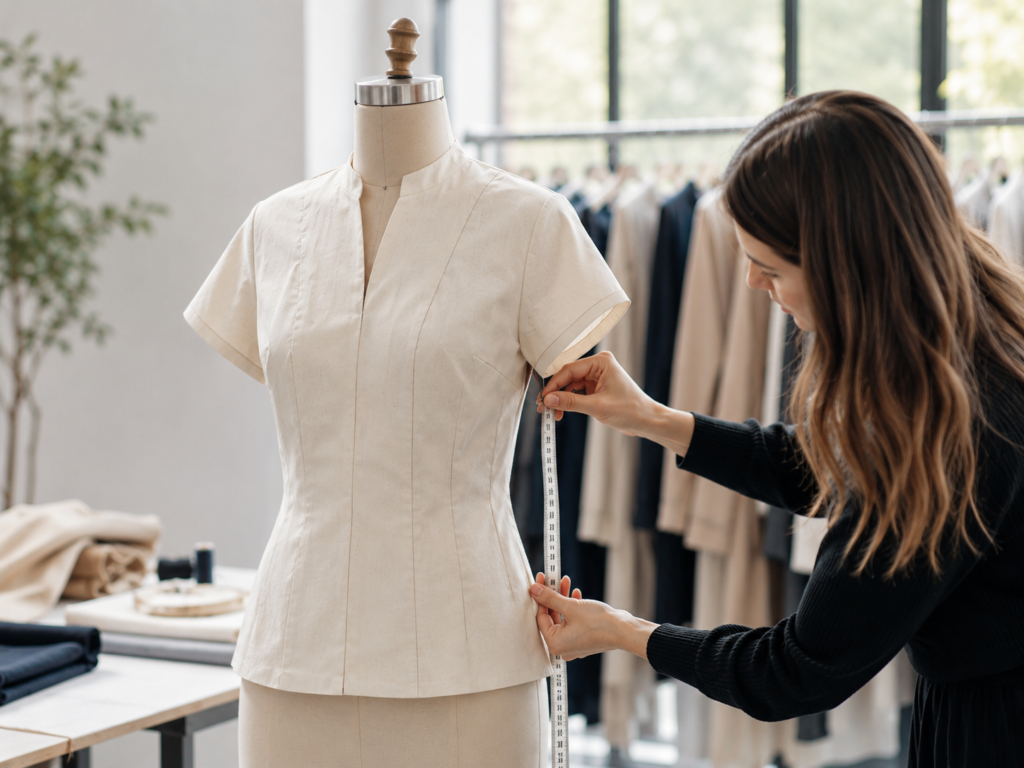
Fit testing must be conducted on a live model or standard dress form while recording key measurement points. A professional OEM apparel manufacturer will produce samples according to the POM chart and tolerance recommendations provided by the customer. In practice, neglecting fine adjustments to shoulder width or armhole depth may cause wearing discomfort. Risk disclosure includes body-shape differences among consumers in different regions, requiring base-size adjustments for the target market. An alternative is to establish multiple base-size libraries for rapid response to different market needs.
Practical Challenges in Fabric and Trim Confirmation
Fabric is the core of garment quality yet also the area most prone to deviation. Professional services require a complete BOM at the sampling stage that includes supplier lot numbers, color codes, and test reports. When a brand specifies specialty functional fabric, the manufacturer must evaluate its sewability and after-treatment requirements. Professional judgment indicates that some waterproof-breathable fabrics may have their membrane damaged by high-temperature pressing, so pressing parameters need adjustment. Risks include temporary supplier batch changes that cause color or hand-feel inconsistency. Alternatives are establishing safety stock or designating two qualified suppliers. An external reference is the WRAP compliance standard to ensure supply-chain transparency https://www.wrapcompliance.org/.
Trims such as zippers, buttons, and labels also require strict confirmation. In practice, poor zipper tooth engagement or button detachment are common customer complaints. Professional teams perform pull tests and require suppliers to provide certification documents. Risk disclosure notes that low-cost trims may deform or fade after washing. Alternatives include prioritizing internationally certified trim brands and conducting durability tests already at the sampling stage. Proper handling of this link can significantly reduce quality risks after bulk production.
Cost Control and Return on Investment at the Sampling Stage
Sample development appears to increase upfront expenditure but is actually an effective means of lowering total cost. Industry observations show that a complete sample cycle typically accounts for 15 to 25 percent of total development cost; omitting this stage can result in later revision and return costs several times higher. A professional OEM apparel manufacturer can provide accurate quotations through precise evaluation and disclose potential hidden costs such as rush fees or special-process surcharges. Reasoning indicates that early investment locks material usage and labor hours, avoiding huge losses from specification changes during bulk production. The risk of chasing only low-price samples is sacrificing quality and creating later problems. An alternative is selecting partners with flexible MOQs to control initial investment. Internal resources can be found on the company advantages page that explains equipment and capacity configuration https://hanjen.tw/advantages/.
Cost control must also consider lead time and number of revisions. In practice, a complete technical package can keep sample revisions to two rounds or fewer and greatly shorten the schedule. Professional judgment emphasizes data-based communication rather than repeated trial-and-error. Risk disclosure includes possible international logistics delays that affect sample arrival time, so buffer periods must be reserved. An alternative is developing multiple styles simultaneously to spread risk.
Quality Risk Disclosure and Prevention Strategies
Quality risks must be fully disclosed already at the sampling stage. Common issues include seam breakage, fabric pilling, measurement drift, and color inconsistency. A professional OEM apparel manufacturer details the probability and impact of each risk in its reports and proposes preventive measures. From an EEAT perspective, manufacturers holding SMETA and GRS certifications can provide higher-credibility risk assessments https://sedex.com/. Reasoning shows that failure to perform needle detection at the sampling stage may lead to metal-contamination complaints after bulk production. Alternatives include introducing in-line quality control plus final full inspection dual mechanisms.
Prevention strategies must cover the entire process from incoming materials to shipment. In practice the four-point fabric inspection method effectively intercepts fabric defects. The risk is that some defects appear only after the garment is assembled, so wear testing must be combined. An alternative is establishing a defect classification standard and jointly confirming the acceptance range with the brand.
Sewing Techniques and Stitch Selection
Sewing techniques directly affect garment durability and appearance. Professional teams select appropriate stitch types and threads according to fabric characteristics and verify them on the sample. Excessively dense stitching may damage the fabric while sparse stitching reduces strength. Risk disclosure includes the need for special needles on certain specialty fabrics. An alternative is conducting small-batch trial sewing to confirm optimal parameters.
OEM apparel manufacturer: Three Real Case Studies and Lessons
Case 1 background: a European casual brand developing a recycled-material T-shirt series. Problem: the specified fabric had 8 percent shrinkage, causing severe dimensional deviation on the fit sample. Handling: the manufacturer recommended switching to a verified low-shrinkage recycled polyester and adjusting pattern allowances. Result: the final sample passed and bulk production proceeded smoothly with return rate below 1 percent. This case demonstrates the importance of early material testing.
Case 2 background: a North American sports brand developing a functional jacket. Problem: water leakage appeared at the junction of the waterproof zipper and fabric. Handling: the professional team redesigned the sewing sequence and added tape sealing. Result: the sample passed strict waterproof testing and secured a long-term order. The risk was that delayed disclosure could have caused an entire batch to be returned.
Case 3 background: an emerging Asian children’s-wear brand. Problem: inconsistent fit across multiple sizes. Handling: a complete graded size chart was established and dual verification on dress form and live models was performed. Result: fit rate across sizes rose above 95 percent. These cases all come from the practical experience of capable OEM apparel manufacturers.
| Case No. | Background | Main Problem | Handling Method | Final Result |
| Case 1 | European casual recycled T-shirt | Excessive fabric shrinkage | Material change and pattern adjustment | Return rate below 1 percent |
| Case 2 | North American functional jacket | Waterproof failure | Redesigned sewing and tape sealing | Passed testing and long-term order |
| Case 3 | Asian children’s-wear brand | Inconsistent multi-size fit | Graded chart and dual verification | Fit rate above 95 percent |
Evaluation Criteria for Choosing a Partner
When selecting an OEM apparel manufacturer, brands must evaluate the experience of its development team, equipment configuration, and completeness of certifications. Partners with in-house pattern-making and CAD capabilities usually provide faster responses. Professional judgment indicates that whether factory capacity and the sample room are separated affects delivery stability. The risk of choosing suppliers that only have bulk production capability but lack development experience is inability to handle complex revisions. An alternative is requiring historical sample-development timelines and success-rate data. Internal information can be found in the company introduction that explains history and certifications https://hanjen.tw/about-us/. An external authority such as the ISO quality-management system can serve as an evaluation reference https://www.iso.org/.
Evaluation must also confirm communication mechanisms and document-management capability. In practice, real-time updating of technical-package versions avoids confusion. Risk disclosure includes possible misunderstandings caused by language and time-zone differences, so bilingual document standards should be established. An alternative is appointing a dedicated project manager for end-to-end tracking.
Future Trends and Sustainable Sample Development
Sustainability has become an important trend in sample development. Professional services prioritize recommending GRS or similar certified materials and calculate carbon-footprint impact already at the sampling stage. Reasoning shows that early introduction of sustainable materials avoids redevelopment after bulk production due to regulatory requirements. The risk is that some recycled materials have not yet reached full performance maturity and require thorough testing. An alternative is blending virgin and recycled materials to balance performance and environmental benefits. The company’s global footprint and sustainability commitment can be referenced on the official website https://hanjen.tw/.
In the future, virtual samples and AI-assisted pattern making will further shorten development cycles, yet physical confirmation remains irreplaceable. Brands should build long-term cooperative relationships with manufacturers to accumulate shared knowledge bases.
Tabular Comparison of Common Development Models
| Development Model | Advantages | Disadvantages | Suitable Brands | Recommended Sample Rounds |
| Full-package OEM | One-stop service and complete technical support | Higher initial communication cost | Mid-to-large brands | 1-3 rounds |
| Semi-package model | Brand retains partial control | Increased coordination complexity | Brands with internal teams | 3-4 rounds |
| Pure CMT | Lower cost | Lack of technical advice | Brands with extremely clear specifications | 4 or more rounds |
| Comparison of development models shows that full-package OEM has clear advantages in risk control. Another table presents key testing items. | ||||
| Test Item | Standard Method | Purpose | Consequence of Failure | Prevention Focus |
| — | — | — | — | — |
| Shrinkage | Relevant ISO | Confirm dimensional stability | Fit failure | Pre-test and pre-shrink |
| Colorfastness | AATCC/ISO | Prevent fading | Increased complaints | Select qualified dyes |
| A third table explains cost structure. | ||||
| Cost Item | Approximate Share | Control Method | Risk | Optimization Suggestion |
| — | — | — | — | — |
| Fabric | 40-50 percent | Lock price early | Price fluctuation | Establish long-term supply |
| Labor | 20-30 percent | Standardize processes | Low efficiency | CAD optimization |
| Revisions | 10-20 percent | Complete technical package | Increased back-and-forth | Early confirmation |
FAQ
Q1 How long does sample development usually take
A1 Complete sample development from technical-package confirmation to final pre-production sample typically requires four to eight weeks depending on complexity and number of revisions. A professional OEM apparel manufacturer can compress the timeline toward the lower end when the technical package is complete.
Q2 What documents does a brand need to provide to start sampling
A2 At minimum, flat sketches, measurement charts, material specifications, and construction details are required. The more complete the technical package, the fewer revision rounds and the higher the first-time success rate.
Q3 Can sample fees be credited against subsequent orders
A3 Most professional manufacturers offer sample-fee credit or reduction policies once a certain order volume is reached; specific terms should be confirmed at the beginning of cooperation.
Q4 How to ensure consistency between sample and bulk production
A4 Require pre-production samples to use actual bulk materials and processes, establish a sealed sample as the bulk benchmark, and implement both in-line and final quality control.
Q5 How can emerging brands handle high MOQs
A5 Choosing an OEM apparel manufacturer that offers flexible MOQs and development support allows shared patterns or staged ordering to lower the initial threshold.
Summary
In summary, the sample development services provided by a professional OEM apparel manufacturer are key for brands to control risks, improve quality, and reduce total cost. From process technology and risk disclosure to actual cases, the value of early rigorous validation is clear. Brands should emphasize technical-package completeness, material testing, and partner selection to ensure smooth transition from sample to bulk production. Development models that balance sustainability and efficiency will become the mainstream of the future.
Contact Us
If you are looking for a reliable OEM apparel manufacturer to assist with sample development and bulk production, please contact Hanjen International LTD.
Company name: Hanjen International LTD.
Address: 5F, No. 657-8 Chung Cheng Road, Hsin Chuang District, New Taipei City, Taiwan. Telephone: +886-2-2903 7662.
Email: hanjen.intl.ltd@gmail.com.
We provide complete services from sample development to global delivery and look forward to working with you.