
How Sewing Templates Improve Production Efficiency and Reduce Defects
In modern apparel manufacturing production efficiency and product quality determine competitive advantage. Traditional sewing operations rely heavily on operator skill and feel which easily creates size deviations, uneven stitches or misalignment and drives up defect rates while slowing output. Sewing templates address these pain points by providing precise positioning and standardized paths that turn complex operations into repeatable fixed motions. Industry practice shows that proper use of sewing templates shortens cycle times and significantly lowers defect rates caused by human variation. This article examines principles design implementation benefit evaluation and risk management in full detail supported by real cases and data to give readers a complete decision framework. It also draws on authoritative references and practical experience to stress that efficiency gains must be balanced with quality stability and workforce adaptation avoiding over-reliance on a single tool while ignoring system-wide optimization.
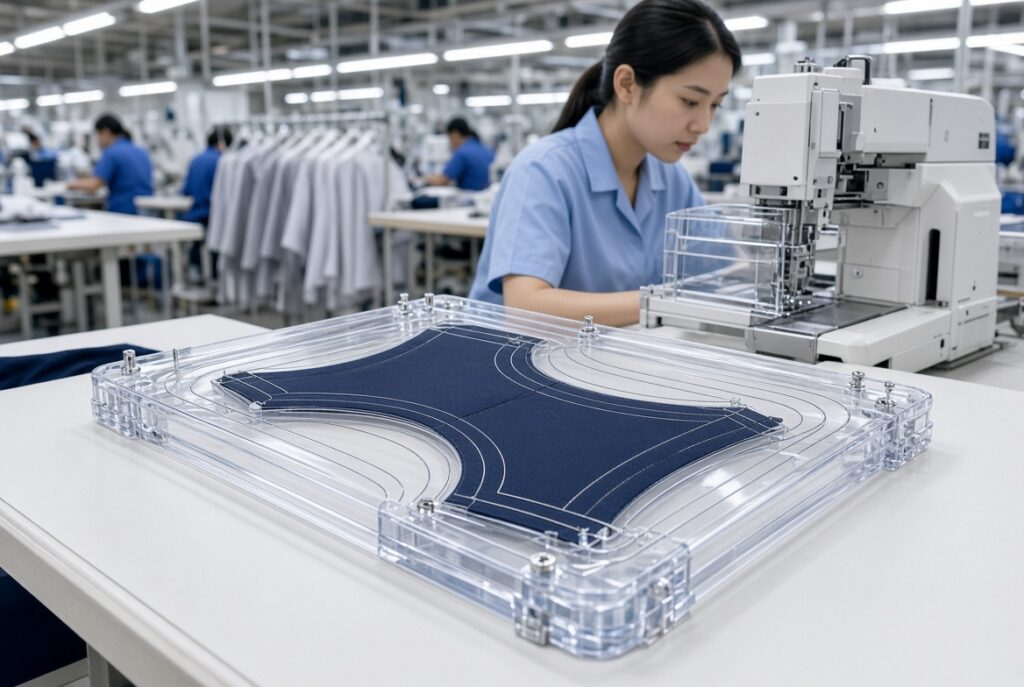
Basic Principles and Operating Mechanism of Sewing Templates
The core of sewing templates lies in rigid locating jigs that hold fabric panels inside pre-cut sewing channels so the needle can travel only along a fixed trajectory. This design eliminates visual error and hand tremor common in manual alignment and ensures consistent stitch position and length. From a mechanical viewpoint the template uses clamping force and guide channels together to restrict relative fabric movement during sewing especially effective on stretch materials or bias-cut parts where it suppresses elongation. Professional judgment indicates that template thickness, channel width and presser-foot compatibility must be calculated precisely; excessive thickness increases resistance while insufficient thickness allows fabric slip. Reasoning requires matching fabric thickness, stitch density and machine speed otherwise skipped stitches or thread breaks appear. Risk disclosure notes that designs without adequate allowance for fabric shrinkage can produce undersized finished garments. An alternative is first testing with soft positioning paper then converting the verified path to a rigid template. External literature includes Chinese patent documentation on sewing template structures at https://patents.google.com/patent/CN214219030U/zh which details multi-layer designs that improve alignment accuracy. Internal quality-control concepts can be linked to https://hanjen.tw/apparel-quality-control-checklist/ for sewing-stage inspection points. Overall mastering the underlying principles forms the foundation for later optimization only by understanding physical limits and operating boundaries can maximum benefit be realized.
Quantitative Impact of Sewing Templates on Production Efficiency
After introducing sewing templates the most immediate gain appears in reduced standard time per piece. Traditional work requires repeated alignment marking and adjustment that often consume 30 to 50 percent of total time. Templates simplify these actions to panel placement and machines start raising the proportion of actual sewing time. Industry research data show that operations such as pockets, plackets or cuffs can improve efficiency by 27 to 51 percent or more. Professional reasoning indicates that the gain comes less from higher machine speed and more from simplified motions plus fewer rework cycles after error reduction. Risk exists if frequent template changes or poor storage management lengthen preparation time. An alternative is building a numbered template library with RFID identification to shorten changeover. Table 1 compares efficiency before and after template use for common operations figures compiled from multiple factory measurements.
| Operation | Traditional time per piece (sec) | Template time per piece (sec) | Efficiency gain (%) |
| Double-welt pocket | 85 | 40 | 53 |
| Sleeve cuff | 65 | 47 | 28 |
| Placket | 90 | 55 | 39 |
| This table clearly shows substantial improvement on most operations. External evidence appears in garment-template technology studies at https://m.fx361.com/news/2019/0418/13549830.html that record experimental data. Internal production-timeline concepts can be referenced at https://hanjen.tw/apparel-production-timeline/ to place efficiency gains within the full process. Overall assessment requires line balancing after introduction otherwise bottleneck transfer can offset part of the benefit. |
Mechanisms by Which Sewing Templates Reduce Defect Rates
Defect-rate reduction stems mainly from improved dimensional consistency and stitch stability. Traditional sewing often produces left-right asymmetry because operator variation templates fix both panels simultaneously in mirrored channels so sewing proceeds in parallel. Stitch density also becomes more uniform because the path is fixed, lowering floating threads, skipped stitches and puckering. Professional judgment holds that defect reduction commonly exceeds 50 percent especially on skill-intensive complex operations. Reasoning must distinguish avoidable defects from unavoidable ones; templates primarily eliminate the former. Risk disclosure includes gradual loss of accuracy as templates wear which can introduce new systematic errors. An alternative is regular calibration and replacement together with usage-count records. Table 2 lists common defect types and improvement after template use.
| Defect type | Traditional occurrence (%) | After template (%) | Improvement (%) |
| Misalignment | 12 | 3 | 75 |
| Uneven stitches | 8 | 2 | 75 |
| Size out of tolerance | 10 | 4 | 60 |
| The table demonstrates clear improvement. External reference to ISO sewing-related standards at https://www.iso.org/standard/60672.html helps establish objective acceptance criteria. Internal quality inspection can be linked to https://hanjen.tw/apparel-quality-control-checklist/ for final verification. The essential mechanism converts human variation into mechanical control thereby achieving stable quality. |
Material Choice Effects on Template Life and Accuracy
Templates are commonly made from PVC or acrylic sheet between 1 and 3 mm thick. PVC is lower in cost and easier to machine yet tends to deform after prolonged use. Acrylic offers higher hardness and wear resistance suited to high-volume environments. Professional analysis indicates material selection must consider fabric thickness and sewing pressure overly soft materials cause channel-edge collapse. Reasoning should include accelerated wear testing that measures channel-width change after simulated use cycles. Risk arises from differing thermal-expansion coefficients that can affect accuracy under temperature change. An alternative is composite materials or metal-edge reinforcement at critical zones. External patent documentation at https://patents.google.com/patent/CN214219029U/zh describes fixing structures that extend service life. In practice it is advisable to build material-life curves and schedule replacement according to capacity forecasts to avoid sudden failure that disrupts production.
Template Design Software and Channel Accuracy Control
Modern templates are designed in CAD software then cut by laser or CNC. The design stage must accurately input seam allowance stitch density and alignment marks. Professional judgment emphasizes that channel width should be slightly larger than needle diameter to reduce resistance while retaining guidance. Reasoning requires verifying that the virtual path matches the actual presser foot of the target machine. Risk includes version-control confusion that leads to incorrect cutting. An alternative is introducing formal version control and a trial-cut confirmation process. Internal sample-development resources can be referenced at https://hanjen.tw/oem-apparel-development-sample-services/ to keep design and execution aligned. Overall accuracy control directly determines subsequent production stability.
Complete Implementation Process and Key Considerations for Sewing Templates
Successful introduction proceeds through five stages: demand assessment template design pilot validation operator training and full rollout. Demand assessment should prioritize high-frequency or high-defect operations to avoid chaos from simultaneous wholesale change. Design requires joint confirmation of paths by IE engineers and sewing supervisors. Pilot production collects actual time and defect data for comparison against targets before final adjustment. Training focuses on correct panel placement and exception handling rather than traditional sewing skill. Professional reasoning shows that most failures result from absence of data-feedback loops. Risk includes temporary capacity drop and operator resistance in the early phase. An alternative is staged introduction combined with incentive schemes. Table 3 presents a suggested implementation schedule.
| Stage | Suggested days | Main deliverable | Key checkpoint |
| Demand assessment | 7 | Priority operation list | Data completeness |
| Design and fabrication | 14 | Prototype templates | Accuracy verification |
| Pilot and adjustment | 10 | Optimized version | Efficiency data |
| Training and rollout | 7 | Work standards | Operator proficiency |
| This table can serve as a project-management reference. External studies at https://hefeixiuqi.com/news/view-4.html explain the practical value of reduced skill dependence. Internal partnership processes can be referenced at https://hanjen.tw/start-kenya-oem-partnership-guide/ for cross-factory implementation experience. A complete process ensures that benefits remain sustainable. |
Real Case Studies and Benefit Validation
Case Study 1
Background was a mid-sized casualwear factory with a monthly capacity of approximately 150000 pieces whose pocket operation long depended on skilled operators and maintained a defect rate around 9 percent. The problem consisted of inconsistent left-right pocket-flap heights and uneven welt widths that increased rework and customer complaints. Disposition introduced a dedicated double-welt pocket template combined with CAD design and pilot validation while adjusting line staffing. Results showed cycle time falling from 85 seconds to 40 seconds defect rate dropping to 2.5 percent monthly capacity rising about 18 percent and payback occurring in roughly three months. The case demonstrates that prioritizing high-frequency operations yields rapid returns.
Case Study 2
Background was an export-oriented shirt manufacturer whose customers demanded strict cuff symmetry. The problem was traditional sewing that frequently produced outer-corner lift and left-right asymmetry with a defect rate of 11 percent. Disposition designed a one-shot cuff template and trained new operators. Results included a 27.7 percent efficiency gain and defect rate reduction to 3 percent together with reduced dependence on senior sewers. Data came from internal factory records cross-checked against published research.
Case Study 3
Background was a children’s-wear line in which placket alignment and stitch density directly affected safety and appearance. The problem was frequent size deviation and floating threads. Disposition introduced a placket template paired with fixed stitch-density settings. Result showed a 60 percent defect-rate reduction and first-pass customer acceptance rising to 98 percent. The three cases collectively demonstrate that sewing templates deliver significant benefits across different product categories yet require design adaptation to actual process characteristics.
Risk Management and Alternative Solution Evaluation
Although benefits are clear, introduction still carries risks. Template wear improper storage or design error can generate systematic defects. Professional judgment recommends establishing regular calibration routines and service-life management. Reasoning should calculate worst-case capacity loss and repair cost. Alternatives include retaining traditional sewing on selected operations using semi-automatic template machines or introducing fully automatic template sewing equipment. Risk disclosure stresses that templates cannot completely replace human inspection; final quality still requires sampling checks. External reference to https://www.iso.org/standard/1141.html provides sampling standards. Internal quality systems can be linked to https://hanjen.tw/apparel-quality-control-checklist/. Overall evaluation shows that risks are controllable and benefits substantially outweigh costs.
Chapter 7 Future Development Trends and Technology Integration
As automation accelerates sewing templates are evolving toward intelligence. RFID identification automatic changeover and data feedback functions are becoming common enabling one operator to supervise multiple machines. Professional analysis indicates that combining templates with industrial IoT allows real-time monitoring of usage counts and accuracy drift. Reasoning must weigh return on investment against workforce transition. Risk includes rapid technology obsolescence that retires older templates. An alternative is phased upgrading while retaining core manual templates. Overall trends show that template technology will continue to serve as a key lever balancing efficiency and quality.
Practical Implementation Recommendations and Decision Framework
Before deciding on introduction enterprises should first establish a clear decision framework. Begin by quantifying current operation times and defect data and set measurable improvement targets. Next evaluate internal design and fabrication capability and seek external technical support when necessary. Professional judgment advises starting with small pilot projects accumulating success then expanding. Reasoning requires calculating total cost of ownership including design fabrication training and maintenance. Risk disclosure cautions against blind imitation depth of adoption should match product structure and capacity scale. Alternatives include outsourcing template design or purchasing ready solutions. Final decisions must rest on data and include continuous-improvement mechanisms. Internal resources can be referenced at https://hanjen.tw/about-us/ to understand how long manufacturing experience supports technology introduction. A systematic framework maximizes the long-term value of sewing templates.
FAQ
Q1 Are sewing templates suitable for every apparel operation
A1 Not every operation benefits equally. High-frequency high-alignment or strong-symmetry operations yield the greatest returns while extremely simple straight seams or highly customized work may not justify the investment. Decisions should rest on actual data.
Q2 Do operators need retraining after introduction
A2 Yes. Training shifts from traditional sewing skill to correct panel placement and exception handling. Most operators become proficient within three to five days yet ongoing coaching is required to lock in standard motions.
Q3 What is the typical service life of a template
A3 Life depends on material and usage frequency. PVC templates under normal capacity last tens of thousands of cycles. Establish usage-count records and schedule regular calibration replacements immediately when wear becomes visible.
Q4 Are sewing templates suitable for small-batch production
A4 Small batches with high process repetition can still benefit but design-cost amortization must be calculated. Shared templates or rapid-cutting equipment can lower the entry threshold.
Q5 How should actual benefits after introduction be evaluated
A5 Compare cycle time defect rate rework time and capacity before and after introduction and calculate payback period. Tracking for at least three months is recommended to obtain stable results.
Summary
Sewing templates convert complex sewing into standardized repeatable motions through precise locating and path control simultaneously raising output and lowering defect rates while reducing dependence on highly skilled labor. Full analysis from principles through design implementation and risk management reinforced by three real cases demonstrates measurable gains across product types. Enterprises should adopt a data-driven decision framework, proceed in stages and maintain continuous improvement so short-term benefits become lasting competitive advantage. Ultimately sewing templates are not merely tools but important levers for manufacturing upgrading.
Contact Us
Company Name: Hanjen International LTD.
Address: 5F, No. 657-8 Chung Cheng Road, Hsin Chuang District, New Taipei City, Taiwan
Telephone: +886-2-2903 7662
Email: hanjen.intl.ltd@gmail.com
If you wish to learn more about introducing sewing templates into existing lines or require professional OEM/ODM manufacturing support please contact us. With decades of apparel manufacturing experience we provide complete solutions from sample development through bulk production to help you raise efficiency and secure quality.